

previously carried out in Vietnam showed that the study farmers did not invest in
soil conservation practices because of insecure land titles (Saint-Macary et al.
2010), this has not been a significant impediment to land use intensification in
the Mae Sa area, as 79 % of the agricultural area is irrigated and farmers grow a
diversity of cash crops such as litchis, as well as vegetables such as cabbages,
lettuce and chayote, plus ornamental flowers (chrysanthemums and roses) and
greenhouse vegetables (bell peppers and tomatoes). (See Neef et al. 2000 for a
comparison of the land tenure security that exists in the mountainous areas of
Thailand and Vietnam). Farmers in the study area are well-integrated into
modern supply chains (Schipmann and Qaim 2010, 2011) and use many
fertilizers and pesticides (Schreinemachers et al. 2011). About a third of the
households in the watershed are not engaged in farming, while 58 % of the
farm households perform paid work outside their own farm. In turn, almost all
farm households (92 %) hire agricultural labor, the majority of which is of Shan
ethnicity. Much of the research carried out so far into fruit production, including
off-season litchi production and fruit tree irrigation, fruit processing (including
fruit drying) and post-harvest innovations, has taken place in the Mae Sa
watershed area.
In Vietnam, the research studied two communes in Yen Chau district (Son La
province). The Muong Lum sub-catchment represents a relatively remote area, one
that is difficult to access by road. It is located at a high altitude (700–1,100 m.a.s.l.)
and is a limestone area with clay shale and alluvial sediments. Of the nine villages
in the sub-catchment, five are inhabited by the Black Thai ethnic group and four
villages, located at higher altitudes, are inhabited by the Hmong. Birth rates are
relatively high and nearly half the population is below the age of 20 (Dang et al.
2008). The amount of land per household is relatively small at 1.2 ha. Between
April 2008 and January 2009, 67 households were moved to the commune from the
area impacted by the Son La hydropower project, and this increased the population
by 13 % and aggravated the problem of land scarcity (Bui and Schreinemachers
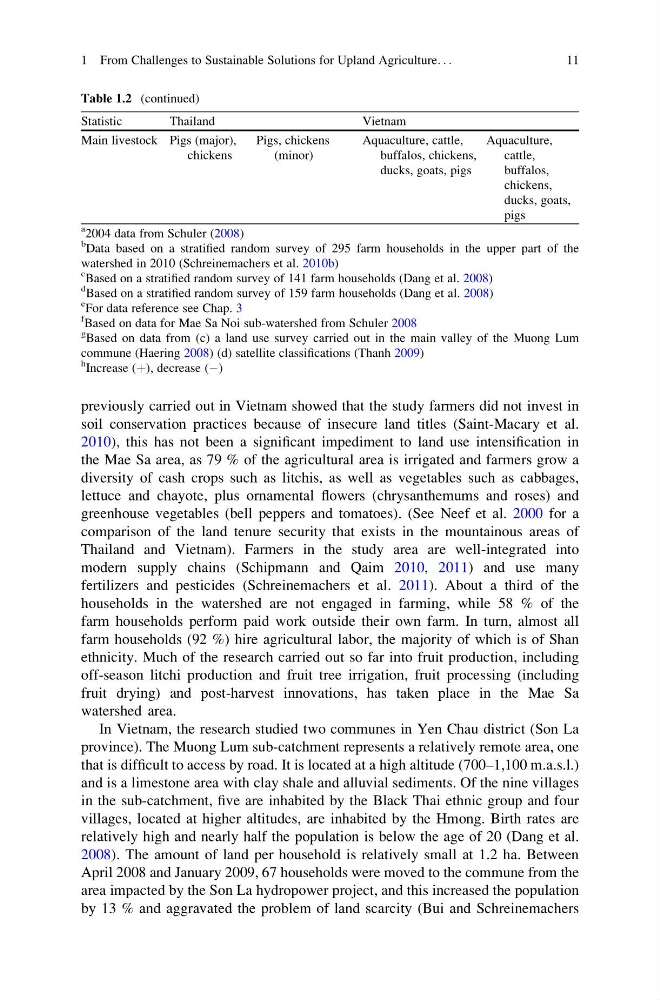
Table 1.2 (continued)
Statistic
Thailand
Vietnam
Main livestock Pigs (major),
chickens
Pigs, chickens
(minor)
Aquaculture, cattle,
buffalos, chickens,
ducks, goats, pigs
Aquaculture,
cattle,
buffalos,
chickens,
ducks, goats,
pigs
a
2004 data from Schuler (2008)
b
Data based on a stratified random survey of 295 farm households in the upper part of the
watershed in 2010 (Schreinemachers et al. 2010b)
c
Based on a stratified random survey of 141 farm households (Dang et al. 2008)
d
Based on a stratified random survey of 159 farm households (Dang et al. 2008)
e
For data reference see Chap. 3
f
Based on data for Mae Sa Noi sub-watershed from Schuler 2008
g
Based on data from (c) a land use survey carried out in the main valley of the Muong Lum
commune (Haering 2008) (d) satellite classifications (Thanh 2009)
h
Increase (þ), decrease (À)
1 From Challenges to Sustainable Solutions for Upland Agriculture. . .
11
soil conservation practices because of insecure land titles (Saint-Macary et al.
2010), this has not been a significant impediment to land use intensification in
the Mae Sa area, as 79 % of the agricultural area is irrigated and farmers grow a
diversity of cash crops such as litchis, as well as vegetables such as cabbages,
lettuce and chayote, plus ornamental flowers (chrysanthemums and roses) and
greenhouse vegetables (bell peppers and tomatoes). (See Neef et al. 2000 for a
comparison of the land tenure security that exists in the mountainous areas of
Thailand and Vietnam). Farmers in the study area are well-integrated into
modern supply chains (Schipmann and Qaim 2010, 2011) and use many
fertilizers and pesticides (Schreinemachers et al. 2011). About a third of the
households in the watershed are not engaged in farming, while 58 % of the
farm households perform paid work outside their own farm. In turn, almost all
farm households (92 %) hire agricultural labor, the majority of which is of Shan
ethnicity. Much of the research carried out so far into fruit production, including
off-season litchi production and fruit tree irrigation, fruit processing (including
fruit drying) and post-harvest innovations, has taken place in the Mae Sa
watershed area.
In Vietnam, the research studied two communes in Yen Chau district (Son La
province). The Muong Lum sub-catchment represents a relatively remote area, one
that is difficult to access by road. It is located at a high altitude (700–1,100 m.a.s.l.)
and is a limestone area with clay shale and alluvial sediments. Of the nine villages
in the sub-catchment, five are inhabited by the Black Thai ethnic group and four
villages, located at higher altitudes, are inhabited by the Hmong. Birth rates are
relatively high and nearly half the population is below the age of 20 (Dang et al.
2008). The amount of land per household is relatively small at 1.2 ha. Between
April 2008 and January 2009, 67 households were moved to the commune from the
area impacted by the Son La hydropower project, and this increased the population
by 13 % and aggravated the problem of land scarcity (Bui and Schreinemachers
Table 1.2 (continued)
Statistic
Thailand
Vietnam
Main livestock Pigs (major),
chickens
Pigs, chickens
(minor)
Aquaculture, cattle,
buffalos, chickens,
ducks, goats, pigs
Aquaculture,
cattle,
buffalos,
chickens,
ducks, goats,
pigs
a
2004 data from Schuler (2008)
b
Data based on a stratified random survey of 295 farm households in the upper part of the
watershed in 2010 (Schreinemachers et al. 2010b)
c
Based on a stratified random survey of 141 farm households (Dang et al. 2008)
d
Based on a stratified random survey of 159 farm households (Dang et al. 2008)
e
For data reference see Chap. 3
f
Based on data for Mae Sa Noi sub-watershed from Schuler 2008
g
Based on data from (c) a land use survey carried out in the main valley of the Muong Lum
commune (Haering 2008) (d) satellite classifications (Thanh 2009)
h
Increase (þ), decrease (À)
1 From Challenges to Sustainable Solutions for Upland Agriculture. . .
11