

properties of pesticides, such as their level of solubility, and by common water
management practices expressed; for example, through hydraulic residence times
and water holding periods. Hence, one key recommended strategy for reducing
pesticide run-off from rice paddies is to significantly extend the length of the water
holding period during and shortly after application.
Concomitant to the paddy field experiment, Lamers et al. (2011) conducted a
study on the watershed scale aimed at examining the environmental exposure to
river and ground water pollution in the Chieng Khoi catchment. For this, they
monitored the concentrations of four commonly applied pesticides in the river
(imidacloprid, fenitrothion, fenobucarb and dichlorvos) at two gauging stations
installed at midstream and outlet positions within the watershed. The total rice
growing areas covered by these gauging stations were 25 and 64 ha respectively.
Furthermore, eight groundwater wells used for household water consumption
within the watershed area (including drinking water) were sampled in April, August
and September.
Results published in Lamers et al. (2011) indicated that pesticide run-off losses
from the watershed ranged from 0.4 % of the total applied mass for dichlorvos, to
16 % for fenitrothion. At both gauging stations, all tested pesticides were detected
at least once; however, only imidacloprid was measured in concentrations above the
detection limit at all sampling dates. The mean measured concentrations at the
gauging stations could be clearly ranked in the following order: fenubocarb,
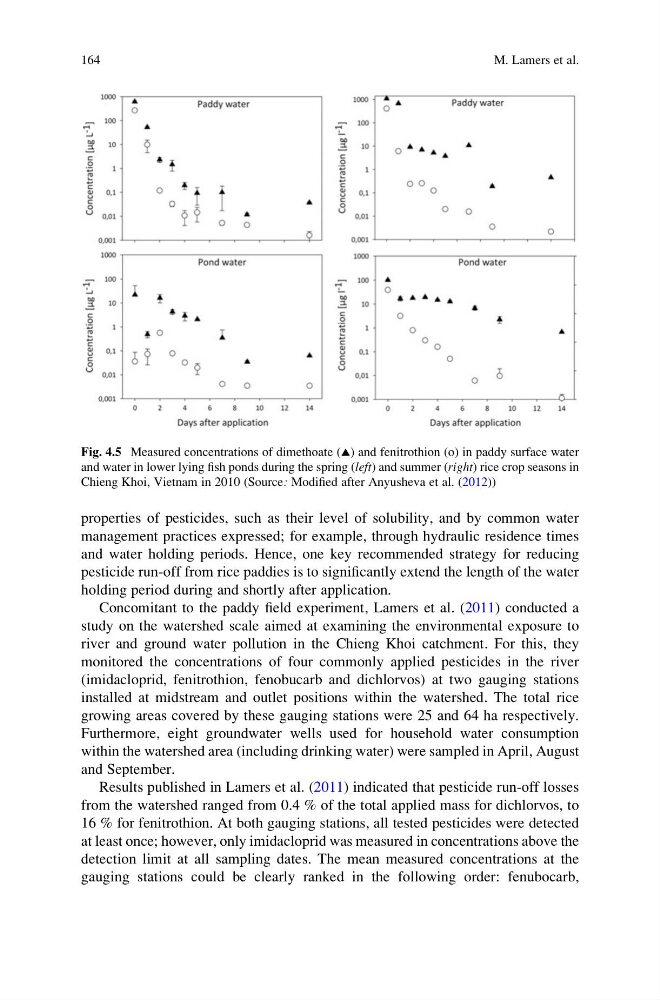
Fig. 4.5 Measured concentrations of dimethoate (~) and fenitrothion (o) in paddy surface water
and water in lower lying fish ponds during the spring (left) and summer (right) rice crop seasons in
Chieng Khoi, Vietnam in 2010 (Source: Modified after Anyusheva et al. (2012))
164
M. Lamers et al.
management practices expressed; for example, through hydraulic residence times
and water holding periods. Hence, one key recommended strategy for reducing
pesticide run-off from rice paddies is to significantly extend the length of the water
holding period during and shortly after application.
Concomitant to the paddy field experiment, Lamers et al. (2011) conducted a
study on the watershed scale aimed at examining the environmental exposure to
river and ground water pollution in the Chieng Khoi catchment. For this, they
monitored the concentrations of four commonly applied pesticides in the river
(imidacloprid, fenitrothion, fenobucarb and dichlorvos) at two gauging stations
installed at midstream and outlet positions within the watershed. The total rice
growing areas covered by these gauging stations were 25 and 64 ha respectively.
Furthermore, eight groundwater wells used for household water consumption
within the watershed area (including drinking water) were sampled in April, August
and September.
Results published in Lamers et al. (2011) indicated that pesticide run-off losses
from the watershed ranged from 0.4 % of the total applied mass for dichlorvos, to
16 % for fenitrothion. At both gauging stations, all tested pesticides were detected
at least once; however, only imidacloprid was measured in concentrations above the
detection limit at all sampling dates. The mean measured concentrations at the
gauging stations could be clearly ranked in the following order: fenubocarb,
Fig. 4.5 Measured concentrations of dimethoate (~) and fenitrothion (o) in paddy surface water
and water in lower lying fish ponds during the spring (left) and summer (right) rice crop seasons in
Chieng Khoi, Vietnam in 2010 (Source: Modified after Anyusheva et al. (2012))
164
M. Lamers et al.