

(dimethoate and fenitrothion) in the various surface water compartments of a
typical paddy field-fish pond farming system during the spring and summer crop
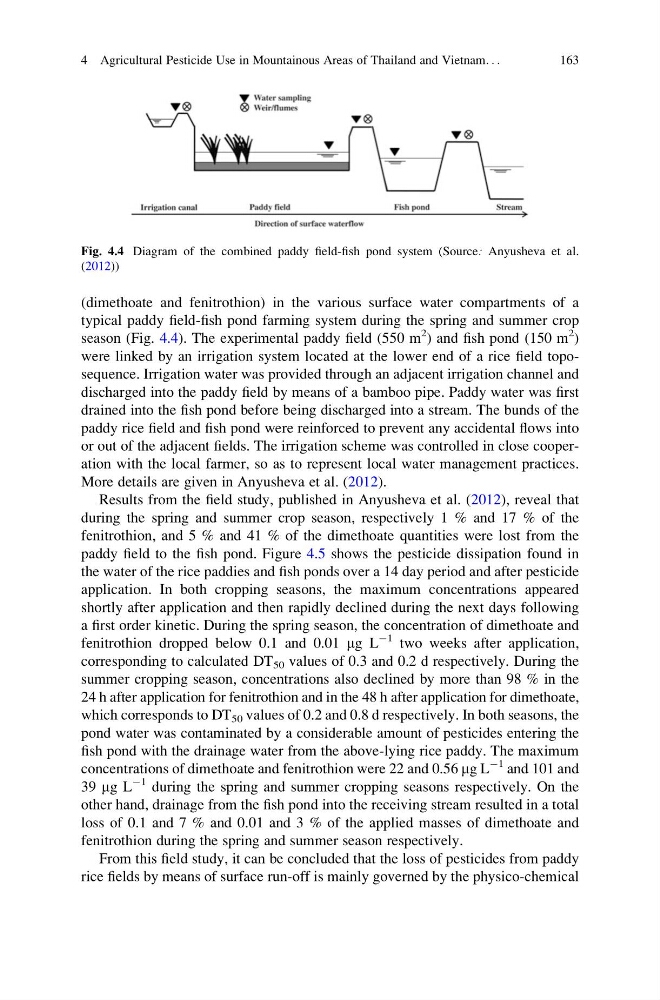
season (Fig. 4.4). The experimental paddy field (550 m
2 ) and fish pond (150 m
2 )
were linked by an irrigation system located at the lower end of a rice field toposequence. Irrigation water was provided through an adjacent irrigation channel and
discharged into the paddy field by means of a bamboo pipe. Paddy water was first
drained into the fish pond before being discharged into a stream. The bunds of the
paddy rice field and fish pond were reinforced to prevent any accidental flows into
or out of the adjacent fields. The irrigation scheme was controlled in close cooperation with the local farmer, so as to represent local water management practices.
More details are given in Anyusheva et al. (2012).
Results from the field study, published in Anyusheva et al. (2012), reveal that
during the spring and summer crop season, respectively 1 % and 17 % of the
fenitrothion, and 5 % and 41 % of the dimethoate quantities were lost from the
paddy field to the fish pond. Figure 4.5 shows the pesticide dissipation found in
the water of the rice paddies and fish ponds over a 14 day period and after pesticide
application. In both cropping seasons, the maximum concentrations appeared
shortly after application and then rapidly declined during the next days following
a first order kinetic. During the spring season, the concentration of dimethoate and
fenitrothion dropped below 0.1 and 0.01 mg L
À1 two weeks after application,
corresponding to calculated DT 50 values of 0.3 and 0.2 d respectively. During the
summer cropping season, concentrations also declined by more than 98 % in the
24 h after application for fenitrothion and in the 48 h after application for dimethoate,
which corresponds to DT 50 values of 0.2 and 0.8 d respectively. In both seasons, the
pond water was contaminated by a considerable amount of pesticides entering the
fish pond with the drainage water from the above-lying rice paddy. The maximum
concentrations of dimethoate and fenitrothion were 22 and 0.56 mg L
À1 and 101 and
39 mg L
À1 during the spring and summer cropping seasons respectively. On the
other hand, drainage from the fish pond into the receiving stream resulted in a total
loss of 0.1 and 7 % and 0.01 and 3 % of the applied masses of dimethoate and
fenitrothion during the spring and summer season respectively.
From this field study, it can be concluded that the loss of pesticides from paddy
rice fields by means of surface run-off is mainly governed by the physico-chemical
Fig. 4.4 Diagram of the combined paddy field-fish pond system (Source: Anyusheva et al.
(2012))
4 Agricultural Pesticide Use in Mountainous Areas of Thailand and Vietnam. . .
163
typical paddy field-fish pond farming system during the spring and summer crop
season (Fig. 4.4). The experimental paddy field (550 m
2 ) and fish pond (150 m
2 )
were linked by an irrigation system located at the lower end of a rice field toposequence. Irrigation water was provided through an adjacent irrigation channel and
discharged into the paddy field by means of a bamboo pipe. Paddy water was first
drained into the fish pond before being discharged into a stream. The bunds of the
paddy rice field and fish pond were reinforced to prevent any accidental flows into
or out of the adjacent fields. The irrigation scheme was controlled in close cooperation with the local farmer, so as to represent local water management practices.
More details are given in Anyusheva et al. (2012).
Results from the field study, published in Anyusheva et al. (2012), reveal that
during the spring and summer crop season, respectively 1 % and 17 % of the
fenitrothion, and 5 % and 41 % of the dimethoate quantities were lost from the
paddy field to the fish pond. Figure 4.5 shows the pesticide dissipation found in
the water of the rice paddies and fish ponds over a 14 day period and after pesticide
application. In both cropping seasons, the maximum concentrations appeared
shortly after application and then rapidly declined during the next days following
a first order kinetic. During the spring season, the concentration of dimethoate and
fenitrothion dropped below 0.1 and 0.01 mg L
À1 two weeks after application,
corresponding to calculated DT 50 values of 0.3 and 0.2 d respectively. During the
summer cropping season, concentrations also declined by more than 98 % in the
24 h after application for fenitrothion and in the 48 h after application for dimethoate,
which corresponds to DT 50 values of 0.2 and 0.8 d respectively. In both seasons, the
pond water was contaminated by a considerable amount of pesticides entering the
fish pond with the drainage water from the above-lying rice paddy. The maximum
concentrations of dimethoate and fenitrothion were 22 and 0.56 mg L
À1 and 101 and
39 mg L
À1 during the spring and summer cropping seasons respectively. On the
other hand, drainage from the fish pond into the receiving stream resulted in a total
loss of 0.1 and 7 % and 0.01 and 3 % of the applied masses of dimethoate and
fenitrothion during the spring and summer season respectively.
From this field study, it can be concluded that the loss of pesticides from paddy
rice fields by means of surface run-off is mainly governed by the physico-chemical
Fig. 4.4 Diagram of the combined paddy field-fish pond system (Source: Anyusheva et al.
(2012))
4 Agricultural Pesticide Use in Mountainous Areas of Thailand and Vietnam. . .
163