

4.3 Pesticide Use in the Mountainous Areas of Thailand
and Vietnam
4.3.1 Pesticide Use Within Intensive Upland Horticulture:
Mae Sa, Thailand
The pace of land use change has been particularly fast in the Mae Sa watershed in
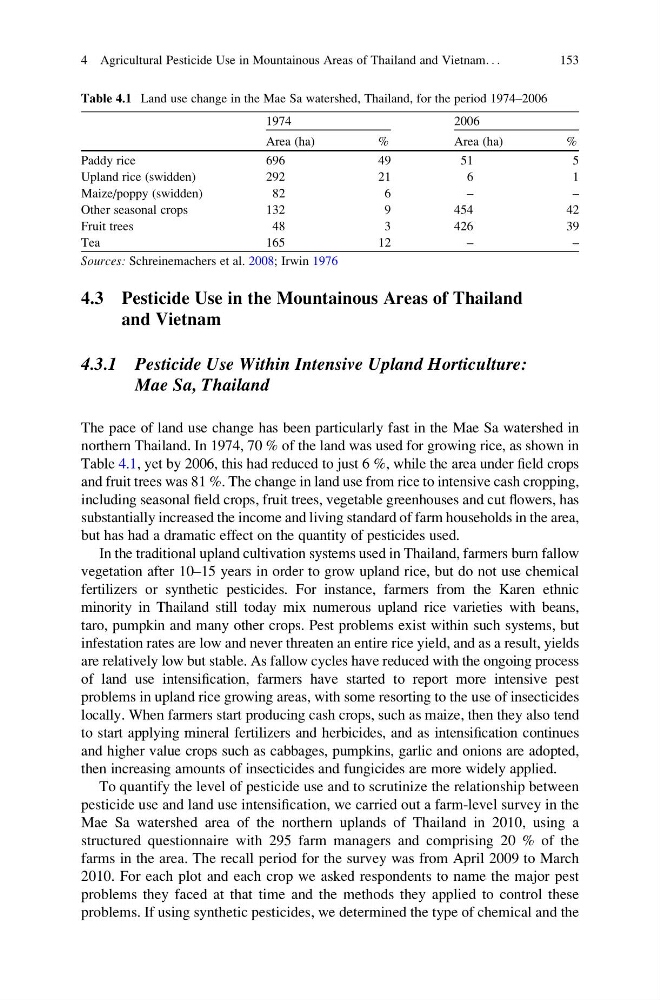
northern Thailand. In 1974, 70 % of the land was used for growing rice, as shown in
Table 4.1, yet by 2006, this had reduced to just 6 %, while the area under field crops
and fruit trees was 81 %. The change in land use from rice to intensive cash cropping,
including seasonal field crops, fruit trees, vegetable greenhouses and cut flowers, has
substantially increased the income and living standard of farm households in the area,
but has had a dramatic effect on the quantity of pesticides used.
In the traditional upland cultivation systems used in Thailand, farmers burn fallow
vegetation after 10–15 years in order to grow upland rice, but do not use chemical
fertilizers or synthetic pesticides. For instance, farmers from the Karen ethnic
minority in Thailand still today mix numerous upland rice varieties with beans,
taro, pumpkin and many other crops. Pest problems exist within such systems, but
infestation rates are low and never threaten an entire rice yield, and as a result, yields
are relatively low but stable. As fallow cycles have reduced with the ongoing process
of land use intensification, farmers have started to report more intensive pest
problems in upland rice growing areas, with some resorting to the use of insecticides
locally. When farmers start producing cash crops, such as maize, then they also tend
to start applying mineral fertilizers and herbicides, and as intensification continues
and higher value crops such as cabbages, pumpkins, garlic and onions are adopted,
then increasing amounts of insecticides and fungicides are more widely applied.
To quantify the level of pesticide use and to scrutinize the relationship between
pesticide use and land use intensification, we carried out a farm-level survey in the
Mae Sa watershed area of the northern uplands of Thailand in 2010, using a
structured questionnaire with 295 farm managers and comprising 20 % of the
farms in the area. The recall period for the survey was from April 2009 to March
2010. For each plot and each crop we asked respondents to name the major pest
problems they faced at that time and the methods they applied to control these
problems. If using synthetic pesticides, we determined the type of chemical and the
Table 4.1 Land use change in the Mae Sa watershed, Thailand, for the period 1974–2006
1974
2006
Area (ha)
%
Area (ha)
%
Paddy rice
696
49
51
5
Upland rice (swidden)
292
21
6
1
Maize/poppy (swidden)
82
6
–
–
Other seasonal crops
132
9
454
42
Fruit trees
48
3
426
39
Tea
165
12
–
–
Sources: Schreinemachers et al. 2008; Irwin 1976
4 Agricultural Pesticide Use in Mountainous Areas of Thailand and Vietnam. . .
153
and Vietnam
4.3.1 Pesticide Use Within Intensive Upland Horticulture:
Mae Sa, Thailand
The pace of land use change has been particularly fast in the Mae Sa watershed in
northern Thailand. In 1974, 70 % of the land was used for growing rice, as shown in
Table 4.1, yet by 2006, this had reduced to just 6 %, while the area under field crops
and fruit trees was 81 %. The change in land use from rice to intensive cash cropping,
including seasonal field crops, fruit trees, vegetable greenhouses and cut flowers, has
substantially increased the income and living standard of farm households in the area,
but has had a dramatic effect on the quantity of pesticides used.
In the traditional upland cultivation systems used in Thailand, farmers burn fallow
vegetation after 10–15 years in order to grow upland rice, but do not use chemical
fertilizers or synthetic pesticides. For instance, farmers from the Karen ethnic
minority in Thailand still today mix numerous upland rice varieties with beans,
taro, pumpkin and many other crops. Pest problems exist within such systems, but
infestation rates are low and never threaten an entire rice yield, and as a result, yields
are relatively low but stable. As fallow cycles have reduced with the ongoing process
of land use intensification, farmers have started to report more intensive pest
problems in upland rice growing areas, with some resorting to the use of insecticides
locally. When farmers start producing cash crops, such as maize, then they also tend
to start applying mineral fertilizers and herbicides, and as intensification continues
and higher value crops such as cabbages, pumpkins, garlic and onions are adopted,
then increasing amounts of insecticides and fungicides are more widely applied.
To quantify the level of pesticide use and to scrutinize the relationship between
pesticide use and land use intensification, we carried out a farm-level survey in the
Mae Sa watershed area of the northern uplands of Thailand in 2010, using a
structured questionnaire with 295 farm managers and comprising 20 % of the
farms in the area. The recall period for the survey was from April 2009 to March
2010. For each plot and each crop we asked respondents to name the major pest
problems they faced at that time and the methods they applied to control these
problems. If using synthetic pesticides, we determined the type of chemical and the
Table 4.1 Land use change in the Mae Sa watershed, Thailand, for the period 1974–2006
1974
2006
Area (ha)
%
Area (ha)
%
Paddy rice
696
49
51
5
Upland rice (swidden)
292
21
6
1
Maize/poppy (swidden)
82
6
–
–
Other seasonal crops
132
9
454
42
Fruit trees
48
3
426
39
Tea
165
12
–
–
Sources: Schreinemachers et al. 2008; Irwin 1976
4 Agricultural Pesticide Use in Mountainous Areas of Thailand and Vietnam. . .
153