

of a pesticide in equilibrium. The higher the K d value, the stronger a pesticide is
sorbed and the less mobile it is in the soil. For nonionic pesticides, the K d value is
often normalized in relation to the mass fraction of organic C in the soil, yielding
the so-called organic C normalized distribution coefficient (K oc ). By virtue of
sorption, the transport of pesticides in the soil matrix is usually strongly retarded,
that is, the transport velocity of the pesticides is much slower than the flow velocity
of the water. An ideal pesticide, from an environmental and health protection
perspective, has a short half-life time, a high K d value and is degraded to harmless
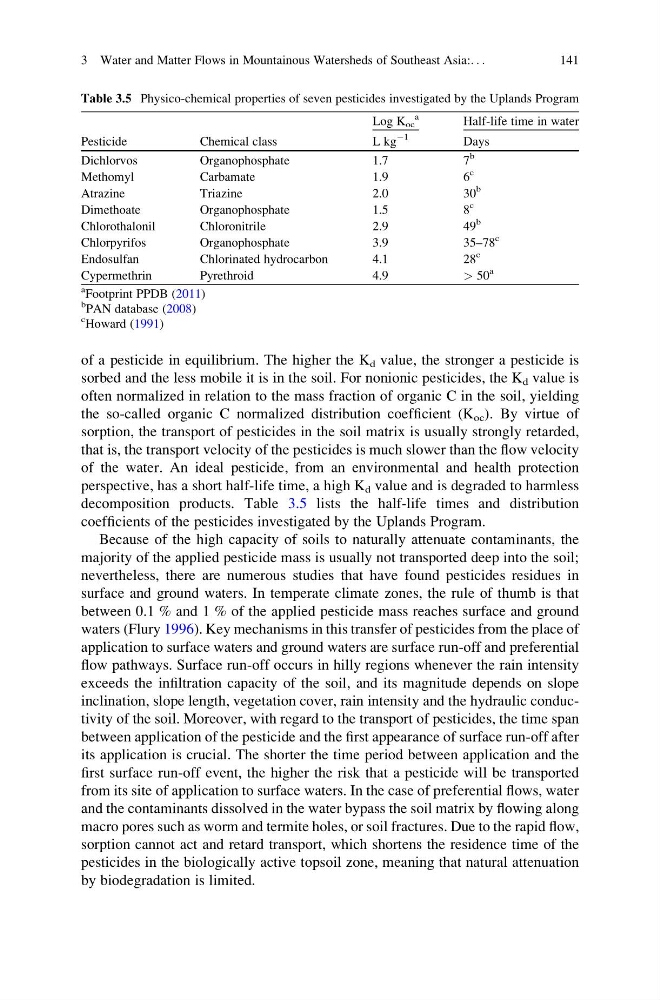
decomposition products. Table 3.5 lists the half-life times and distribution
coefficients of the pesticides investigated by the Uplands Program.
Because of the high capacity of soils to naturally attenuate contaminants, the
majority of the applied pesticide mass is usually not transported deep into the soil;
nevertheless, there are numerous studies that have found pesticides residues in
surface and ground waters. In temperate climate zones, the rule of thumb is that
between 0.1 % and 1 % of the applied pesticide mass reaches surface and ground
waters (Flury 1996). Key mechanisms in this transfer of pesticides from the place of
application to surface waters and ground waters are surface run-off and preferential
flow pathways. Surface run-off occurs in hilly regions whenever the rain intensity
exceeds the infiltration capacity of the soil, and its magnitude depends on slope
inclination, slope length, vegetation cover, rain intensity and the hydraulic conductivity of the soil. Moreover, with regard to the transport of pesticides, the time span
between application of the pesticide and the first appearance of surface run-off after
its application is crucial. The shorter the time period between application and the
first surface run-off event, the higher the risk that a pesticide will be transported
from its site of application to surface waters. In the case of preferential flows, water
and the contaminants dissolved in the water bypass the soil matrix by flowing along
macro pores such as worm and termite holes, or soil fractures. Due to the rapid flow,
sorption cannot act and retard transport, which shortens the residence time of the
pesticides in the biologically active topsoil zone, meaning that natural attenuation
by biodegradation is limited.
Table 3.5 Physico-chemical properties of seven pesticides investigated by the Uplands Program
Pesticide
Chemical class
Log K oc
a
Half-life time in water
L kg
À1
Days
Dichlorvos
Organophosphate
1.7
7
b
Methomyl
Carbamate
1.9
6
c
Atrazine
Triazine
2.0
30
b
Dimethoate
Organophosphate
1.5
8
c
Chlorothalonil
Chloronitrile
2.9
49
b
Chlorpyrifos
Organophosphate
3.9
35–78
c
Endosulfan
Chlorinated hydrocarbon
4.1
28
c
Cypermethrin
Pyrethroid
4.9
> 50
a
a
Footprint PPDB (2011)
b
PAN database (2008)
c
Howard (1991)
3 Water and Matter Flows in Mountainous Watersheds of Southeast Asia:. . .
141
sorbed and the less mobile it is in the soil. For nonionic pesticides, the K d value is
often normalized in relation to the mass fraction of organic C in the soil, yielding
the so-called organic C normalized distribution coefficient (K oc ). By virtue of
sorption, the transport of pesticides in the soil matrix is usually strongly retarded,
that is, the transport velocity of the pesticides is much slower than the flow velocity
of the water. An ideal pesticide, from an environmental and health protection
perspective, has a short half-life time, a high K d value and is degraded to harmless
decomposition products. Table 3.5 lists the half-life times and distribution
coefficients of the pesticides investigated by the Uplands Program.
Because of the high capacity of soils to naturally attenuate contaminants, the
majority of the applied pesticide mass is usually not transported deep into the soil;
nevertheless, there are numerous studies that have found pesticides residues in
surface and ground waters. In temperate climate zones, the rule of thumb is that
between 0.1 % and 1 % of the applied pesticide mass reaches surface and ground
waters (Flury 1996). Key mechanisms in this transfer of pesticides from the place of
application to surface waters and ground waters are surface run-off and preferential
flow pathways. Surface run-off occurs in hilly regions whenever the rain intensity
exceeds the infiltration capacity of the soil, and its magnitude depends on slope
inclination, slope length, vegetation cover, rain intensity and the hydraulic conductivity of the soil. Moreover, with regard to the transport of pesticides, the time span
between application of the pesticide and the first appearance of surface run-off after
its application is crucial. The shorter the time period between application and the
first surface run-off event, the higher the risk that a pesticide will be transported
from its site of application to surface waters. In the case of preferential flows, water
and the contaminants dissolved in the water bypass the soil matrix by flowing along
macro pores such as worm and termite holes, or soil fractures. Due to the rapid flow,
sorption cannot act and retard transport, which shortens the residence time of the
pesticides in the biologically active topsoil zone, meaning that natural attenuation
by biodegradation is limited.
Table 3.5 Physico-chemical properties of seven pesticides investigated by the Uplands Program
Pesticide
Chemical class
Log K oc
a
Half-life time in water
L kg
À1
Days
Dichlorvos
Organophosphate
1.7
7
b
Methomyl
Carbamate
1.9
6
c
Atrazine
Triazine
2.0
30
b
Dimethoate
Organophosphate
1.5
8
c
Chlorothalonil
Chloronitrile
2.9
49
b
Chlorpyrifos
Organophosphate
3.9
35–78
c
Endosulfan
Chlorinated hydrocarbon
4.1
28
c
Cypermethrin
Pyrethroid
4.9
> 50
a
a
Footprint PPDB (2011)
b
PAN database (2008)
c
Howard (1991)
3 Water and Matter Flows in Mountainous Watersheds of Southeast Asia:. . .
141