

80
2 Experiments in Pebble Flows
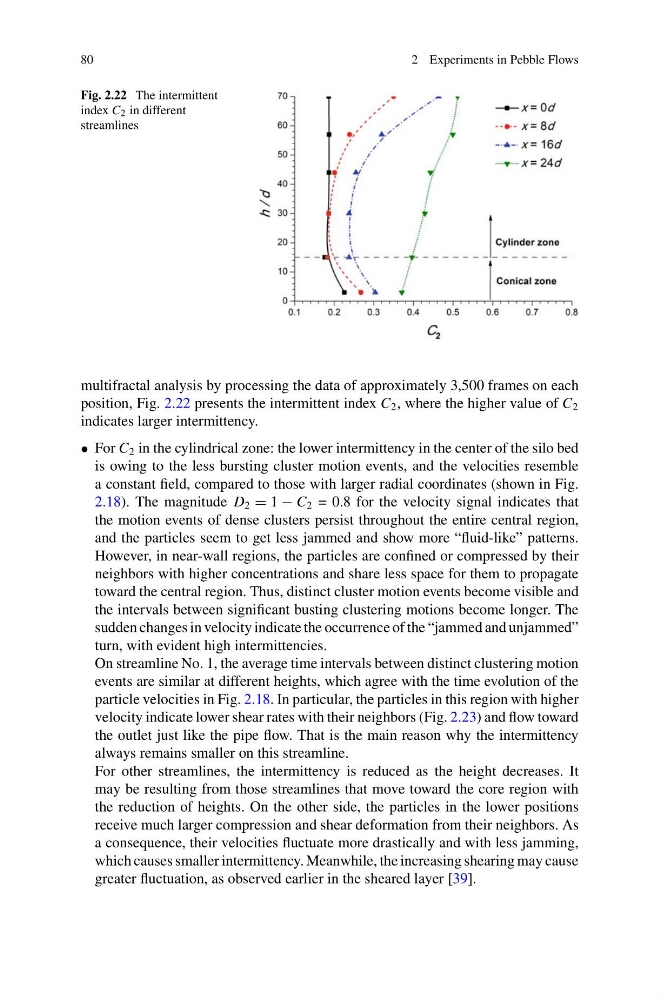
Fig. 2.22 The intermittent
index C 2 in different
streamlines
multifractal analysis by processing the data of approximately 3,500 frames on each
position, Fig. 2.22 presents the intermittent index C 2 , where the higher value of C 2
indicates larger intermittency.
• For C 2 in the cylindrical zone: the lower intermittency in the center of the silo bed
is owing to the less bursting cluster motion events, and the velocities resemble
a constant field, compared to those with larger radial coordinates (shown in Fig.
2.18). The magnitude D 2 = 1 − C 2 = 0.8 for the velocity signal indicates that
the motion events of dense clusters persist throughout the entire central region,
and the particles seem to get less jammed and show more “fluid-like” patterns.
However, in near-wall regions, the particles are confined or compressed by their
neighbors with higher concentrations and share less space for them to propagate
toward the central region. Thus, distinct cluster motion events become visible and
the intervals between significant busting clustering motions become longer. The
sudden changes in velocity indicate the occurrence of the “jammed and unjammed”
turn, with evident high intermittencies.
On streamline No. 1, the average time intervals between distinct clustering motion
events are similar at different heights, which agree with the time evolution of the
particle velocities in Fig. 2.18. In particular, the particles in this region with higher
velocity indicate lower shear rates with their neighbors (Fig. 2.23) and flow toward
the outlet just like the pipe flow. That is the main reason why the intermittency
always remains smaller on this streamline.
For other streamlines, the intermittency is reduced as the height decreases. It
may be resulting from those streamlines that move toward the core region with
the reduction of heights. On the other side, the particles in the lower positions
receive much larger compression and shear deformation from their neighbors. As
a consequence, their velocities fluctuate more drastically and with less jamming,
which causes smaller intermittency. Meanwhile, the increasing shearing may cause
greater fluctuation, as observed earlier in the sheared layer [39].
2 Experiments in Pebble Flows
Fig. 2.22 The intermittent
index C 2 in different
streamlines
multifractal analysis by processing the data of approximately 3,500 frames on each
position, Fig. 2.22 presents the intermittent index C 2 , where the higher value of C 2
indicates larger intermittency.
• For C 2 in the cylindrical zone: the lower intermittency in the center of the silo bed
is owing to the less bursting cluster motion events, and the velocities resemble
a constant field, compared to those with larger radial coordinates (shown in Fig.
2.18). The magnitude D 2 = 1 − C 2 = 0.8 for the velocity signal indicates that
the motion events of dense clusters persist throughout the entire central region,
and the particles seem to get less jammed and show more “fluid-like” patterns.
However, in near-wall regions, the particles are confined or compressed by their
neighbors with higher concentrations and share less space for them to propagate
toward the central region. Thus, distinct cluster motion events become visible and
the intervals between significant busting clustering motions become longer. The
sudden changes in velocity indicate the occurrence of the “jammed and unjammed”
turn, with evident high intermittencies.
On streamline No. 1, the average time intervals between distinct clustering motion
events are similar at different heights, which agree with the time evolution of the
particle velocities in Fig. 2.18. In particular, the particles in this region with higher
velocity indicate lower shear rates with their neighbors (Fig. 2.23) and flow toward
the outlet just like the pipe flow. That is the main reason why the intermittency
always remains smaller on this streamline.
For other streamlines, the intermittency is reduced as the height decreases. It
may be resulting from those streamlines that move toward the core region with
the reduction of heights. On the other side, the particles in the lower positions
receive much larger compression and shear deformation from their neighbors. As
a consequence, their velocities fluctuate more drastically and with less jamming,
which causes smaller intermittency. Meanwhile, the increasing shearing may cause
greater fluctuation, as observed earlier in the sheared layer [39].