

7.5 Friction Optimization
495
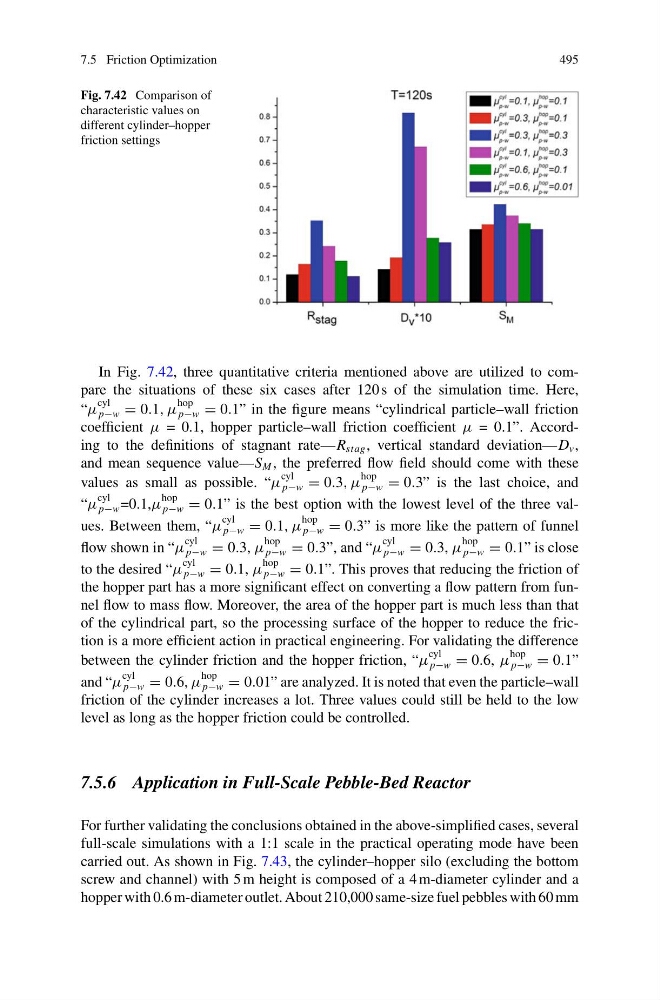
Fig. 7.42 Comparison of
characteristic values on
different cylinder–hopper
friction settings
In Fig. 7.42, three quantitative criteria mentioned above are utilized to compare the situations of these six cases after 120 s of the simulation time. Here,
“μ
cyl
p−w = 0.1, μ
hop
p−w = 0.1” in the figure means “cylindrical particle–wall friction
coefficient μ = 0.1, hopper particle–wall friction coefficient μ = 0.1”. According to the definitions of stagnant rate—R stag , vertical standard deviation—D v ,
and mean sequence value—S M , the preferred flow field should come with these
values as small as possible. “μ
cyl
p−w = 0.3, μ
hop
p−w = 0.3” is the last choice, and
“μ
cyl
p−w =0.1,μ
hop
p−w = 0.1” is the best option with the lowest level of the three values. Between them, “μ
cyl
p−w = 0.1, μ
hop
p−w = 0.3” is more like the pattern of funnel
flow shown in “μ
cyl
p−w = 0.3, μ
hop
p−w = 0.3”, and “μ
cyl
p−w = 0.3, μ
hop
p−w = 0.1” is close
to the desired “μ
cyl
p−w = 0.1, μ
hop
p−w = 0.1”. This proves that reducing the friction of
the hopper part has a more significant effect on converting a flow pattern from funnel flow to mass flow. Moreover, the area of the hopper part is much less than that
of the cylindrical part, so the processing surface of the hopper to reduce the friction is a more efficient action in practical engineering. For validating the difference
between the cylinder friction and the hopper friction, “μ
cyl
p−w = 0.6, μ
hop
p−w = 0.1”
and “μ
cyl
p−w = 0.6, μ
hop
p−w = 0.01” are analyzed. It is noted that even the particle–wall
friction of the cylinder increases a lot. Three values could still be held to the low
level as long as the hopper friction could be controlled.
7.5.6 Application in Full-Scale Pebble-Bed Reactor
For further validating the conclusions obtained in the above-simplified cases, several
full-scale simulations with a 1:1 scale in the practical operating mode have been
carried out. As shown in Fig. 7.43, the cylinder–hopper silo (excluding the bottom
screw and channel) with 5 m height is composed of a 4 m-diameter cylinder and a
hopper with 0.6 m-diameter outlet. About 210,000 same-size fuel pebbles with 60 mm
495
Fig. 7.42 Comparison of
characteristic values on
different cylinder–hopper
friction settings
In Fig. 7.42, three quantitative criteria mentioned above are utilized to compare the situations of these six cases after 120 s of the simulation time. Here,
“μ
cyl
p−w = 0.1, μ
hop
p−w = 0.1” in the figure means “cylindrical particle–wall friction
coefficient μ = 0.1, hopper particle–wall friction coefficient μ = 0.1”. According to the definitions of stagnant rate—R stag , vertical standard deviation—D v ,
and mean sequence value—S M , the preferred flow field should come with these
values as small as possible. “μ
cyl
p−w = 0.3, μ
hop
p−w = 0.3” is the last choice, and
“μ
cyl
p−w =0.1,μ
hop
p−w = 0.1” is the best option with the lowest level of the three values. Between them, “μ
cyl
p−w = 0.1, μ
hop
p−w = 0.3” is more like the pattern of funnel
flow shown in “μ
cyl
p−w = 0.3, μ
hop
p−w = 0.3”, and “μ
cyl
p−w = 0.3, μ
hop
p−w = 0.1” is close
to the desired “μ
cyl
p−w = 0.1, μ
hop
p−w = 0.1”. This proves that reducing the friction of
the hopper part has a more significant effect on converting a flow pattern from funnel flow to mass flow. Moreover, the area of the hopper part is much less than that
of the cylindrical part, so the processing surface of the hopper to reduce the friction is a more efficient action in practical engineering. For validating the difference
between the cylinder friction and the hopper friction, “μ
cyl
p−w = 0.6, μ
hop
p−w = 0.1”
and “μ
cyl
p−w = 0.6, μ
hop
p−w = 0.01” are analyzed. It is noted that even the particle–wall
friction of the cylinder increases a lot. Three values could still be held to the low
level as long as the hopper friction could be controlled.
7.5.6 Application in Full-Scale Pebble-Bed Reactor
For further validating the conclusions obtained in the above-simplified cases, several
full-scale simulations with a 1:1 scale in the practical operating mode have been
carried out. As shown in Fig. 7.43, the cylinder–hopper silo (excluding the bottom
screw and channel) with 5 m height is composed of a 4 m-diameter cylinder and a
hopper with 0.6 m-diameter outlet. About 210,000 same-size fuel pebbles with 60 mm