

480
7 Applications: Pebble Flow Optimizations
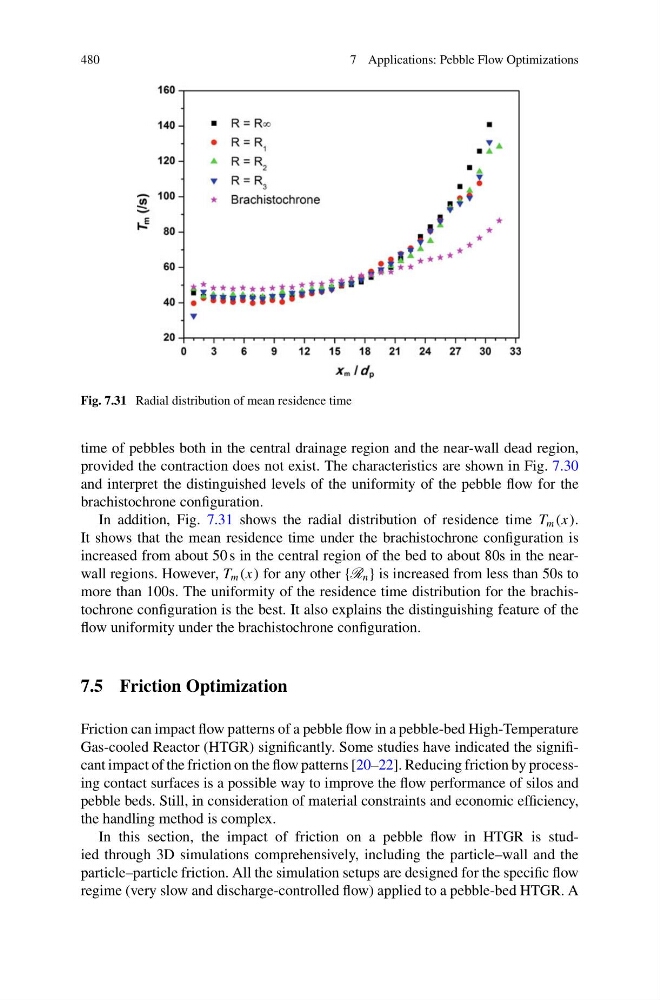
Fig. 7.31 Radial distribution of mean residence time
time of pebbles both in the central drainage region and the near-wall dead region,
provided the contraction does not exist. The characteristics are shown in Fig. 7.30
and interpret the distinguished levels of the uniformity of the pebble flow for the
brachistochrone configuration.
In addition, Fig. 7.31 shows the radial distribution of residence time T m (x).
It shows that the mean residence time under the brachistochrone configuration is
increased from about 50 s in the central region of the bed to about 80s in the nearwall regions. However, T m (x) for any other {R n } is increased from less than 50s to
more than 100s. The uniformity of the residence time distribution for the brachistochrone configuration is the best. It also explains the distinguishing feature of the
flow uniformity under the brachistochrone configuration.
7.5 Friction Optimization
Friction can impact flow patterns of a pebble flow in a pebble-bed High-Temperature
Gas-cooled Reactor (HTGR) significantly. Some studies have indicated the significant impact of the friction on the flow patterns [20–22]. Reducing friction by processing contact surfaces is a possible way to improve the flow performance of silos and
pebble beds. Still, in consideration of material constraints and economic efficiency,
the handling method is complex.
In this section, the impact of friction on a pebble flow in HTGR is studied through 3D simulations comprehensively, including the particle–wall and the
particle–particle friction. All the simulation setups are designed for the specific flow
regime (very slow and discharge-controlled flow) applied to a pebble-bed HTGR. A
7 Applications: Pebble Flow Optimizations
Fig. 7.31 Radial distribution of mean residence time
time of pebbles both in the central drainage region and the near-wall dead region,
provided the contraction does not exist. The characteristics are shown in Fig. 7.30
and interpret the distinguished levels of the uniformity of the pebble flow for the
brachistochrone configuration.
In addition, Fig. 7.31 shows the radial distribution of residence time T m (x).
It shows that the mean residence time under the brachistochrone configuration is
increased from about 50 s in the central region of the bed to about 80s in the nearwall regions. However, T m (x) for any other {R n } is increased from less than 50s to
more than 100s. The uniformity of the residence time distribution for the brachistochrone configuration is the best. It also explains the distinguishing feature of the
flow uniformity under the brachistochrone configuration.
7.5 Friction Optimization
Friction can impact flow patterns of a pebble flow in a pebble-bed High-Temperature
Gas-cooled Reactor (HTGR) significantly. Some studies have indicated the significant impact of the friction on the flow patterns [20–22]. Reducing friction by processing contact surfaces is a possible way to improve the flow performance of silos and
pebble beds. Still, in consideration of material constraints and economic efficiency,
the handling method is complex.
In this section, the impact of friction on a pebble flow in HTGR is studied through 3D simulations comprehensively, including the particle–wall and the
particle–particle friction. All the simulation setups are designed for the specific flow
regime (very slow and discharge-controlled flow) applied to a pebble-bed HTGR. A