

476
7 Applications: Pebble Flow Optimizations
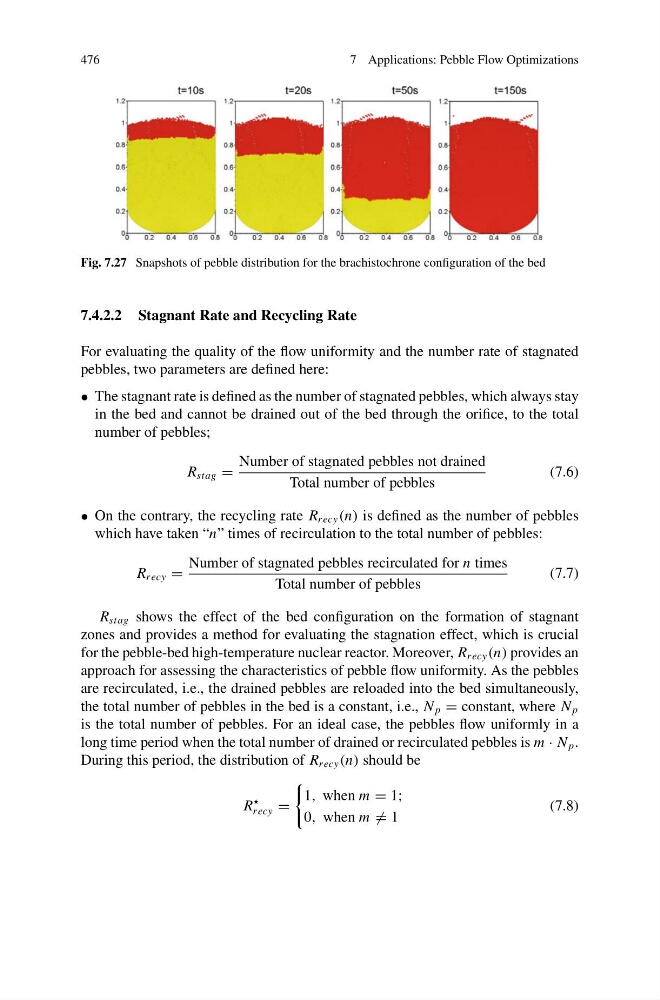
Fig. 7.27 Snapshots of pebble distribution for the brachistochrone configuration of the bed
7.4.2.2 Stagnant Rate and Recycling Rate
For evaluating the quality of the flow uniformity and the number rate of stagnated
pebbles, two parameters are defined here:
• The stagnant rate is defined as the number of stagnated pebbles, which always stay
in the bed and cannot be drained out of the bed through the orifice, to the total
number of pebbles;
R stag =
Number of stagnated pebbles not drained
Total number of pebbles
(7.6)
• On the contrary, the recycling rate R recy (n) is defined as the number of pebbles
which have taken “n” times of recirculation to the total number of pebbles:
R recy =
Number of stagnated pebbles recirculated for n times
Total number of pebbles
(7.7)
R stag shows the effect of the bed configuration on the formation of stagnant
zones and provides a method for evaluating the stagnation effect, which is crucial
for the pebble-bed high-temperature nuclear reactor. Moreover, R recy (n) provides an
approach for assessing the characteristics of pebble flow uniformity. As the pebbles
are recirculated, i.e., the drained pebbles are reloaded into the bed simultaneously,
the total number of pebbles in the bed is a constant, i.e., N p = constant, where N p
is the total number of pebbles. For an ideal case, the pebbles flow uniformly in a
long time period when the total number of drained or recirculated pebbles is m · N p .
During this period, the distribution of R recy (n) should be
R
recy =
1, when m = 1;
0, when m = 1
(7.8)
7 Applications: Pebble Flow Optimizations
Fig. 7.27 Snapshots of pebble distribution for the brachistochrone configuration of the bed
7.4.2.2 Stagnant Rate and Recycling Rate
For evaluating the quality of the flow uniformity and the number rate of stagnated
pebbles, two parameters are defined here:
• The stagnant rate is defined as the number of stagnated pebbles, which always stay
in the bed and cannot be drained out of the bed through the orifice, to the total
number of pebbles;
R stag =
Number of stagnated pebbles not drained
Total number of pebbles
(7.6)
• On the contrary, the recycling rate R recy (n) is defined as the number of pebbles
which have taken “n” times of recirculation to the total number of pebbles:
R recy =
Number of stagnated pebbles recirculated for n times
Total number of pebbles
(7.7)
R stag shows the effect of the bed configuration on the formation of stagnant
zones and provides a method for evaluating the stagnation effect, which is crucial
for the pebble-bed high-temperature nuclear reactor. Moreover, R recy (n) provides an
approach for assessing the characteristics of pebble flow uniformity. As the pebbles
are recirculated, i.e., the drained pebbles are reloaded into the bed simultaneously,
the total number of pebbles in the bed is a constant, i.e., N p = constant, where N p
is the total number of pebbles. For an ideal case, the pebbles flow uniformly in a
long time period when the total number of drained or recirculated pebbles is m · N p .
During this period, the distribution of R recy (n) should be
R
recy =
1, when m = 1;
0, when m = 1
(7.8)