

7.3 Flow-Corrective Insert Optimization
467
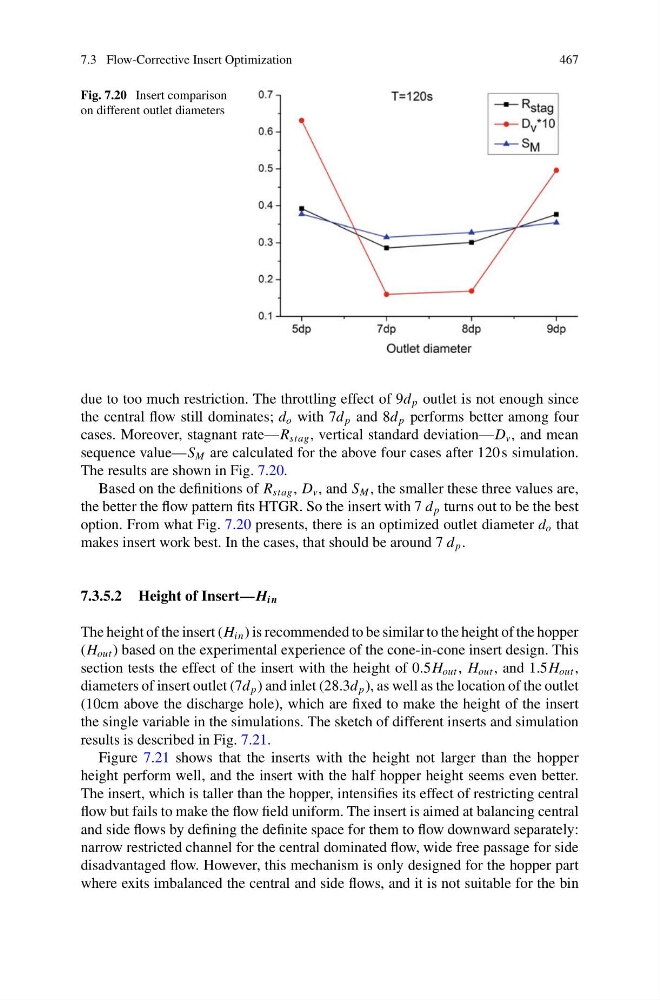
Fig. 7.20 Insert comparison
on different outlet diameters
due to too much restriction. The throttling effect of 9d p outlet is not enough since
the central flow still dominates; d o with 7d p and 8d p performs better among four
cases. Moreover, stagnant rate—R stag , vertical standard deviation—D v , and mean
sequence value—S M are calculated for the above four cases after 120 s simulation.
The results are shown in Fig. 7.20.
Based on the definitions of R stag , D v , and S M , the smaller these three values are,
the better the flow pattern fits HTGR. So the insert with 7 d p turns out to be the best
option. From what Fig. 7.20 presents, there is an optimized outlet diameter d o that
makes insert work best. In the cases, that should be around 7 d p .
7.3.5.2 Height of Insert—H in
The height of the insert (H in ) is recommended to be similar to the height of the hopper
(H out ) based on the experimental experience of the cone-in-cone insert design. This
section tests the effect of the insert with the height of 0.5H out , H out , and 1.5H out ,
diameters of insert outlet (7d p ) and inlet (28.3d p ), as well as the location of the outlet
(10cm above the discharge hole), which are fixed to make the height of the insert
the single variable in the simulations. The sketch of different inserts and simulation
results is described in Fig. 7.21.
Figure 7.21 shows that the inserts with the height not larger than the hopper
height perform well, and the insert with the half hopper height seems even better.
The insert, which is taller than the hopper, intensifies its effect of restricting central
flow but fails to make the flow field uniform. The insert is aimed at balancing central
and side flows by defining the definite space for them to flow downward separately:
narrow restricted channel for the central dominated flow, wide free passage for side
disadvantaged flow. However, this mechanism is only designed for the hopper part
where exits imbalanced the central and side flows, and it is not suitable for the bin
467
Fig. 7.20 Insert comparison
on different outlet diameters
due to too much restriction. The throttling effect of 9d p outlet is not enough since
the central flow still dominates; d o with 7d p and 8d p performs better among four
cases. Moreover, stagnant rate—R stag , vertical standard deviation—D v , and mean
sequence value—S M are calculated for the above four cases after 120 s simulation.
The results are shown in Fig. 7.20.
Based on the definitions of R stag , D v , and S M , the smaller these three values are,
the better the flow pattern fits HTGR. So the insert with 7 d p turns out to be the best
option. From what Fig. 7.20 presents, there is an optimized outlet diameter d o that
makes insert work best. In the cases, that should be around 7 d p .
7.3.5.2 Height of Insert—H in
The height of the insert (H in ) is recommended to be similar to the height of the hopper
(H out ) based on the experimental experience of the cone-in-cone insert design. This
section tests the effect of the insert with the height of 0.5H out , H out , and 1.5H out ,
diameters of insert outlet (7d p ) and inlet (28.3d p ), as well as the location of the outlet
(10cm above the discharge hole), which are fixed to make the height of the insert
the single variable in the simulations. The sketch of different inserts and simulation
results is described in Fig. 7.21.
Figure 7.21 shows that the inserts with the height not larger than the hopper
height perform well, and the insert with the half hopper height seems even better.
The insert, which is taller than the hopper, intensifies its effect of restricting central
flow but fails to make the flow field uniform. The insert is aimed at balancing central
and side flows by defining the definite space for them to flow downward separately:
narrow restricted channel for the central dominated flow, wide free passage for side
disadvantaged flow. However, this mechanism is only designed for the hopper part
where exits imbalanced the central and side flows, and it is not suitable for the bin