

7.3 Flow-Corrective Insert Optimization
463
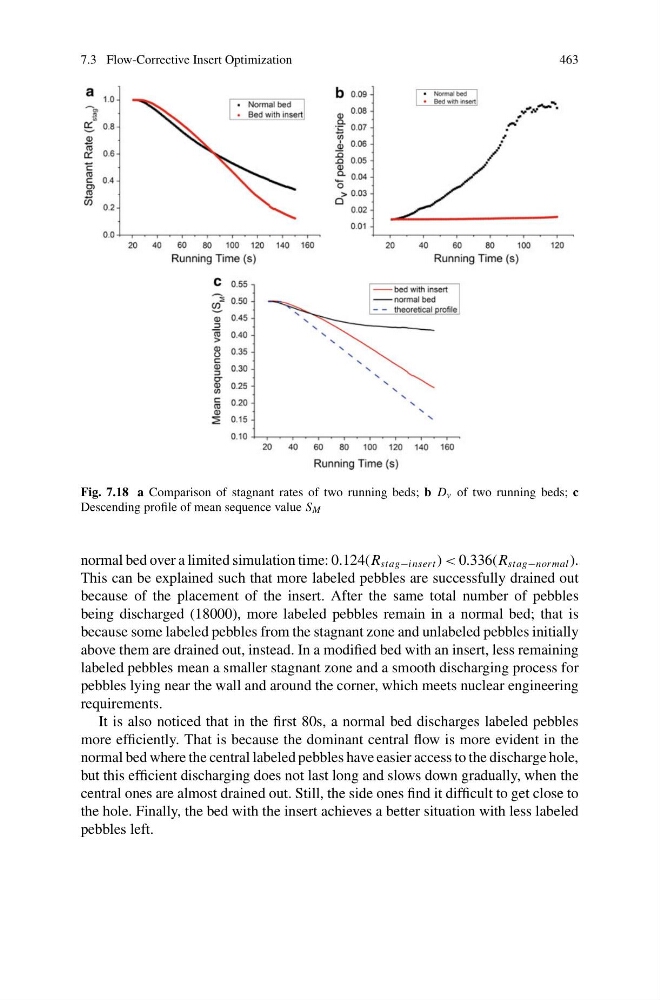
Fig. 7.18 a Comparison of stagnant rates of two running beds; b D v of two running beds; c
Descending profile of mean sequence value S M
normal bed over a limited simulation time: 0.124(R stag−insert ) < 0.336(R stag−normal ).
This can be explained such that more labeled pebbles are successfully drained out
because of the placement of the insert. After the same total number of pebbles
being discharged (18000), more labeled pebbles remain in a normal bed; that is
because some labeled pebbles from the stagnant zone and unlabeled pebbles initially
above them are drained out, instead. In a modified bed with an insert, less remaining
labeled pebbles mean a smaller stagnant zone and a smooth discharging process for
pebbles lying near the wall and around the corner, which meets nuclear engineering
requirements.
It is also noticed that in the first 80s, a normal bed discharges labeled pebbles
more efficiently. That is because the dominant central flow is more evident in the
normal bed where the central labeled pebbles have easier access to the discharge hole,
but this efficient discharging does not last long and slows down gradually, when the
central ones are almost drained out. Still, the side ones find it difficult to get close to
the hole. Finally, the bed with the insert achieves a better situation with less labeled
pebbles left.
463
Fig. 7.18 a Comparison of stagnant rates of two running beds; b D v of two running beds; c
Descending profile of mean sequence value S M
normal bed over a limited simulation time: 0.124(R stag−insert ) < 0.336(R stag−normal ).
This can be explained such that more labeled pebbles are successfully drained out
because of the placement of the insert. After the same total number of pebbles
being discharged (18000), more labeled pebbles remain in a normal bed; that is
because some labeled pebbles from the stagnant zone and unlabeled pebbles initially
above them are drained out, instead. In a modified bed with an insert, less remaining
labeled pebbles mean a smaller stagnant zone and a smooth discharging process for
pebbles lying near the wall and around the corner, which meets nuclear engineering
requirements.
It is also noticed that in the first 80s, a normal bed discharges labeled pebbles
more efficiently. That is because the dominant central flow is more evident in the
normal bed where the central labeled pebbles have easier access to the discharge hole,
but this efficient discharging does not last long and slows down gradually, when the
central ones are almost drained out. Still, the side ones find it difficult to get close to
the hole. Finally, the bed with the insert achieves a better situation with less labeled
pebbles left.