

438
6 Applications: Two-Region Pebble Beds
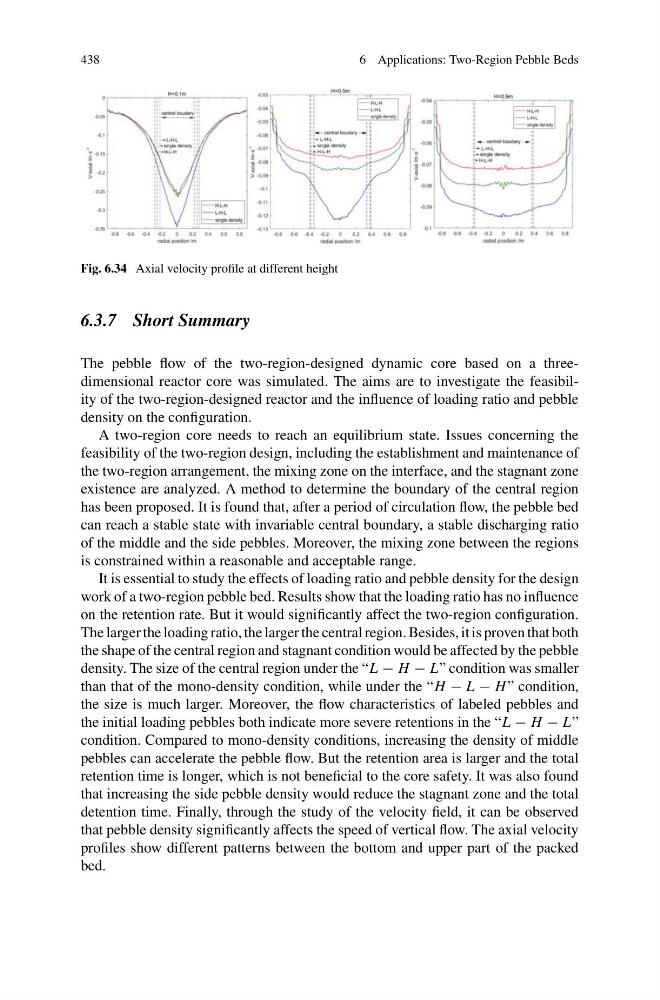
Fig. 6.34 Axial velocity profile at different height
6.3.7 Short Summary
The pebble flow of the two-region-designed dynamic core based on a threedimensional reactor core was simulated. The aims are to investigate the feasibility of the two-region-designed reactor and the influence of loading ratio and pebble
density on the configuration.
A two-region core needs to reach an equilibrium state. Issues concerning the
feasibility of the two-region design, including the establishment and maintenance of
the two-region arrangement, the mixing zone on the interface, and the stagnant zone
existence are analyzed. A method to determine the boundary of the central region
has been proposed. It is found that, after a period of circulation flow, the pebble bed
can reach a stable state with invariable central boundary, a stable discharging ratio
of the middle and the side pebbles. Moreover, the mixing zone between the regions
is constrained within a reasonable and acceptable range.
It is essential to study the effects of loading ratio and pebble density for the design
work of a two-region pebble bed. Results show that the loading ratio has no influence
on the retention rate. But it would significantly affect the two-region configuration.
The larger the loading ratio, the larger the central region. Besides, it is proven that both
the shape of the central region and stagnant condition would be affected by the pebble
density. The size of the central region under the “L − H − L” condition was smaller
than that of the mono-density condition, while under the “H − L − H ” condition,
the size is much larger. Moreover, the flow characteristics of labeled pebbles and
the initial loading pebbles both indicate more severe retentions in the “L − H − L”
condition. Compared to mono-density conditions, increasing the density of middle
pebbles can accelerate the pebble flow. But the retention area is larger and the total
retention time is longer, which is not beneficial to the core safety. It was also found
that increasing the side pebble density would reduce the stagnant zone and the total
detention time. Finally, through the study of the velocity field, it can be observed
that pebble density significantly affects the speed of vertical flow. The axial velocity
profiles show different patterns between the bottom and upper part of the packed
bed.
6 Applications: Two-Region Pebble Beds
Fig. 6.34 Axial velocity profile at different height
6.3.7 Short Summary
The pebble flow of the two-region-designed dynamic core based on a threedimensional reactor core was simulated. The aims are to investigate the feasibility of the two-region-designed reactor and the influence of loading ratio and pebble
density on the configuration.
A two-region core needs to reach an equilibrium state. Issues concerning the
feasibility of the two-region design, including the establishment and maintenance of
the two-region arrangement, the mixing zone on the interface, and the stagnant zone
existence are analyzed. A method to determine the boundary of the central region
has been proposed. It is found that, after a period of circulation flow, the pebble bed
can reach a stable state with invariable central boundary, a stable discharging ratio
of the middle and the side pebbles. Moreover, the mixing zone between the regions
is constrained within a reasonable and acceptable range.
It is essential to study the effects of loading ratio and pebble density for the design
work of a two-region pebble bed. Results show that the loading ratio has no influence
on the retention rate. But it would significantly affect the two-region configuration.
The larger the loading ratio, the larger the central region. Besides, it is proven that both
the shape of the central region and stagnant condition would be affected by the pebble
density. The size of the central region under the “L − H − L” condition was smaller
than that of the mono-density condition, while under the “H − L − H ” condition,
the size is much larger. Moreover, the flow characteristics of labeled pebbles and
the initial loading pebbles both indicate more severe retentions in the “L − H − L”
condition. Compared to mono-density conditions, increasing the density of middle
pebbles can accelerate the pebble flow. But the retention area is larger and the total
retention time is longer, which is not beneficial to the core safety. It was also found
that increasing the side pebble density would reduce the stagnant zone and the total
detention time. Finally, through the study of the velocity field, it can be observed
that pebble density significantly affects the speed of vertical flow. The axial velocity
profiles show different patterns between the bottom and upper part of the packed
bed.