

6.3 Density Difference and Loading Ratio Effects
437
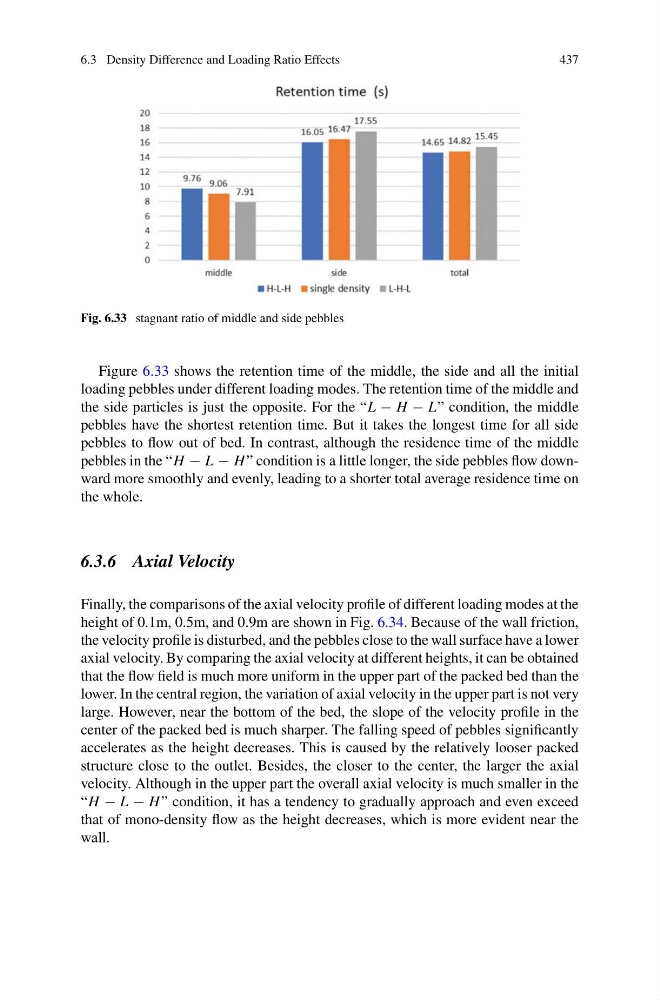
Fig. 6.33 stagnant ratio of middle and side pebbles
Figure 6.33 shows the retention time of the middle, the side and all the initial
loading pebbles under different loading modes. The retention time of the middle and
the side particles is just the opposite. For the “L − H − L” condition, the middle
pebbles have the shortest retention time. But it takes the longest time for all side
pebbles to flow out of bed. In contrast, although the residence time of the middle
pebbles in the “H − L − H ” condition is a little longer, the side pebbles flow downward more smoothly and evenly, leading to a shorter total average residence time on
the whole.
6.3.6 Axial Velocity
Finally, the comparisons of the axial velocity profile of different loading modes at the
height of 0.1m, 0.5m, and 0.9m are shown in Fig. 6.34. Because of the wall friction,
the velocity profile is disturbed, and the pebbles close to the wall surface have a lower
axial velocity. By comparing the axial velocity at different heights, it can be obtained
that the flow field is much more uniform in the upper part of the packed bed than the
lower. In the central region, the variation of axial velocity in the upper part is not very
large. However, near the bottom of the bed, the slope of the velocity profile in the
center of the packed bed is much sharper. The falling speed of pebbles significantly
accelerates as the height decreases. This is caused by the relatively looser packed
structure close to the outlet. Besides, the closer to the center, the larger the axial
velocity. Although in the upper part the overall axial velocity is much smaller in the
“H − L − H ” condition, it has a tendency to gradually approach and even exceed
that of mono-density flow as the height decreases, which is more evident near the
wall.
437
Fig. 6.33 stagnant ratio of middle and side pebbles
Figure 6.33 shows the retention time of the middle, the side and all the initial
loading pebbles under different loading modes. The retention time of the middle and
the side particles is just the opposite. For the “L − H − L” condition, the middle
pebbles have the shortest retention time. But it takes the longest time for all side
pebbles to flow out of bed. In contrast, although the residence time of the middle
pebbles in the “H − L − H ” condition is a little longer, the side pebbles flow downward more smoothly and evenly, leading to a shorter total average residence time on
the whole.
6.3.6 Axial Velocity
Finally, the comparisons of the axial velocity profile of different loading modes at the
height of 0.1m, 0.5m, and 0.9m are shown in Fig. 6.34. Because of the wall friction,
the velocity profile is disturbed, and the pebbles close to the wall surface have a lower
axial velocity. By comparing the axial velocity at different heights, it can be obtained
that the flow field is much more uniform in the upper part of the packed bed than the
lower. In the central region, the variation of axial velocity in the upper part is not very
large. However, near the bottom of the bed, the slope of the velocity profile in the
center of the packed bed is much sharper. The falling speed of pebbles significantly
accelerates as the height decreases. This is caused by the relatively looser packed
structure close to the outlet. Besides, the closer to the center, the larger the axial
velocity. Although in the upper part the overall axial velocity is much smaller in the
“H − L − H ” condition, it has a tendency to gradually approach and even exceed
that of mono-density flow as the height decreases, which is more evident near the
wall.