

416
6 Applications: Two-Region Pebble Beds
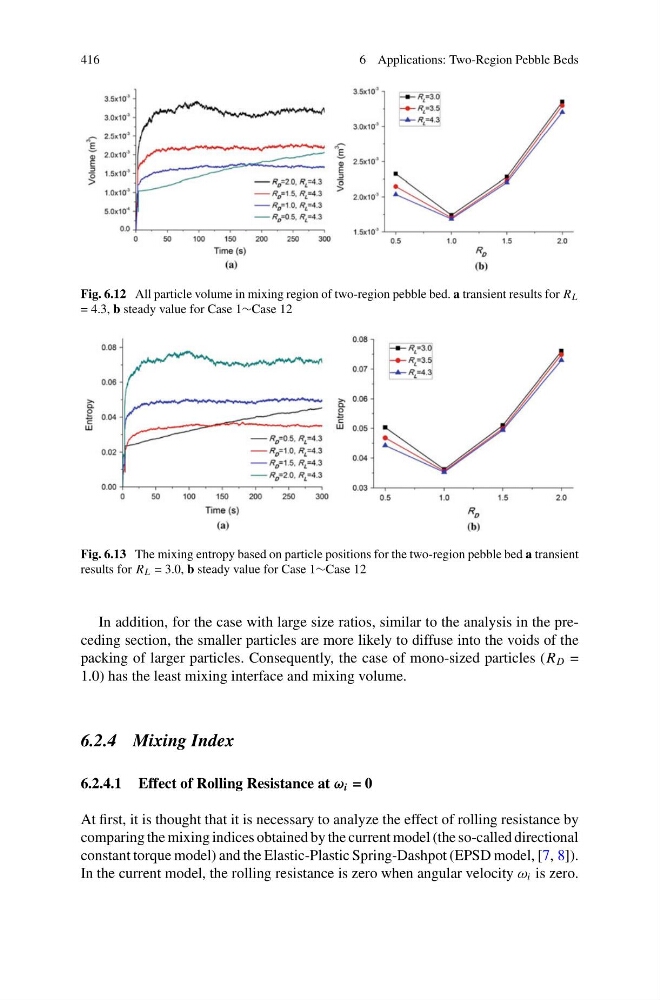
Fig. 6.12 All particle volume in mixing region of two-region pebble bed. a transient results for R L
= 4.3, b steady value for Case 1∼Case 12
Fig. 6.13 The mixing entropy based on particle positions for the two-region pebble bed a transient
results for R L = 3.0, b steady value for Case 1∼Case 12
In addition, for the case with large size ratios, similar to the analysis in the preceding section, the smaller particles are more likely to diffuse into the voids of the
packing of larger particles. Consequently, the case of mono-sized particles (R D =
1.0) has the least mixing interface and mixing volume.
6.2.4 Mixing Index
6.2.4.1 Effect of Rolling Resistance at ω i = 0
At first, it is thought that it is necessary to analyze the effect of rolling resistance by
comparing the mixing indices obtained by the current model (the so-called directional
constant torque model) and the Elastic-Plastic Spring-Dashpot (EPSD model, [7, 8]).
In the current model, the rolling resistance is zero when angular velocity ω i is zero.
6 Applications: Two-Region Pebble Beds
Fig. 6.12 All particle volume in mixing region of two-region pebble bed. a transient results for R L
= 4.3, b steady value for Case 1∼Case 12
Fig. 6.13 The mixing entropy based on particle positions for the two-region pebble bed a transient
results for R L = 3.0, b steady value for Case 1∼Case 12
In addition, for the case with large size ratios, similar to the analysis in the preceding section, the smaller particles are more likely to diffuse into the voids of the
packing of larger particles. Consequently, the case of mono-sized particles (R D =
1.0) has the least mixing interface and mixing volume.
6.2.4 Mixing Index
6.2.4.1 Effect of Rolling Resistance at ω i = 0
At first, it is thought that it is necessary to analyze the effect of rolling resistance by
comparing the mixing indices obtained by the current model (the so-called directional
constant torque model) and the Elastic-Plastic Spring-Dashpot (EPSD model, [7, 8]).
In the current model, the rolling resistance is zero when angular velocity ω i is zero.