

372
5 Numerical Models for Pebble-Bed Heat Transfer
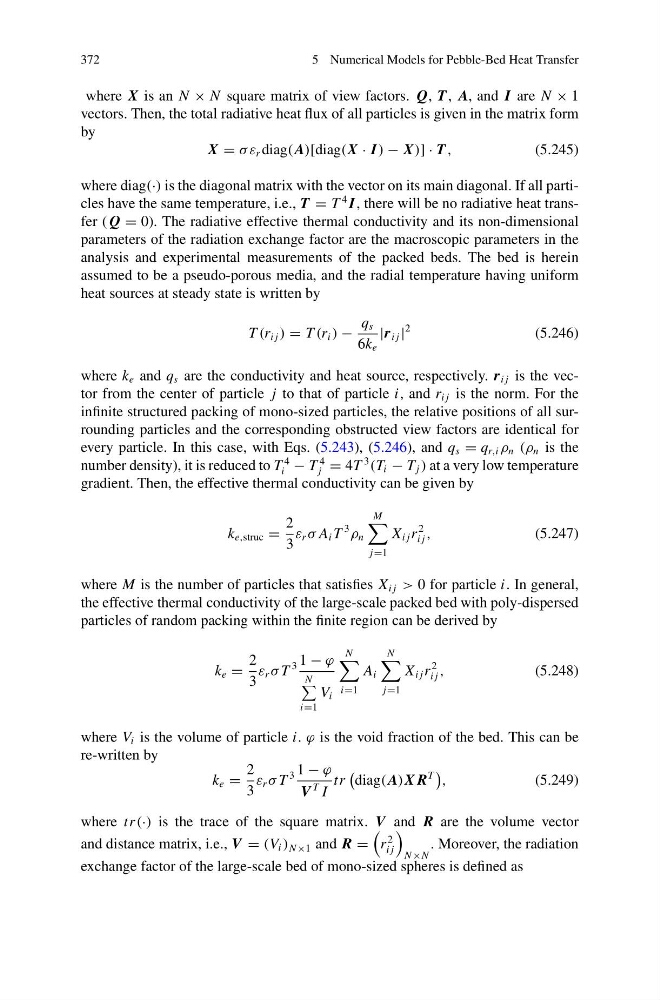
where X is an N × N square matrix of view factors. Q, T , A, and I are N × 1
vectors. Then, the total radiative heat flux of all particles is given in the matrix form
by
X = σ ε r diag( A)[diag(X · I) − X)] · T ,
(5.245)
where diag(·) is the diagonal matrix with the vector on its main diagonal. If all particles have the same temperature, i.e., T = T
4 I, there will be no radiative heat transfer ( Q = 0). The radiative effective thermal conductivity and its non-dimensional
parameters of the radiation exchange factor are the macroscopic parameters in the
analysis and experimental measurements of the packed beds. The bed is herein
assumed to be a pseudo-porous media, and the radial temperature having uniform
heat sources at steady state is written by
T (r i j ) = T (r i ) −
q s
6k e
|r i j |
2
(5.246)
where k e and q s are the conductivity and heat source, respectively. r i j is the vector from the center of particle j to that of particle i, and r i j is the norm. For the
infinite structured packing of mono-sized particles, the relative positions of all surrounding particles and the corresponding obstructed view factors are identical for
every particle. In this case, with Eqs. (5.243), (5.246), and q s = q r,i ρ n (ρ n is the
number density), it is reduced to T
4
i − T
4
j = 4T
3
(T i − T j ) at a very low temperature
gradient. Then, the effective thermal conductivity can be given by
k e,struc =
2
3
ε r σ A i T
3
ρ n
M
j=1
X i j r
2
i j ,
(5.247)
where M is the number of particles that satisfies X i j > 0 for particle i. In general,
the effective thermal conductivity of the large-scale packed bed with poly-dispersed
particles of random packing within the finite region can be derived by
k e =
2
3
ε r σ T
3 1 − ϕ
N
i=1
V i
N
i=1
A i
N
j=1
X i j r
2
i j ,
(5.248)
where V i is the volume of particle i. ϕ is the void fraction of the bed. This can be
re-written by
k e =
2
3
ε r σ T
3 1 − ϕ
V
T I
tr
diag( A)X R
T
,
(5.249)
where tr(·) is the trace of the square matrix. V and R are the volume vector
and distance matrix, i.e., V = (V i ) N ×1 and R =
r
2
i j
N ×N
. Moreover, the radiation
exchange factor of the large-scale bed of mono-sized spheres is defined as
5 Numerical Models for Pebble-Bed Heat Transfer
where X is an N × N square matrix of view factors. Q, T , A, and I are N × 1
vectors. Then, the total radiative heat flux of all particles is given in the matrix form
by
X = σ ε r diag( A)[diag(X · I) − X)] · T ,
(5.245)
where diag(·) is the diagonal matrix with the vector on its main diagonal. If all particles have the same temperature, i.e., T = T
4 I, there will be no radiative heat transfer ( Q = 0). The radiative effective thermal conductivity and its non-dimensional
parameters of the radiation exchange factor are the macroscopic parameters in the
analysis and experimental measurements of the packed beds. The bed is herein
assumed to be a pseudo-porous media, and the radial temperature having uniform
heat sources at steady state is written by
T (r i j ) = T (r i ) −
q s
6k e
|r i j |
2
(5.246)
where k e and q s are the conductivity and heat source, respectively. r i j is the vector from the center of particle j to that of particle i, and r i j is the norm. For the
infinite structured packing of mono-sized particles, the relative positions of all surrounding particles and the corresponding obstructed view factors are identical for
every particle. In this case, with Eqs. (5.243), (5.246), and q s = q r,i ρ n (ρ n is the
number density), it is reduced to T
4
i − T
4
j = 4T
3
(T i − T j ) at a very low temperature
gradient. Then, the effective thermal conductivity can be given by
k e,struc =
2
3
ε r σ A i T
3
ρ n
M
j=1
X i j r
2
i j ,
(5.247)
where M is the number of particles that satisfies X i j > 0 for particle i. In general,
the effective thermal conductivity of the large-scale packed bed with poly-dispersed
particles of random packing within the finite region can be derived by
k e =
2
3
ε r σ T
3 1 − ϕ
N
i=1
V i
N
i=1
A i
N
j=1
X i j r
2
i j ,
(5.248)
where V i is the volume of particle i. ϕ is the void fraction of the bed. This can be
re-written by
k e =
2
3
ε r σ T
3 1 − ϕ
V
T I
tr
diag( A)X R
T
,
(5.249)
where tr(·) is the trace of the square matrix. V and R are the volume vector
and distance matrix, i.e., V = (V i ) N ×1 and R =
r
2
i j
N ×N
. Moreover, the radiation
exchange factor of the large-scale bed of mono-sized spheres is defined as