

5.5 Further Issues
371
in a large-scale packed bed, the large datasets of different sphere-sphere obstructed
view factors can be trained to understand the rule of computation of the view factor.
It becomes feasible to compute the view factor efficiently without the range-cutoff
technique, especially in the range of a very long distance.
In this section, the full ranges of radiative heat transfer and the effective thermal
conductivity are discussed in a matrix form embedded in the thermal radiation coupled DEM code for large-scale nuclear-packed pebble beds. The nonlinear regression
model of the deep neural network is trained by large datasets to compute the complicated obstructed view factor. Then, this model is applied to the analysis of local
features and transient real-time radiation characteristics of the large-scale packed
bed.
5.5.3.1 Radiation Governing Equations
For accurate prediction of heat transfer in high-temperature packed beds, it is necessary to calculate the radiation between any possible pairs, including the near-range
part and the far-range part. In general, for two particles (i and j) in the bed, the
full-range radiative flux can be formulated as
q r,i j = f s ε r σ A i X i j (T
4
i − T
4
j ),
(5.242)
where T i , A i , and σ are the particle temperature, surface area, and Stefan–Boltzmann
constant, respectively. ε r is the particle surface emissivity, and f s is a correction
coefficient instead of other factors, such as the particle thermal conductivity, the
gas absorption, and the wall effect. For simplifying the problem in this analysis, no
correction is considered, and f s = 1 is applied in the following discussions. X i j is
the view factor between any pairs of two particles, and it may be partially obstructed
by other ones in the densely packed bed.
The total flux of the particle “i” in the bed filled with N particles is then given by
q r,i j =
N
j=1
q r,i j = ε r σ A i
⎛
⎝ T
4
i
N
j=1
X i j −
N
j=1
X i j T
4
j
⎞
⎠ .
(5.243)
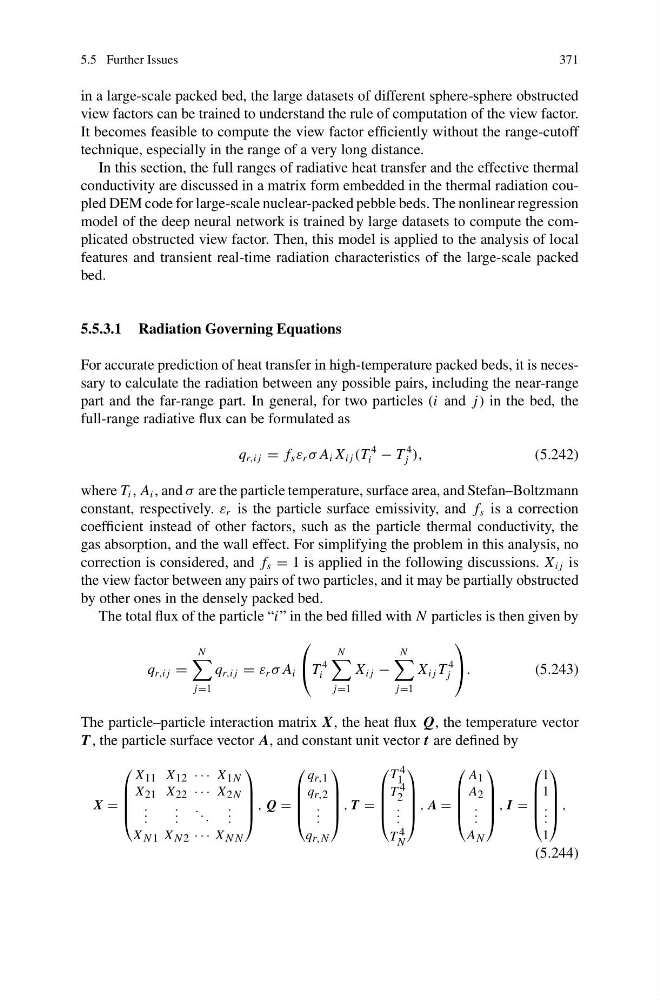
The particle–particle interaction matrix X, the heat flux Q, the temperature vector
T , the particle surface vector A, and constant unit vector t are defined by
X =
⎛
⎜
⎜
⎜
⎝
X 11 X 12 · · · X 1N
X 21 X 22 · · · X 2N
. . .
. . .
. . .
. . .
X N 1 X N 2 · · · X N N
⎞
⎟
⎟
⎟
⎠
, Q =
⎛
⎜
⎜
⎜
⎝
q r,1
q r,2
. . .
q r,N
⎞
⎟
⎟
⎟
⎠
, T =
⎛
⎜
⎜
⎜
⎝
T 4
1
T 4
2
. . .
T 4
N
⎞
⎟
⎟
⎟
⎠
, A =
⎛
⎜
⎜
⎜
⎝
A 1
A 2
. . .
A N
⎞
⎟
⎟
⎟
⎠
, I =
⎛
⎜
⎜
⎜
⎝
1
1
. . .
1
⎞
⎟
⎟
⎟
⎠
,
(5.244)
371
in a large-scale packed bed, the large datasets of different sphere-sphere obstructed
view factors can be trained to understand the rule of computation of the view factor.
It becomes feasible to compute the view factor efficiently without the range-cutoff
technique, especially in the range of a very long distance.
In this section, the full ranges of radiative heat transfer and the effective thermal
conductivity are discussed in a matrix form embedded in the thermal radiation coupled DEM code for large-scale nuclear-packed pebble beds. The nonlinear regression
model of the deep neural network is trained by large datasets to compute the complicated obstructed view factor. Then, this model is applied to the analysis of local
features and transient real-time radiation characteristics of the large-scale packed
bed.
5.5.3.1 Radiation Governing Equations
For accurate prediction of heat transfer in high-temperature packed beds, it is necessary to calculate the radiation between any possible pairs, including the near-range
part and the far-range part. In general, for two particles (i and j) in the bed, the
full-range radiative flux can be formulated as
q r,i j = f s ε r σ A i X i j (T
4
i − T
4
j ),
(5.242)
where T i , A i , and σ are the particle temperature, surface area, and Stefan–Boltzmann
constant, respectively. ε r is the particle surface emissivity, and f s is a correction
coefficient instead of other factors, such as the particle thermal conductivity, the
gas absorption, and the wall effect. For simplifying the problem in this analysis, no
correction is considered, and f s = 1 is applied in the following discussions. X i j is
the view factor between any pairs of two particles, and it may be partially obstructed
by other ones in the densely packed bed.
The total flux of the particle “i” in the bed filled with N particles is then given by
q r,i j =
N
j=1
q r,i j = ε r σ A i
⎛
⎝ T
4
i
N
j=1
X i j −
N
j=1
X i j T
4
j
⎞
⎠ .
(5.243)
The particle–particle interaction matrix X, the heat flux Q, the temperature vector
T , the particle surface vector A, and constant unit vector t are defined by
X =
⎛
⎜
⎜
⎜
⎝
X 11 X 12 · · · X 1N
X 21 X 22 · · · X 2N
. . .
. . .
. . .
. . .
X N 1 X N 2 · · · X N N
⎞
⎟
⎟
⎟
⎠
, Q =
⎛
⎜
⎜
⎜
⎝
q r,1
q r,2
. . .
q r,N
⎞
⎟
⎟
⎟
⎠
, T =
⎛
⎜
⎜
⎜
⎝
T 4
1
T 4
2
. . .
T 4
N
⎞
⎟
⎟
⎟
⎠
, A =
⎛
⎜
⎜
⎜
⎝
A 1
A 2
. . .
A N
⎞
⎟
⎟
⎟
⎠
, I =
⎛
⎜
⎜
⎜
⎝
1
1
. . .
1
⎞
⎟
⎟
⎟
⎠
,
(5.244)