

368
5 Numerical Models for Pebble-Bed Heat Transfer
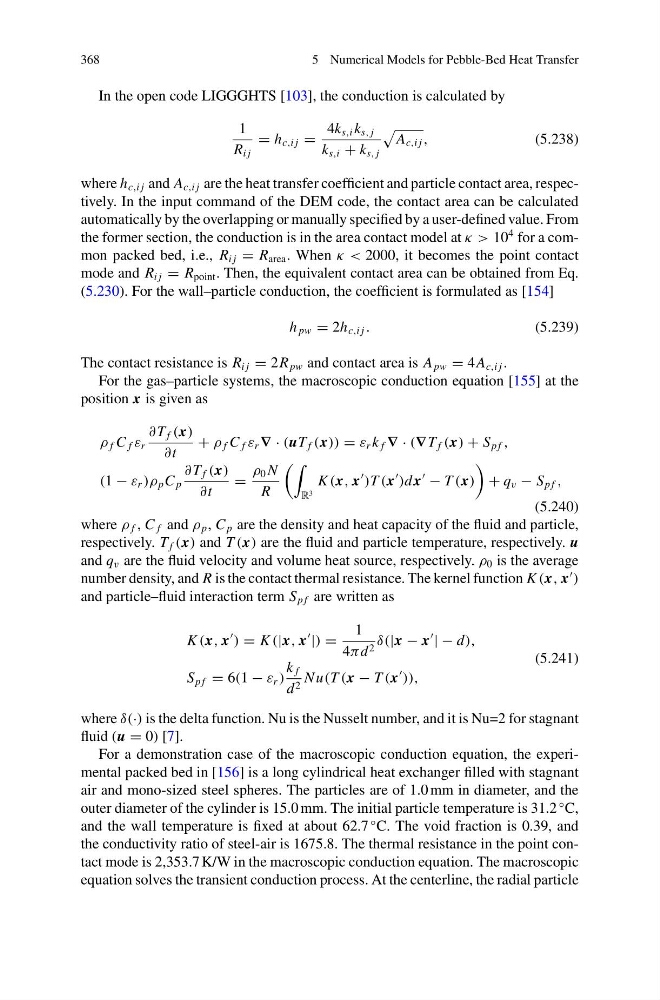
In the open code LIGGGHTS [103], the conduction is calculated by
1
R i j
= h c,i j =
4k s,i k s, j
k s,i + k s, j
A c,i j ,
(5.238)
where h c,i j and A c,i j are the heat transfer coefficient and particle contact area, respectively. In the input command of the DEM code, the contact area can be calculated
automatically by the overlapping or manually specified by a user-defined value. From
the former section, the conduction is in the area contact model at κ > 10
4 for a common packed bed, i.e., R i j = R area . When κ < 2000, it becomes the point contact
mode and R i j = R point . Then, the equivalent contact area can be obtained from Eq.
(5.230). For the wall–particle conduction, the coefficient is formulated as [154]
h pw = 2h c,i j .
(5.239)
The contact resistance is R i j = 2R pw and contact area is A pw = 4 A c,i j .
For the gas–particle systems, the macroscopic conduction equation [155] at the
position x is given as
ρ f C f ε r
∂ T f (x)
∂t
+ ρ f C f ε r ∇ · (uT f (x)) = ε r k f ∇ · (∇T f (x) + S p f ,
(1 − ε r )ρ p C p
∂ T f (x)
∂t
=
ρ 0 N
R
R 3
K (x, x
)T (x
)d x
− T (x)
+ q v − S p f ,
(5.240)
where ρ f , C f and ρ p , C p are the density and heat capacity of the fluid and particle,
respectively. T f (x) and T (x) are the fluid and particle temperature, respectively. u
and q v are the fluid velocity and volume heat source, respectively. ρ 0 is the average
number density, and R is the contact thermal resistance. The kernel function K (x, x
)
and particle–fluid interaction term S p f are written as
K (x, x
) = K (|x, x
|) =
1
4π d 2 δ(|x − x
| − d),
S p f = 6(1 − ε r )
k f
d 2 N u(T (x − T (x
)),
(5.241)
where δ(·) is the delta function. Nu is the Nusselt number, and it is Nu=2 for stagnant
fluid (u = 0) [7].
For a demonstration case of the macroscopic conduction equation, the experimental packed bed in [156] is a long cylindrical heat exchanger filled with stagnant
air and mono-sized steel spheres. The particles are of 1.0 mm in diameter, and the
outer diameter of the cylinder is 15.0 mm. The initial particle temperature is 31.2
◦ C,
and the wall temperature is fixed at about 62.7
◦ C. The void fraction is 0.39, and
the conductivity ratio of steel-air is 1675.8. The thermal resistance in the point contact mode is 2,353.7 K/W in the macroscopic conduction equation. The macroscopic
equation solves the transient conduction process. At the centerline, the radial particle
5 Numerical Models for Pebble-Bed Heat Transfer
In the open code LIGGGHTS [103], the conduction is calculated by
1
R i j
= h c,i j =
4k s,i k s, j
k s,i + k s, j
A c,i j ,
(5.238)
where h c,i j and A c,i j are the heat transfer coefficient and particle contact area, respectively. In the input command of the DEM code, the contact area can be calculated
automatically by the overlapping or manually specified by a user-defined value. From
the former section, the conduction is in the area contact model at κ > 10
4 for a common packed bed, i.e., R i j = R area . When κ < 2000, it becomes the point contact
mode and R i j = R point . Then, the equivalent contact area can be obtained from Eq.
(5.230). For the wall–particle conduction, the coefficient is formulated as [154]
h pw = 2h c,i j .
(5.239)
The contact resistance is R i j = 2R pw and contact area is A pw = 4 A c,i j .
For the gas–particle systems, the macroscopic conduction equation [155] at the
position x is given as
ρ f C f ε r
∂ T f (x)
∂t
+ ρ f C f ε r ∇ · (uT f (x)) = ε r k f ∇ · (∇T f (x) + S p f ,
(1 − ε r )ρ p C p
∂ T f (x)
∂t
=
ρ 0 N
R
R 3
K (x, x
)T (x
)d x
− T (x)
+ q v − S p f ,
(5.240)
where ρ f , C f and ρ p , C p are the density and heat capacity of the fluid and particle,
respectively. T f (x) and T (x) are the fluid and particle temperature, respectively. u
and q v are the fluid velocity and volume heat source, respectively. ρ 0 is the average
number density, and R is the contact thermal resistance. The kernel function K (x, x
)
and particle–fluid interaction term S p f are written as
K (x, x
) = K (|x, x
|) =
1
4π d 2 δ(|x − x
| − d),
S p f = 6(1 − ε r )
k f
d 2 N u(T (x − T (x
)),
(5.241)
where δ(·) is the delta function. Nu is the Nusselt number, and it is Nu=2 for stagnant
fluid (u = 0) [7].
For a demonstration case of the macroscopic conduction equation, the experimental packed bed in [156] is a long cylindrical heat exchanger filled with stagnant
air and mono-sized steel spheres. The particles are of 1.0 mm in diameter, and the
outer diameter of the cylinder is 15.0 mm. The initial particle temperature is 31.2
◦ C,
and the wall temperature is fixed at about 62.7
◦ C. The void fraction is 0.39, and
the conductivity ratio of steel-air is 1675.8. The thermal resistance in the point contact mode is 2,353.7 K/W in the macroscopic conduction equation. The macroscopic
equation solves the transient conduction process. At the centerline, the radial particle