

5.5 Further Issues
365
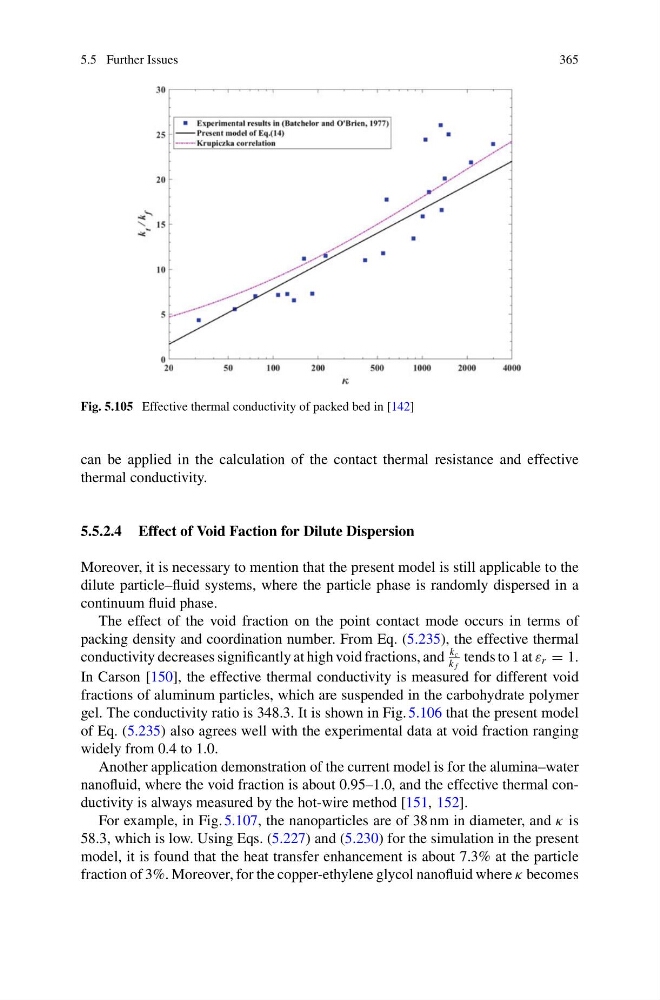
Fig. 5.105 Effective thermal conductivity of packed bed in [142]
can be applied in the calculation of the contact thermal resistance and effective
thermal conductivity.
5.5.2.4 Effect of Void Faction for Dilute Dispersion
Moreover, it is necessary to mention that the present model is still applicable to the
dilute particle–fluid systems, where the particle phase is randomly dispersed in a
continuum fluid phase.
The effect of the void fraction on the point contact mode occurs in terms of
packing density and coordination number. From Eq. (5.235), the effective thermal
conductivity decreases significantly at high void fractions, and
k c
k f
tends to 1 at ε r = 1.
In Carson [150], the effective thermal conductivity is measured for different void
fractions of aluminum particles, which are suspended in the carbohydrate polymer
gel. The conductivity ratio is 348.3. It is shown in Fig. 5.106 that the present model
of Eq. (5.235) also agrees well with the experimental data at void fraction ranging
widely from 0.4 to 1.0.
Another application demonstration of the current model is for the alumina–water
nanofluid, where the void fraction is about 0.95–1.0, and the effective thermal conductivity is always measured by the hot-wire method [151, 152].
For example, in Fig. 5.107, the nanoparticles are of 38 nm in diameter, and κ is
58.3, which is low. Using Eqs. (5.227) and (5.230) for the simulation in the present
model, it is found that the heat transfer enhancement is about 7.3% at the particle
fraction of 3%. Moreover, for the copper-ethylene glycol nanofluid where κ becomes
365
Fig. 5.105 Effective thermal conductivity of packed bed in [142]
can be applied in the calculation of the contact thermal resistance and effective
thermal conductivity.
5.5.2.4 Effect of Void Faction for Dilute Dispersion
Moreover, it is necessary to mention that the present model is still applicable to the
dilute particle–fluid systems, where the particle phase is randomly dispersed in a
continuum fluid phase.
The effect of the void fraction on the point contact mode occurs in terms of
packing density and coordination number. From Eq. (5.235), the effective thermal
conductivity decreases significantly at high void fractions, and
k c
k f
tends to 1 at ε r = 1.
In Carson [150], the effective thermal conductivity is measured for different void
fractions of aluminum particles, which are suspended in the carbohydrate polymer
gel. The conductivity ratio is 348.3. It is shown in Fig. 5.106 that the present model
of Eq. (5.235) also agrees well with the experimental data at void fraction ranging
widely from 0.4 to 1.0.
Another application demonstration of the current model is for the alumina–water
nanofluid, where the void fraction is about 0.95–1.0, and the effective thermal conductivity is always measured by the hot-wire method [151, 152].
For example, in Fig. 5.107, the nanoparticles are of 38 nm in diameter, and κ is
58.3, which is low. Using Eqs. (5.227) and (5.230) for the simulation in the present
model, it is found that the heat transfer enhancement is about 7.3% at the particle
fraction of 3%. Moreover, for the copper-ethylene glycol nanofluid where κ becomes