

5.5 Further Issues
363
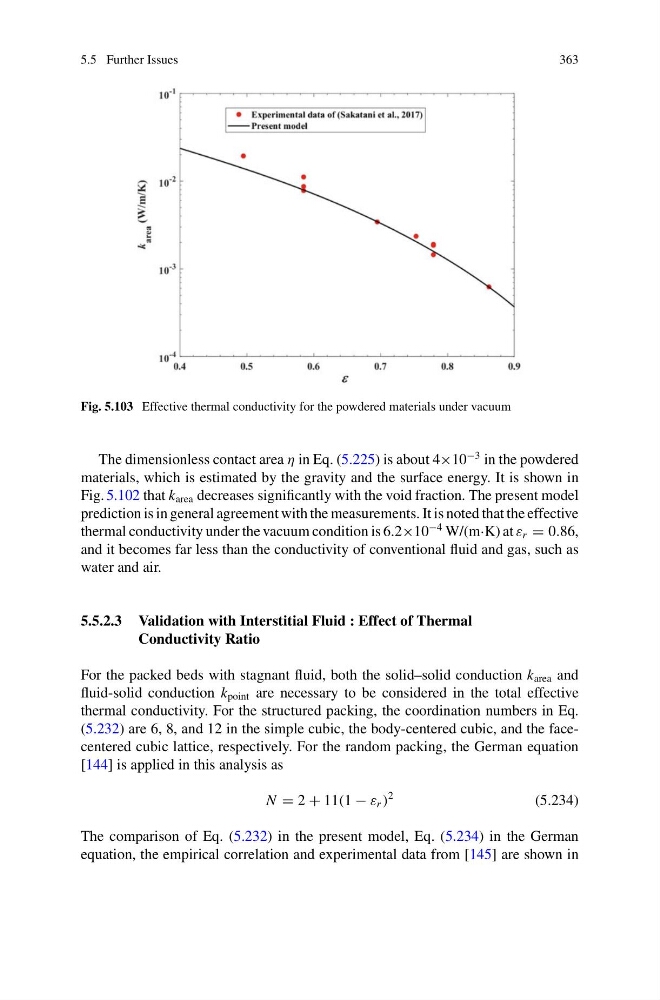
Fig. 5.103 Effective thermal conductivity for the powdered materials under vacuum
The dimensionless contact area η in Eq. (5.225) is about 4×10
−3 in the powdered
materials, which is estimated by the gravity and the surface energy. It is shown in
Fig. 5.102 that k area decreases significantly with the void fraction. The present model
prediction is in general agreement with the measurements. It is noted that the effective
thermal conductivity under the vacuum condition is 6.2×10
−4 W/(m·K) at ε r = 0.86,
and it becomes far less than the conductivity of conventional fluid and gas, such as
water and air.
5.5.2.3 Validation with Interstitial Fluid : Effect of Thermal
Conductivity Ratio
For the packed beds with stagnant fluid, both the solid–solid conduction k area and
fluid-solid conduction k point are necessary to be considered in the total effective
thermal conductivity. For the structured packing, the coordination numbers in Eq.
(5.232) are 6, 8, and 12 in the simple cubic, the body-centered cubic, and the facecentered cubic lattice, respectively. For the random packing, the German equation
[144] is applied in this analysis as
N = 2 + 11(1 − ε r )
2
(5.234)
The comparison of Eq. (5.232) in the present model, Eq. (5.234) in the German
equation, the empirical correlation and experimental data from [145] are shown in
363
Fig. 5.103 Effective thermal conductivity for the powdered materials under vacuum
The dimensionless contact area η in Eq. (5.225) is about 4×10
−3 in the powdered
materials, which is estimated by the gravity and the surface energy. It is shown in
Fig. 5.102 that k area decreases significantly with the void fraction. The present model
prediction is in general agreement with the measurements. It is noted that the effective
thermal conductivity under the vacuum condition is 6.2×10
−4 W/(m·K) at ε r = 0.86,
and it becomes far less than the conductivity of conventional fluid and gas, such as
water and air.
5.5.2.3 Validation with Interstitial Fluid : Effect of Thermal
Conductivity Ratio
For the packed beds with stagnant fluid, both the solid–solid conduction k area and
fluid-solid conduction k point are necessary to be considered in the total effective
thermal conductivity. For the structured packing, the coordination numbers in Eq.
(5.232) are 6, 8, and 12 in the simple cubic, the body-centered cubic, and the facecentered cubic lattice, respectively. For the random packing, the German equation
[144] is applied in this analysis as
N = 2 + 11(1 − ε r )
2
(5.234)
The comparison of Eq. (5.232) in the present model, Eq. (5.234) in the German
equation, the empirical correlation and experimental data from [145] are shown in