

348
5 Numerical Models for Pebble-Bed Heat Transfer
Q
r
i j =
J i − J j
R i j
=
E b,i − E b, j
1
A i X i j
= AX i j σ (T
4
i − T
4
j ),
(5.193)
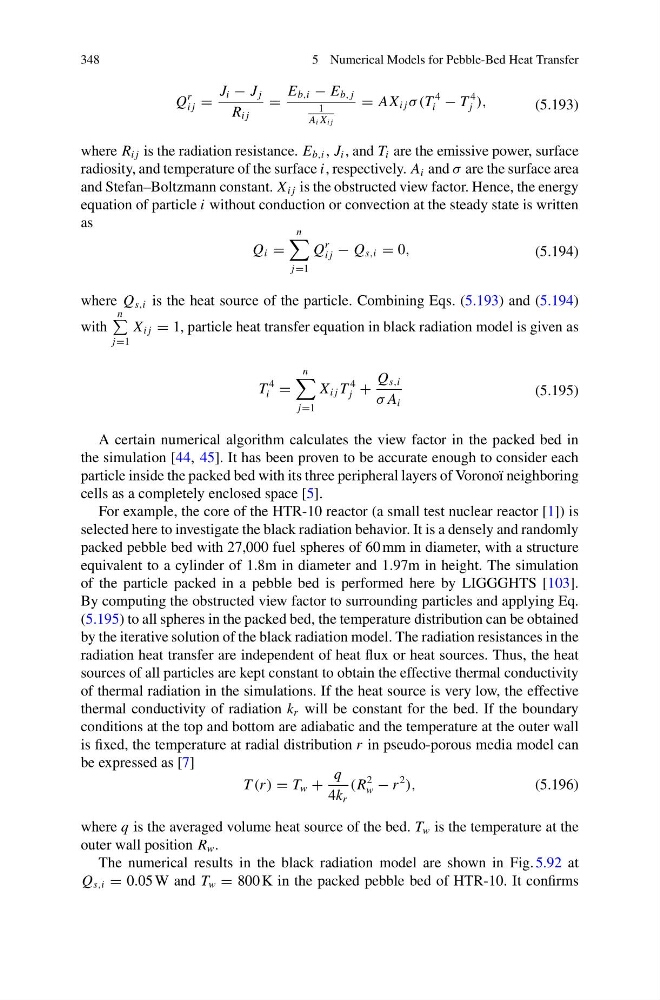
where R i j is the radiation resistance. E b,i , J i , and T i are the emissive power, surface
radiosity, and temperature of the surface i, respectively. A i and σ are the surface area
and Stefan–Boltzmann constant. X i j is the obstructed view factor. Hence, the energy
equation of particle i without conduction or convection at the steady state is written
as
Q i =
n
j=1
Q
r
i j − Q s,i = 0,
(5.194)
where Q s,i is the heat source of the particle. Combining Eqs. (5.193) and (5.194)
with
n
j=1
X i j = 1, particle heat transfer equation in black radiation model is given as
T
4
i =
n
j=1
X i j T
4
j +
Q s,i
σ A i
(5.195)
A certain numerical algorithm calculates the view factor in the packed bed in
the simulation [44, 45]. It has been proven to be accurate enough to consider each
particle inside the packed bed with its three peripheral layers of Voronoï neighboring
cells as a completely enclosed space [5].
For example, the core of the HTR-10 reactor (a small test nuclear reactor [1]) is
selected here to investigate the black radiation behavior. It is a densely and randomly
packed pebble bed with 27,000 fuel spheres of 60 mm in diameter, with a structure
equivalent to a cylinder of 1.8m in diameter and 1.97m in height. The simulation
of the particle packed in a pebble bed is performed here by LIGGGHTS [103].
By computing the obstructed view factor to surrounding particles and applying Eq.
(5.195) to all spheres in the packed bed, the temperature distribution can be obtained
by the iterative solution of the black radiation model. The radiation resistances in the
radiation heat transfer are independent of heat flux or heat sources. Thus, the heat
sources of all particles are kept constant to obtain the effective thermal conductivity
of thermal radiation in the simulations. If the heat source is very low, the effective
thermal conductivity of radiation k r will be constant for the bed. If the boundary
conditions at the top and bottom are adiabatic and the temperature at the outer wall
is fixed, the temperature at radial distribution r in pseudo-porous media model can
be expressed as [7]
T (r ) = T w +
q
4k r
(R
2
w − r
2
),
(5.196)
where q is the averaged volume heat source of the bed. T w is the temperature at the
outer wall position R w .
The numerical results in the black radiation model are shown in Fig. 5.92 at
Q s,i = 0.05 W and T w = 800 K in the packed pebble bed of HTR-10. It confirms
5 Numerical Models for Pebble-Bed Heat Transfer
Q
r
i j =
J i − J j
R i j
=
E b,i − E b, j
1
A i X i j
= AX i j σ (T
4
i − T
4
j ),
(5.193)
where R i j is the radiation resistance. E b,i , J i , and T i are the emissive power, surface
radiosity, and temperature of the surface i, respectively. A i and σ are the surface area
and Stefan–Boltzmann constant. X i j is the obstructed view factor. Hence, the energy
equation of particle i without conduction or convection at the steady state is written
as
Q i =
n
j=1
Q
r
i j − Q s,i = 0,
(5.194)
where Q s,i is the heat source of the particle. Combining Eqs. (5.193) and (5.194)
with
n
j=1
X i j = 1, particle heat transfer equation in black radiation model is given as
T
4
i =
n
j=1
X i j T
4
j +
Q s,i
σ A i
(5.195)
A certain numerical algorithm calculates the view factor in the packed bed in
the simulation [44, 45]. It has been proven to be accurate enough to consider each
particle inside the packed bed with its three peripheral layers of Voronoï neighboring
cells as a completely enclosed space [5].
For example, the core of the HTR-10 reactor (a small test nuclear reactor [1]) is
selected here to investigate the black radiation behavior. It is a densely and randomly
packed pebble bed with 27,000 fuel spheres of 60 mm in diameter, with a structure
equivalent to a cylinder of 1.8m in diameter and 1.97m in height. The simulation
of the particle packed in a pebble bed is performed here by LIGGGHTS [103].
By computing the obstructed view factor to surrounding particles and applying Eq.
(5.195) to all spheres in the packed bed, the temperature distribution can be obtained
by the iterative solution of the black radiation model. The radiation resistances in the
radiation heat transfer are independent of heat flux or heat sources. Thus, the heat
sources of all particles are kept constant to obtain the effective thermal conductivity
of thermal radiation in the simulations. If the heat source is very low, the effective
thermal conductivity of radiation k r will be constant for the bed. If the boundary
conditions at the top and bottom are adiabatic and the temperature at the outer wall
is fixed, the temperature at radial distribution r in pseudo-porous media model can
be expressed as [7]
T (r ) = T w +
q
4k r
(R
2
w − r
2
),
(5.196)
where q is the averaged volume heat source of the bed. T w is the temperature at the
outer wall position R w .
The numerical results in the black radiation model are shown in Fig. 5.92 at
Q s,i = 0.05 W and T w = 800 K in the packed pebble bed of HTR-10. It confirms