

5.5 Further Issues
347
Table 5.5 List of models mentioned or proposed in this section
Full integral scale
Models
Proposed by
Emissivity
Scale
Black surface
model
Black radiation
model
This work
–
Particle scale
Gray surface
model
Two flux model
[4]
Independent
–
Asakuma
radiation model
[134]
Independent
–
Uniform
radiation model
This work
Independent
Particle scale
Local radiation
model
This work
dependent
Mesh scale
Particle scale
radiation model
This work
dependent
Particle scale
Partial integral scale (neighboring-Voronoi cutoff)
Short-range radiation model
[5]
Dependent
Particle scale
Sub-cell radiation model
[9]
Dependent
Particle scale
emissivity was handled correctly in the local radiation model without the uniform
assumption. Since the computation cost of the local radiation model in large-scale
granular systems was huge and not applicable to the CFD-DEM simulation, the
particle-scale radiation model was developed in this study to predict the radiation
flux in Discrete Element Method (DEM). It was shown that the effect of particle
emissivity was a separable term in the radiative heat transfer equation. The particlescale radiation model provided a good approximation of the local radiation model
and enabled the efficient prediction of radiative heat transfer in a densely packed
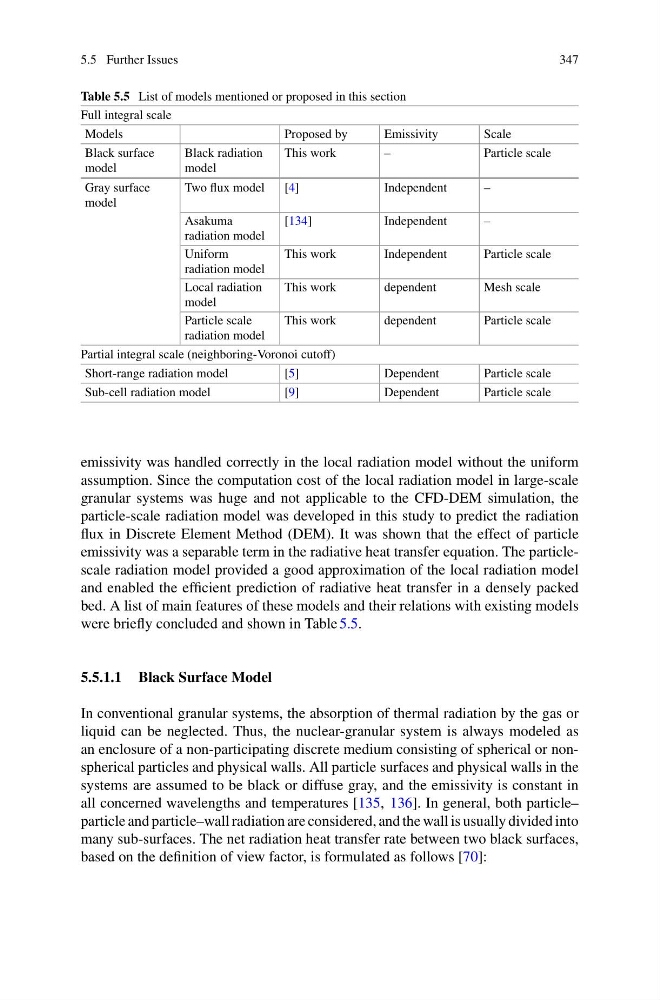
bed. A list of main features of these models and their relations with existing models
were briefly concluded and shown in Table 5.5.
5.5.1.1 Black Surface Model
In conventional granular systems, the absorption of thermal radiation by the gas or
liquid can be neglected. Thus, the nuclear-granular system is always modeled as
an enclosure of a non-participating discrete medium consisting of spherical or nonspherical particles and physical walls. All particle surfaces and physical walls in the
systems are assumed to be black or diffuse gray, and the emissivity is constant in
all concerned wavelengths and temperatures [135, 136]. In general, both particle–
particle and particle–wall radiation are considered, and the wall is usually divided into
many sub-surfaces. The net radiation heat transfer rate between two black surfaces,
based on the definition of view factor, is formulated as follows [70]:
347
Table 5.5 List of models mentioned or proposed in this section
Full integral scale
Models
Proposed by
Emissivity
Scale
Black surface
model
Black radiation
model
This work
–
Particle scale
Gray surface
model
Two flux model
[4]
Independent
–
Asakuma
radiation model
[134]
Independent
–
Uniform
radiation model
This work
Independent
Particle scale
Local radiation
model
This work
dependent
Mesh scale
Particle scale
radiation model
This work
dependent
Particle scale
Partial integral scale (neighboring-Voronoi cutoff)
Short-range radiation model
[5]
Dependent
Particle scale
Sub-cell radiation model
[9]
Dependent
Particle scale
emissivity was handled correctly in the local radiation model without the uniform
assumption. Since the computation cost of the local radiation model in large-scale
granular systems was huge and not applicable to the CFD-DEM simulation, the
particle-scale radiation model was developed in this study to predict the radiation
flux in Discrete Element Method (DEM). It was shown that the effect of particle
emissivity was a separable term in the radiative heat transfer equation. The particlescale radiation model provided a good approximation of the local radiation model
and enabled the efficient prediction of radiative heat transfer in a densely packed
bed. A list of main features of these models and their relations with existing models
were briefly concluded and shown in Table 5.5.
5.5.1.1 Black Surface Model
In conventional granular systems, the absorption of thermal radiation by the gas or
liquid can be neglected. Thus, the nuclear-granular system is always modeled as
an enclosure of a non-participating discrete medium consisting of spherical or nonspherical particles and physical walls. All particle surfaces and physical walls in the
systems are assumed to be black or diffuse gray, and the emissivity is constant in
all concerned wavelengths and temperatures [135, 136]. In general, both particle–
particle and particle–wall radiation are considered, and the wall is usually divided into
many sub-surfaces. The net radiation heat transfer rate between two black surfaces,
based on the definition of view factor, is formulated as follows [70]: