

344
5 Numerical Models for Pebble-Bed Heat Transfer
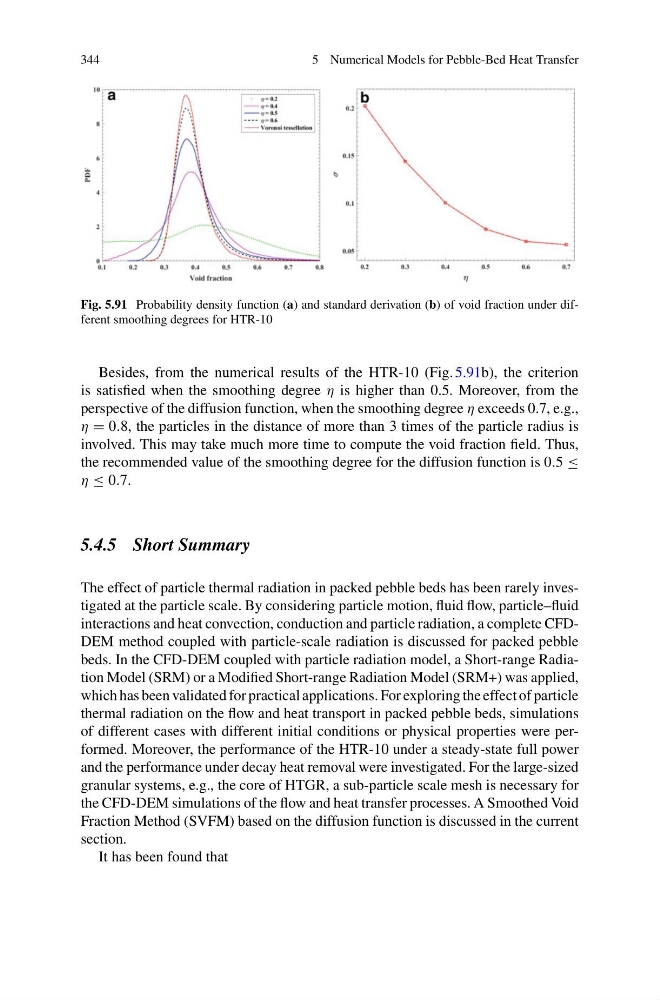
Fig. 5.91 Probability density function (a) and standard derivation (b) of void fraction under different smoothing degrees for HTR-10
Besides, from the numerical results of the HTR-10 (Fig. 5.91b), the criterion
is satisfied when the smoothing degree η is higher than 0.5. Moreover, from the
perspective of the diffusion function, when the smoothing degree η exceeds 0.7, e.g.,
η = 0.8, the particles in the distance of more than 3 times of the particle radius is
involved. This may take much more time to compute the void fraction field. Thus,
the recommended value of the smoothing degree for the diffusion function is 0.5 ≤
η ≤ 0.7.
5.4.5 Short Summary
The effect of particle thermal radiation in packed pebble beds has been rarely investigated at the particle scale. By considering particle motion, fluid flow, particle–fluid
interactions and heat convection, conduction and particle radiation, a complete CFDDEM method coupled with particle-scale radiation is discussed for packed pebble
beds. In the CFD-DEM coupled with particle radiation model, a Short-range Radiation Model (SRM) or a Modified Short-range Radiation Model (SRM+) was applied,
which has been validated for practical applications. For exploring the effect of particle
thermal radiation on the flow and heat transport in packed pebble beds, simulations
of different cases with different initial conditions or physical properties were performed. Moreover, the performance of the HTR-10 under a steady-state full power
and the performance under decay heat removal were investigated. For the large-sized
granular systems, e.g., the core of HTGR, a sub-particle scale mesh is necessary for
the CFD-DEM simulations of the flow and heat transfer processes. A Smoothed Void
Fraction Method (SVFM) based on the diffusion function is discussed in the current
section.
It has been found that
5 Numerical Models for Pebble-Bed Heat Transfer
Fig. 5.91 Probability density function (a) and standard derivation (b) of void fraction under different smoothing degrees for HTR-10
Besides, from the numerical results of the HTR-10 (Fig. 5.91b), the criterion
is satisfied when the smoothing degree η is higher than 0.5. Moreover, from the
perspective of the diffusion function, when the smoothing degree η exceeds 0.7, e.g.,
η = 0.8, the particles in the distance of more than 3 times of the particle radius is
involved. This may take much more time to compute the void fraction field. Thus,
the recommended value of the smoothing degree for the diffusion function is 0.5 ≤
η ≤ 0.7.
5.4.5 Short Summary
The effect of particle thermal radiation in packed pebble beds has been rarely investigated at the particle scale. By considering particle motion, fluid flow, particle–fluid
interactions and heat convection, conduction and particle radiation, a complete CFDDEM method coupled with particle-scale radiation is discussed for packed pebble
beds. In the CFD-DEM coupled with particle radiation model, a Short-range Radiation Model (SRM) or a Modified Short-range Radiation Model (SRM+) was applied,
which has been validated for practical applications. For exploring the effect of particle
thermal radiation on the flow and heat transport in packed pebble beds, simulations
of different cases with different initial conditions or physical properties were performed. Moreover, the performance of the HTR-10 under a steady-state full power
and the performance under decay heat removal were investigated. For the large-sized
granular systems, e.g., the core of HTGR, a sub-particle scale mesh is necessary for
the CFD-DEM simulations of the flow and heat transfer processes. A Smoothed Void
Fraction Method (SVFM) based on the diffusion function is discussed in the current
section.
It has been found that