

324
5 Numerical Models for Pebble-Bed Heat Transfer
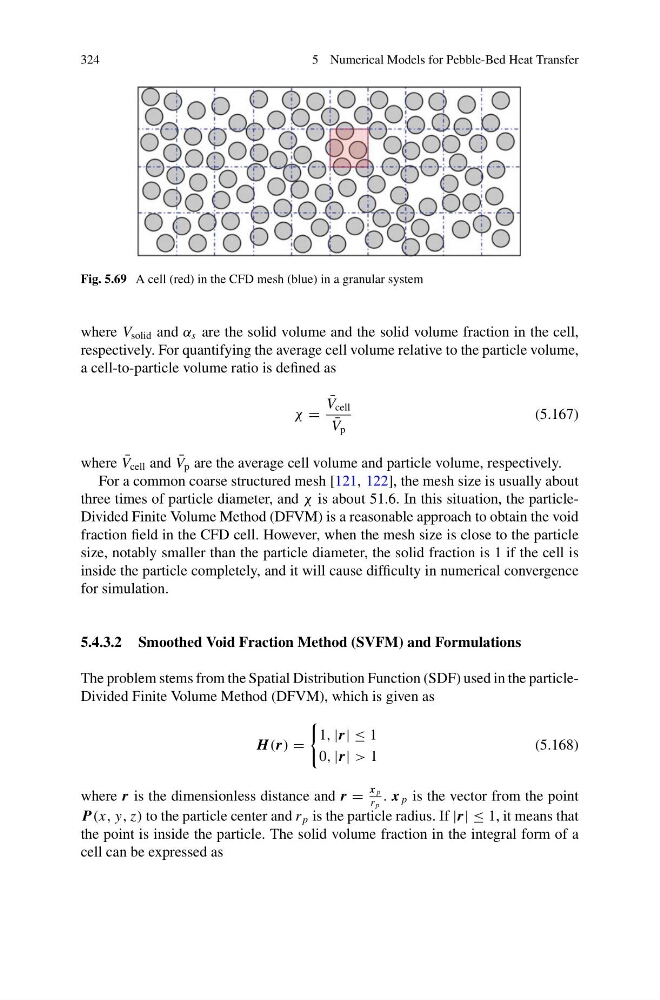
Fig. 5.69 A cell (red) in the CFD mesh (blue) in a granular system
where V solid and α s are the solid volume and the solid volume fraction in the cell,
respectively. For quantifying the average cell volume relative to the particle volume,
a cell-to-particle volume ratio is defined as
χ =
¯
V cell
¯
V p
(5.167)
where ¯
V cell and ¯
V p are the average cell volume and particle volume, respectively.
For a common coarse structured mesh [121, 122], the mesh size is usually about
three times of particle diameter, and χ is about 51.6. In this situation, the particleDivided Finite Volume Method (DFVM) is a reasonable approach to obtain the void
fraction field in the CFD cell. However, when the mesh size is close to the particle
size, notably smaller than the particle diameter, the solid fraction is 1 if the cell is
inside the particle completely, and it will cause difficulty in numerical convergence
for simulation.
5.4.3.2 Smoothed Void Fraction Method (SVFM) and Formulations
The problem stems from the Spatial Distribution Function (SDF) used in the particleDivided Finite Volume Method (DFVM), which is given as
H(r) =
1, |r| ≤ 1
0, |r| > 1
(5.168)
where r is the dimensionless distance and r =
x p
r p
. x p is the vector from the point
P(x, y, z) to the particle center and r p is the particle radius. If |r| ≤ 1, it means that
the point is inside the particle. The solid volume fraction in the integral form of a
cell can be expressed as
5 Numerical Models for Pebble-Bed Heat Transfer
Fig. 5.69 A cell (red) in the CFD mesh (blue) in a granular system
where V solid and α s are the solid volume and the solid volume fraction in the cell,
respectively. For quantifying the average cell volume relative to the particle volume,
a cell-to-particle volume ratio is defined as
χ =
¯
V cell
¯
V p
(5.167)
where ¯
V cell and ¯
V p are the average cell volume and particle volume, respectively.
For a common coarse structured mesh [121, 122], the mesh size is usually about
three times of particle diameter, and χ is about 51.6. In this situation, the particleDivided Finite Volume Method (DFVM) is a reasonable approach to obtain the void
fraction field in the CFD cell. However, when the mesh size is close to the particle
size, notably smaller than the particle diameter, the solid fraction is 1 if the cell is
inside the particle completely, and it will cause difficulty in numerical convergence
for simulation.
5.4.3.2 Smoothed Void Fraction Method (SVFM) and Formulations
The problem stems from the Spatial Distribution Function (SDF) used in the particleDivided Finite Volume Method (DFVM), which is given as
H(r) =
1, |r| ≤ 1
0, |r| > 1
(5.168)
where r is the dimensionless distance and r =
x p
r p
. x p is the vector from the point
P(x, y, z) to the particle center and r p is the particle radius. If |r| ≤ 1, it means that
the point is inside the particle. The solid volume fraction in the integral form of a
cell can be expressed as