

5.3 Discrete Modeling of Pebble Radiation
293
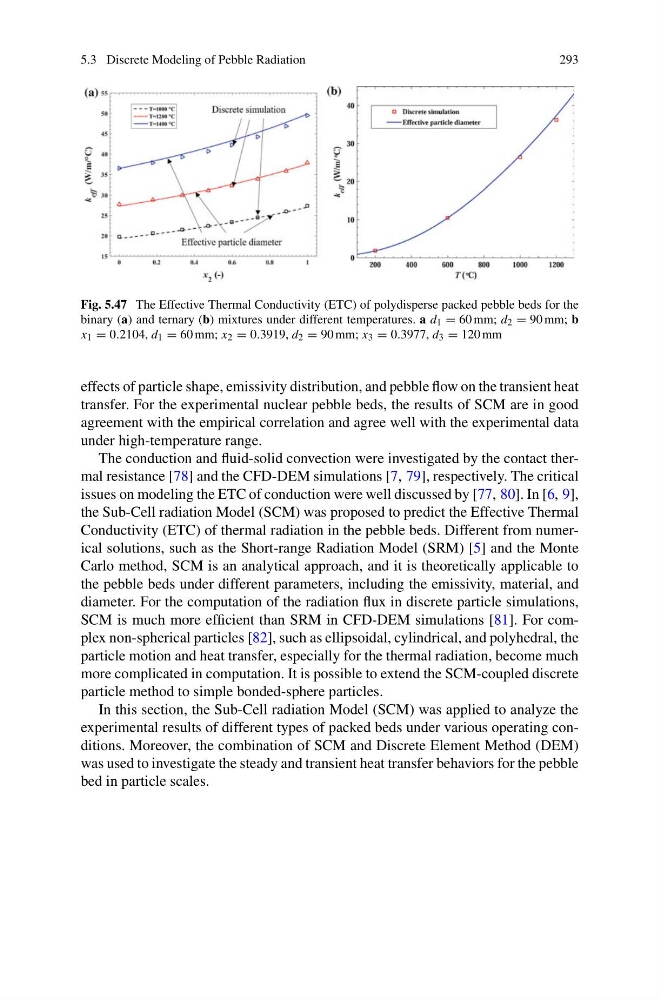
Fig. 5.47 The Effective Thermal Conductivity (ETC) of polydisperse packed pebble beds for the
binary (a) and ternary (b) mixtures under different temperatures. a d 1 = 60 mm; d 2 = 90 mm; b
x 1 = 0.2104, d 1 = 60 mm; x 2 = 0.3919, d 2 = 90 mm; x 3 = 0.3977, d 3 = 120 mm
effects of particle shape, emissivity distribution, and pebble flow on the transient heat
transfer. For the experimental nuclear pebble beds, the results of SCM are in good
agreement with the empirical correlation and agree well with the experimental data
under high-temperature range.
The conduction and fluid-solid convection were investigated by the contact thermal resistance [78] and the CFD-DEM simulations [7, 79], respectively. The critical
issues on modeling the ETC of conduction were well discussed by [77, 80]. In [6, 9],
the Sub-Cell radiation Model (SCM) was proposed to predict the Effective Thermal
Conductivity (ETC) of thermal radiation in the pebble beds. Different from numerical solutions, such as the Short-range Radiation Model (SRM) [5] and the Monte
Carlo method, SCM is an analytical approach, and it is theoretically applicable to
the pebble beds under different parameters, including the emissivity, material, and
diameter. For the computation of the radiation flux in discrete particle simulations,
SCM is much more efficient than SRM in CFD-DEM simulations [81]. For complex non-spherical particles [82], such as ellipsoidal, cylindrical, and polyhedral, the
particle motion and heat transfer, especially for the thermal radiation, become much
more complicated in computation. It is possible to extend the SCM-coupled discrete
particle method to simple bonded-sphere particles.
In this section, the Sub-Cell radiation Model (SCM) was applied to analyze the
experimental results of different types of packed beds under various operating conditions. Moreover, the combination of SCM and Discrete Element Method (DEM)
was used to investigate the steady and transient heat transfer behaviors for the pebble
bed in particle scales.
293
Fig. 5.47 The Effective Thermal Conductivity (ETC) of polydisperse packed pebble beds for the
binary (a) and ternary (b) mixtures under different temperatures. a d 1 = 60 mm; d 2 = 90 mm; b
x 1 = 0.2104, d 1 = 60 mm; x 2 = 0.3919, d 2 = 90 mm; x 3 = 0.3977, d 3 = 120 mm
effects of particle shape, emissivity distribution, and pebble flow on the transient heat
transfer. For the experimental nuclear pebble beds, the results of SCM are in good
agreement with the empirical correlation and agree well with the experimental data
under high-temperature range.
The conduction and fluid-solid convection were investigated by the contact thermal resistance [78] and the CFD-DEM simulations [7, 79], respectively. The critical
issues on modeling the ETC of conduction were well discussed by [77, 80]. In [6, 9],
the Sub-Cell radiation Model (SCM) was proposed to predict the Effective Thermal
Conductivity (ETC) of thermal radiation in the pebble beds. Different from numerical solutions, such as the Short-range Radiation Model (SRM) [5] and the Monte
Carlo method, SCM is an analytical approach, and it is theoretically applicable to
the pebble beds under different parameters, including the emissivity, material, and
diameter. For the computation of the radiation flux in discrete particle simulations,
SCM is much more efficient than SRM in CFD-DEM simulations [81]. For complex non-spherical particles [82], such as ellipsoidal, cylindrical, and polyhedral, the
particle motion and heat transfer, especially for the thermal radiation, become much
more complicated in computation. It is possible to extend the SCM-coupled discrete
particle method to simple bonded-sphere particles.
In this section, the Sub-Cell radiation Model (SCM) was applied to analyze the
experimental results of different types of packed beds under various operating conditions. Moreover, the combination of SCM and Discrete Element Method (DEM)
was used to investigate the steady and transient heat transfer behaviors for the pebble
bed in particle scales.