

292
5 Numerical Models for Pebble-Bed Heat Transfer
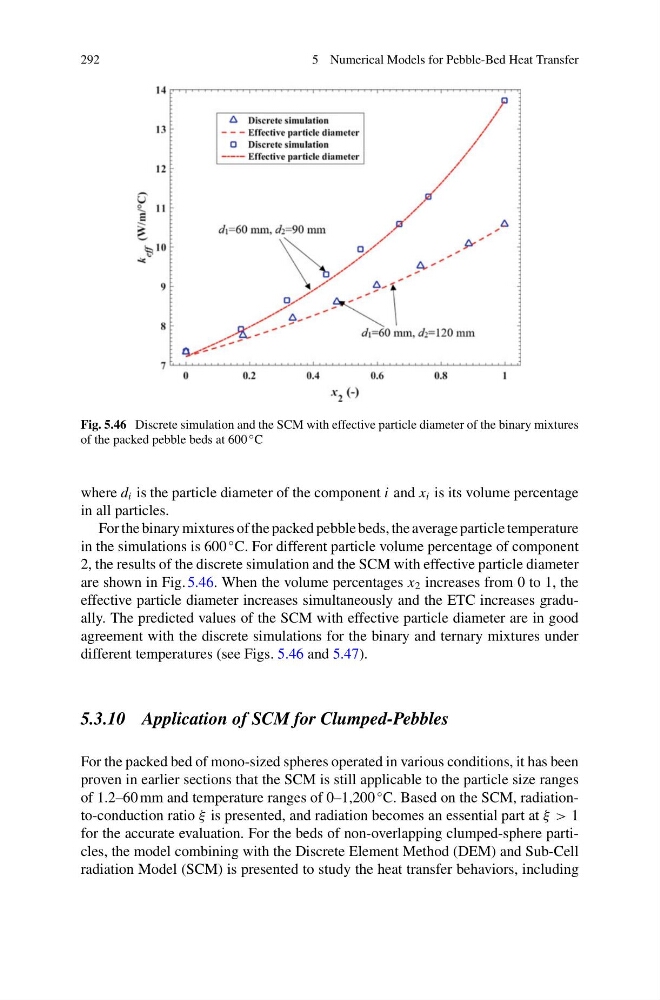
Fig. 5.46 Discrete simulation and the SCM with effective particle diameter of the binary mixtures
of the packed pebble beds at 600 ◦ C
where d i is the particle diameter of the component i and x i is its volume percentage
in all particles.
For the binary mixtures of the packed pebble beds, the average particle temperature
in the simulations is 600
◦ C. For different particle volume percentage of component
2, the results of the discrete simulation and the SCM with effective particle diameter
are shown in Fig. 5.46. When the volume percentages x 2 increases from 0 to 1, the
effective particle diameter increases simultaneously and the ETC increases gradually. The predicted values of the SCM with effective particle diameter are in good
agreement with the discrete simulations for the binary and ternary mixtures under
different temperatures (see Figs. 5.46 and 5.47).
5.3.10 Application of SCM for Clumped-Pebbles
For the packed bed of mono-sized spheres operated in various conditions, it has been
proven in earlier sections that the SCM is still applicable to the particle size ranges
of 1.2–60 mm and temperature ranges of 0–1,200
◦ C. Based on the SCM, radiationto-conduction ratio ξ is presented, and radiation becomes an essential part at ξ > 1
for the accurate evaluation. For the beds of non-overlapping clumped-sphere particles, the model combining with the Discrete Element Method (DEM) and Sub-Cell
radiation Model (SCM) is presented to study the heat transfer behaviors, including
5 Numerical Models for Pebble-Bed Heat Transfer
Fig. 5.46 Discrete simulation and the SCM with effective particle diameter of the binary mixtures
of the packed pebble beds at 600 ◦ C
where d i is the particle diameter of the component i and x i is its volume percentage
in all particles.
For the binary mixtures of the packed pebble beds, the average particle temperature
in the simulations is 600
◦ C. For different particle volume percentage of component
2, the results of the discrete simulation and the SCM with effective particle diameter
are shown in Fig. 5.46. When the volume percentages x 2 increases from 0 to 1, the
effective particle diameter increases simultaneously and the ETC increases gradually. The predicted values of the SCM with effective particle diameter are in good
agreement with the discrete simulations for the binary and ternary mixtures under
different temperatures (see Figs. 5.46 and 5.47).
5.3.10 Application of SCM for Clumped-Pebbles
For the packed bed of mono-sized spheres operated in various conditions, it has been
proven in earlier sections that the SCM is still applicable to the particle size ranges
of 1.2–60 mm and temperature ranges of 0–1,200
◦ C. Based on the SCM, radiationto-conduction ratio ξ is presented, and radiation becomes an essential part at ξ > 1
for the accurate evaluation. For the beds of non-overlapping clumped-sphere particles, the model combining with the Discrete Element Method (DEM) and Sub-Cell
radiation Model (SCM) is presented to study the heat transfer behaviors, including