

288
5 Numerical Models for Pebble-Bed Heat Transfer
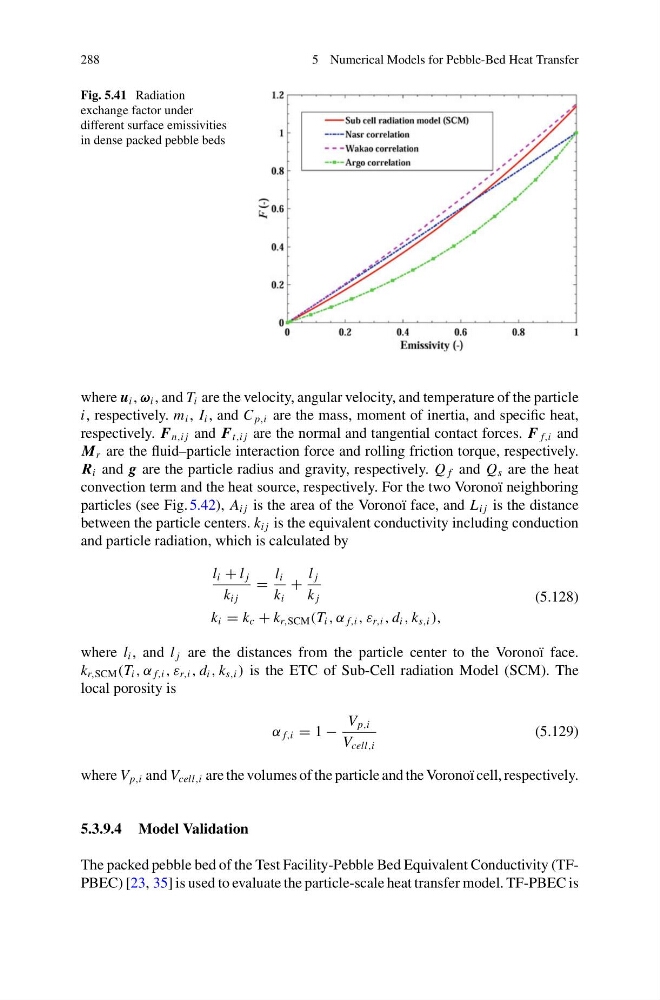
Fig. 5.41 Radiation
exchange factor under
different surface emissivities
in dense packed pebble beds
where u i , ω i , and T i are the velocity, angular velocity, and temperature of the particle
i, respectively. m i , I i , and C p,i are the mass, moment of inertia, and specific heat,
respectively. F n,i j and F t,i j are the normal and tangential contact forces. F f,i and
M r are the fluid–particle interaction force and rolling friction torque, respectively.
R i and g are the particle radius and gravity, respectively. Q f and Q s are the heat
convection term and the heat source, respectively. For the two Voronoï neighboring
particles (see Fig. 5.42), A i j is the area of the Voronoï face, and L i j is the distance
between the particle centers. k i j is the equivalent conductivity including conduction
and particle radiation, which is calculated by
l i + l j
k i j
=
l i
k i
+
l j
k j
k i = k c + k r,SCM (T i , α f,i , ε r,i , d i , k s,i ),
(5.128)
where l i , and l j are the distances from the particle center to the Voronoï face.
k r,SCM (T i , α f,i , ε r,i , d i , k s,i ) is the ETC of Sub-Cell radiation Model (SCM). The
local porosity is
α f,i = 1 −
V p,i
V cell,i
(5.129)
where V p,i and V cell,i are the volumes of the particle and the Voronoï cell, respectively.
5.3.9.4 Model Validation
The packed pebble bed of the Test Facility-Pebble Bed Equivalent Conductivity (TFPBEC) [23, 35] is used to evaluate the particle-scale heat transfer model. TF-PBEC is
5 Numerical Models for Pebble-Bed Heat Transfer
Fig. 5.41 Radiation
exchange factor under
different surface emissivities
in dense packed pebble beds
where u i , ω i , and T i are the velocity, angular velocity, and temperature of the particle
i, respectively. m i , I i , and C p,i are the mass, moment of inertia, and specific heat,
respectively. F n,i j and F t,i j are the normal and tangential contact forces. F f,i and
M r are the fluid–particle interaction force and rolling friction torque, respectively.
R i and g are the particle radius and gravity, respectively. Q f and Q s are the heat
convection term and the heat source, respectively. For the two Voronoï neighboring
particles (see Fig. 5.42), A i j is the area of the Voronoï face, and L i j is the distance
between the particle centers. k i j is the equivalent conductivity including conduction
and particle radiation, which is calculated by
l i + l j
k i j
=
l i
k i
+
l j
k j
k i = k c + k r,SCM (T i , α f,i , ε r,i , d i , k s,i ),
(5.128)
where l i , and l j are the distances from the particle center to the Voronoï face.
k r,SCM (T i , α f,i , ε r,i , d i , k s,i ) is the ETC of Sub-Cell radiation Model (SCM). The
local porosity is
α f,i = 1 −
V p,i
V cell,i
(5.129)
where V p,i and V cell,i are the volumes of the particle and the Voronoï cell, respectively.
5.3.9.4 Model Validation
The packed pebble bed of the Test Facility-Pebble Bed Equivalent Conductivity (TFPBEC) [23, 35] is used to evaluate the particle-scale heat transfer model. TF-PBEC is