

5.3 Discrete Modeling of Pebble Radiation
285
α f,∞ =
2.14ξ 2 − 2.35ξ + 1, ξ ≤ 0.637
α f,∞ + 0.29 exp(−0.6ξ) cos(2.3π(ξ − 0.16)) + 0.15 exp(−0.9ξ), ξ > 0.637.
(5.120)
The packed pebble bed of the HTTU experiment [21] is chosen to investigate the
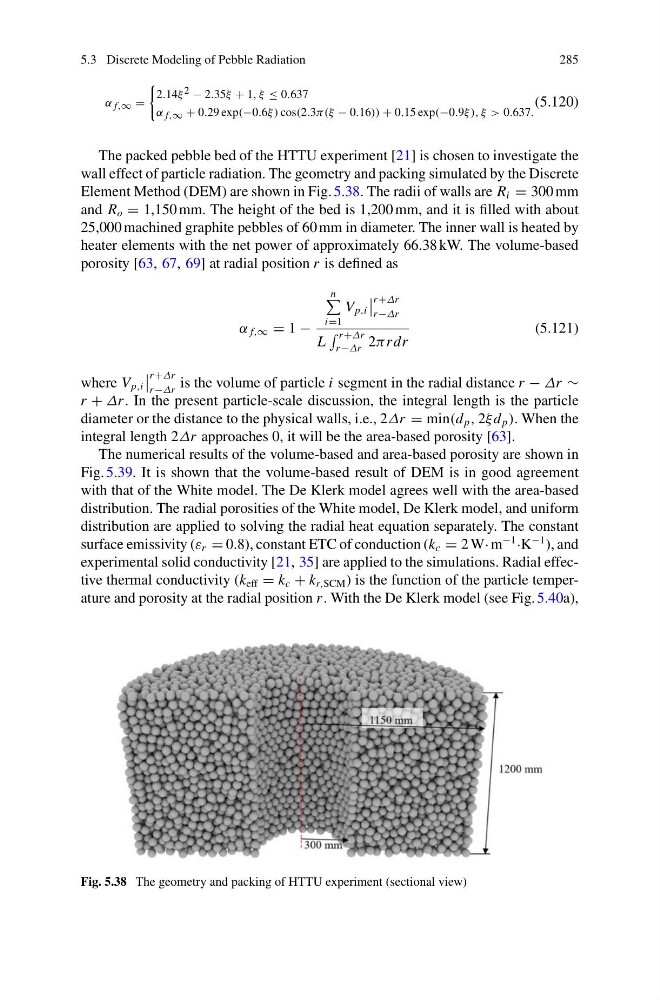
wall effect of particle radiation. The geometry and packing simulated by the Discrete
Element Method (DEM) are shown in Fig. 5.38. The radii of walls are R i = 300 mm
and R o = 1,150 mm. The height of the bed is 1,200 mm, and it is filled with about
25,000 machined graphite pebbles of 60 mm in diameter. The inner wall is heated by
heater elements with the net power of approximately 66.38 kW. The volume-based
porosity [63, 67, 69] at radial position r is defined as
α f,∞ = 1 −
n
i=1
V p,i
r +Δr
r −Δr
L
r +Δr
r −Δr 2πrdr
(5.121)
where V p,i
r +Δr
r −Δr
is the volume of particle i segment in the radial distance r − Δr ∼
r + Δr . In the present particle-scale discussion, the integral length is the particle
diameter or the distance to the physical walls, i.e., 2Δr = min(d p , 2ξ d p ). When the
integral length 2Δr approaches 0, it will be the area-based porosity [63].
The numerical results of the volume-based and area-based porosity are shown in
Fig. 5.39. It is shown that the volume-based result of DEM is in good agreement
with that of the White model. The De Klerk model agrees well with the area-based
distribution. The radial porosities of the White model, De Klerk model, and uniform
distribution are applied to solving the radial heat equation separately. The constant
surface emissivity (ε r = 0.8), constant ETC of conduction (k c = 2 W· m
−1
·K
−1 ), and
experimental solid conductivity [21, 35] are applied to the simulations. Radial effective thermal conductivity (k eff = k c + k r,SCM ) is the function of the particle temperature and porosity at the radial position r . With the De Klerk model (see Fig. 5.40a),
Fig. 5.38 The geometry and packing of HTTU experiment (sectional view)
285
α f,∞ =
2.14ξ 2 − 2.35ξ + 1, ξ ≤ 0.637
α f,∞ + 0.29 exp(−0.6ξ) cos(2.3π(ξ − 0.16)) + 0.15 exp(−0.9ξ), ξ > 0.637.
(5.120)
The packed pebble bed of the HTTU experiment [21] is chosen to investigate the
wall effect of particle radiation. The geometry and packing simulated by the Discrete
Element Method (DEM) are shown in Fig. 5.38. The radii of walls are R i = 300 mm
and R o = 1,150 mm. The height of the bed is 1,200 mm, and it is filled with about
25,000 machined graphite pebbles of 60 mm in diameter. The inner wall is heated by
heater elements with the net power of approximately 66.38 kW. The volume-based
porosity [63, 67, 69] at radial position r is defined as
α f,∞ = 1 −
n
i=1
V p,i
r +Δr
r −Δr
L
r +Δr
r −Δr 2πrdr
(5.121)
where V p,i
r +Δr
r −Δr
is the volume of particle i segment in the radial distance r − Δr ∼
r + Δr . In the present particle-scale discussion, the integral length is the particle
diameter or the distance to the physical walls, i.e., 2Δr = min(d p , 2ξ d p ). When the
integral length 2Δr approaches 0, it will be the area-based porosity [63].
The numerical results of the volume-based and area-based porosity are shown in
Fig. 5.39. It is shown that the volume-based result of DEM is in good agreement
with that of the White model. The De Klerk model agrees well with the area-based
distribution. The radial porosities of the White model, De Klerk model, and uniform
distribution are applied to solving the radial heat equation separately. The constant
surface emissivity (ε r = 0.8), constant ETC of conduction (k c = 2 W· m
−1
·K
−1 ), and
experimental solid conductivity [21, 35] are applied to the simulations. Radial effective thermal conductivity (k eff = k c + k r,SCM ) is the function of the particle temperature and porosity at the radial position r . With the De Klerk model (see Fig. 5.40a),
Fig. 5.38 The geometry and packing of HTTU experiment (sectional view)