

284
5 Numerical Models for Pebble-Bed Heat Transfer
nuclear reactors [1, 2, 58] and the related experimental facilities [21, 35, 59], the
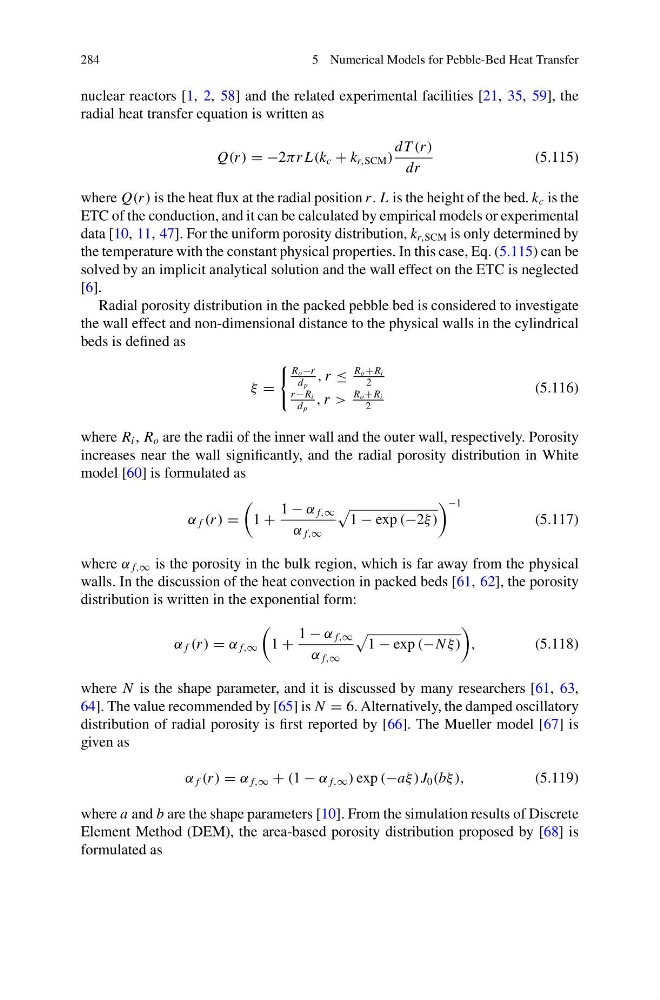
radial heat transfer equation is written as
Q(r ) = −2πr L(k c + k r,SCM )
dT (r )
dr
(5.115)
where Q(r ) is the heat flux at the radial position r . L is the height of the bed. k c is the
ETC of the conduction, and it can be calculated by empirical models or experimental
data [10, 11, 47]. For the uniform porosity distribution, k r,SCM is only determined by
the temperature with the constant physical properties. In this case, Eq. (5.115) can be
solved by an implicit analytical solution and the wall effect on the ETC is neglected
[6].
Radial porosity distribution in the packed pebble bed is considered to investigate
the wall effect and non-dimensional distance to the physical walls in the cylindrical
beds is defined as
ξ =
R o −r
d p
, r ≤
R o +R i
2
r −R i
d p
, r >
R o +R i
2
(5.116)
where R i , R o are the radii of the inner wall and the outer wall, respectively. Porosity
increases near the wall significantly, and the radial porosity distribution in White
model [60] is formulated as
α f (r ) =
1 +
1 − α f,∞
α f,∞
1 − exp (−2ξ)
−1
(5.117)
where α f,∞ is the porosity in the bulk region, which is far away from the physical
walls. In the discussion of the heat convection in packed beds [61, 62], the porosity
distribution is written in the exponential form:
α f (r ) = α f,∞
1 +
1 − α f,∞
α f,∞
1 − exp (−N ξ)
,
(5.118)
where N is the shape parameter, and it is discussed by many researchers [61, 63,
64]. The value recommended by [65] is N = 6. Alternatively, the damped oscillatory
distribution of radial porosity is first reported by [66]. The Mueller model [67] is
given as
α f (r ) = α f,∞ + (1 − α f,∞ ) exp (−aξ)J 0 (bξ),
(5.119)
where a and b are the shape parameters [10]. From the simulation results of Discrete
Element Method (DEM), the area-based porosity distribution proposed by [68] is
formulated as
5 Numerical Models for Pebble-Bed Heat Transfer
nuclear reactors [1, 2, 58] and the related experimental facilities [21, 35, 59], the
radial heat transfer equation is written as
Q(r ) = −2πr L(k c + k r,SCM )
dT (r )
dr
(5.115)
where Q(r ) is the heat flux at the radial position r . L is the height of the bed. k c is the
ETC of the conduction, and it can be calculated by empirical models or experimental
data [10, 11, 47]. For the uniform porosity distribution, k r,SCM is only determined by
the temperature with the constant physical properties. In this case, Eq. (5.115) can be
solved by an implicit analytical solution and the wall effect on the ETC is neglected
[6].
Radial porosity distribution in the packed pebble bed is considered to investigate
the wall effect and non-dimensional distance to the physical walls in the cylindrical
beds is defined as
ξ =
R o −r
d p
, r ≤
R o +R i
2
r −R i
d p
, r >
R o +R i
2
(5.116)
where R i , R o are the radii of the inner wall and the outer wall, respectively. Porosity
increases near the wall significantly, and the radial porosity distribution in White
model [60] is formulated as
α f (r ) =
1 +
1 − α f,∞
α f,∞
1 − exp (−2ξ)
−1
(5.117)
where α f,∞ is the porosity in the bulk region, which is far away from the physical
walls. In the discussion of the heat convection in packed beds [61, 62], the porosity
distribution is written in the exponential form:
α f (r ) = α f,∞
1 +
1 − α f,∞
α f,∞
1 − exp (−N ξ)
,
(5.118)
where N is the shape parameter, and it is discussed by many researchers [61, 63,
64]. The value recommended by [65] is N = 6. Alternatively, the damped oscillatory
distribution of radial porosity is first reported by [66]. The Mueller model [67] is
given as
α f (r ) = α f,∞ + (1 − α f,∞ ) exp (−aξ)J 0 (bξ),
(5.119)
where a and b are the shape parameters [10]. From the simulation results of Discrete
Element Method (DEM), the area-based porosity distribution proposed by [68] is
formulated as