

5.3 Discrete Modeling of Pebble Radiation
279
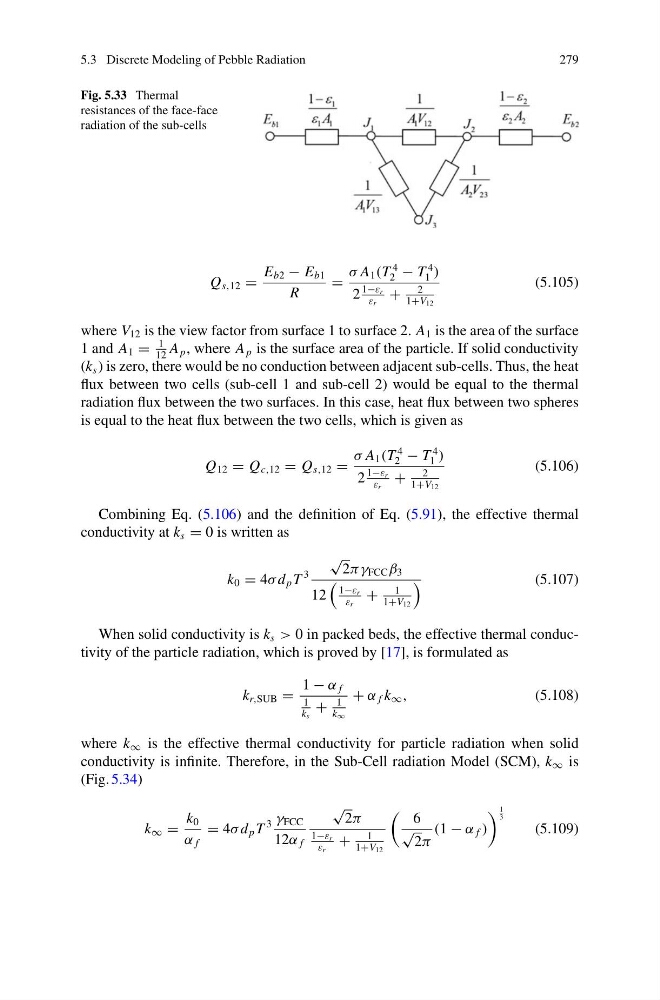
Fig. 5.33 Thermal
resistances of the face-face
radiation of the sub-cells
Q s,12 =
E b2 − E b1
R
=
σ A 1 (T
4
2 − T
4
1 )
2
1−ε r
ε r
+
2
1+V 12
(5.105)
where V 12 is the view factor from surface 1 to surface 2. A 1 is the area of the surface
1 and A 1 =
1
12
A p , where A p is the surface area of the particle. If solid conductivity
(k s ) is zero, there would be no conduction between adjacent sub-cells. Thus, the heat
flux between two cells (sub-cell 1 and sub-cell 2) would be equal to the thermal
radiation flux between the two surfaces. In this case, heat flux between two spheres
is equal to the heat flux between the two cells, which is given as
Q 12 = Q c,12 = Q s,12 =
σ A 1 (T
4
2 − T
4
1 )
2
1−ε r
ε r
+
2
1+V 12
(5.106)
Combining Eq. (5.106) and the definition of Eq. (5.91), the effective thermal
conductivity at k s = 0 is written as
k 0 = 4σ d p T
3
√
2πγ FCC β 3
12
1−ε r
ε r
+
1
1+V 12
(5.107)
When solid conductivity is k s > 0 in packed beds, the effective thermal conductivity of the particle radiation, which is proved by [17], is formulated as
k r,SUB =
1 − α f
1
k s
+
1
k ∞
+ α f k ∞ ,
(5.108)
where k ∞ is the effective thermal conductivity for particle radiation when solid
conductivity is infinite. Therefore, in the Sub-Cell radiation Model (SCM), k ∞ is
(Fig. 5.34)
k ∞ =
k 0
α f
= 4σ d p T
3 γ FCC
12α f
√
2π
1−ε r
ε r
+
1
1+V 12
6
√
2π
(1 − α f )
1
3
(5.109)
279
Fig. 5.33 Thermal
resistances of the face-face
radiation of the sub-cells
Q s,12 =
E b2 − E b1
R
=
σ A 1 (T
4
2 − T
4
1 )
2
1−ε r
ε r
+
2
1+V 12
(5.105)
where V 12 is the view factor from surface 1 to surface 2. A 1 is the area of the surface
1 and A 1 =
1
12
A p , where A p is the surface area of the particle. If solid conductivity
(k s ) is zero, there would be no conduction between adjacent sub-cells. Thus, the heat
flux between two cells (sub-cell 1 and sub-cell 2) would be equal to the thermal
radiation flux between the two surfaces. In this case, heat flux between two spheres
is equal to the heat flux between the two cells, which is given as
Q 12 = Q c,12 = Q s,12 =
σ A 1 (T
4
2 − T
4
1 )
2
1−ε r
ε r
+
2
1+V 12
(5.106)
Combining Eq. (5.106) and the definition of Eq. (5.91), the effective thermal
conductivity at k s = 0 is written as
k 0 = 4σ d p T
3
√
2πγ FCC β 3
12
1−ε r
ε r
+
1
1+V 12
(5.107)
When solid conductivity is k s > 0 in packed beds, the effective thermal conductivity of the particle radiation, which is proved by [17], is formulated as
k r,SUB =
1 − α f
1
k s
+
1
k ∞
+ α f k ∞ ,
(5.108)
where k ∞ is the effective thermal conductivity for particle radiation when solid
conductivity is infinite. Therefore, in the Sub-Cell radiation Model (SCM), k ∞ is
(Fig. 5.34)
k ∞ =
k 0
α f
= 4σ d p T
3 γ FCC
12α f
√
2π
1−ε r
ε r
+
1
1+V 12
6
√
2π
(1 − α f )
1
3
(5.109)