

5.2 Continuum Modeling of Pebble Radiation
249
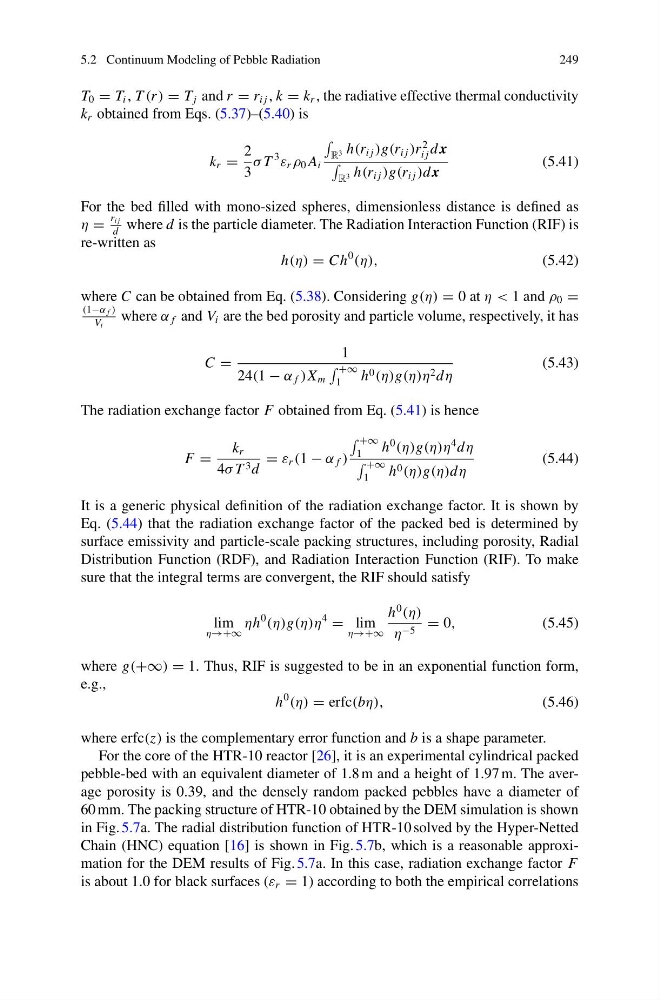
T 0 = T i , T (r ) = T j and r = r i j , k = k r , the radiative effective thermal conductivity
k r obtained from Eqs. (5.37)–(5.40) is
k r =
2
3
σ T
3
ε r ρ 0 A i
R 3 h(r i j )g(r i j )r
2
i j d x
R 3 h(r i j )g(r i j )d x
(5.41)
For the bed filled with mono-sized spheres, dimensionless distance is defined as
η =
r i j
d
where d is the particle diameter. The Radiation Interaction Function (RIF) is
re-written as
h(η) = Ch
0
(η),
(5.42)
where C can be obtained from Eq. (5.38). Considering g(η) = 0 at η < 1 and ρ 0 =
(1−α f )
V i
where α f and V i are the bed porosity and particle volume, respectively, it has
C =
1
24(1 − α f )X m
+∞
1
h 0 (η)g(η)η 2 dη
(5.43)
The radiation exchange factor F obtained from Eq. (5.41) is hence
F =
k r
4σ T 3 d
= ε r (1 − α f )
+∞
1
h
0
(η)g(η)η
4 dη
+∞
1
h 0 (η)g(η)dη
(5.44)
It is a generic physical definition of the radiation exchange factor. It is shown by
Eq. (5.44) that the radiation exchange factor of the packed bed is determined by
surface emissivity and particle-scale packing structures, including porosity, Radial
Distribution Function (RDF), and Radiation Interaction Function (RIF). To make
sure that the integral terms are convergent, the RIF should satisfy
lim
η→+∞
ηh
0
(η)g(η)η
4
= lim
η→+∞
h
0
(η)
η −5 = 0,
(5.45)
where g(+∞) = 1. Thus, RIF is suggested to be in an exponential function form,
e.g.,
h
0
(η) = erfc(bη),
(5.46)
where erfc(z) is the complementary error function and b is a shape parameter.
For the core of the HTR-10 reactor [26], it is an experimental cylindrical packed
pebble-bed with an equivalent diameter of 1.8 m and a height of 1.97 m. The average porosity is 0.39, and the densely random packed pebbles have a diameter of
60 mm. The packing structure of HTR-10 obtained by the DEM simulation is shown
in Fig. 5.7a. The radial distribution function of HTR-10 solved by the Hyper-Netted
Chain (HNC) equation [16] is shown in Fig. 5.7b, which is a reasonable approximation for the DEM results of Fig. 5.7a. In this case, radiation exchange factor F
is about 1.0 for black surfaces (ε r = 1) according to both the empirical correlations
249
T 0 = T i , T (r ) = T j and r = r i j , k = k r , the radiative effective thermal conductivity
k r obtained from Eqs. (5.37)–(5.40) is
k r =
2
3
σ T
3
ε r ρ 0 A i
R 3 h(r i j )g(r i j )r
2
i j d x
R 3 h(r i j )g(r i j )d x
(5.41)
For the bed filled with mono-sized spheres, dimensionless distance is defined as
η =
r i j
d
where d is the particle diameter. The Radiation Interaction Function (RIF) is
re-written as
h(η) = Ch
0
(η),
(5.42)
where C can be obtained from Eq. (5.38). Considering g(η) = 0 at η < 1 and ρ 0 =
(1−α f )
V i
where α f and V i are the bed porosity and particle volume, respectively, it has
C =
1
24(1 − α f )X m
+∞
1
h 0 (η)g(η)η 2 dη
(5.43)
The radiation exchange factor F obtained from Eq. (5.41) is hence
F =
k r
4σ T 3 d
= ε r (1 − α f )
+∞
1
h
0
(η)g(η)η
4 dη
+∞
1
h 0 (η)g(η)dη
(5.44)
It is a generic physical definition of the radiation exchange factor. It is shown by
Eq. (5.44) that the radiation exchange factor of the packed bed is determined by
surface emissivity and particle-scale packing structures, including porosity, Radial
Distribution Function (RDF), and Radiation Interaction Function (RIF). To make
sure that the integral terms are convergent, the RIF should satisfy
lim
η→+∞
ηh
0
(η)g(η)η
4
= lim
η→+∞
h
0
(η)
η −5 = 0,
(5.45)
where g(+∞) = 1. Thus, RIF is suggested to be in an exponential function form,
e.g.,
h
0
(η) = erfc(bη),
(5.46)
where erfc(z) is the complementary error function and b is a shape parameter.
For the core of the HTR-10 reactor [26], it is an experimental cylindrical packed
pebble-bed with an equivalent diameter of 1.8 m and a height of 1.97 m. The average porosity is 0.39, and the densely random packed pebbles have a diameter of
60 mm. The packing structure of HTR-10 obtained by the DEM simulation is shown
in Fig. 5.7a. The radial distribution function of HTR-10 solved by the Hyper-Netted
Chain (HNC) equation [16] is shown in Fig. 5.7b, which is a reasonable approximation for the DEM results of Fig. 5.7a. In this case, radiation exchange factor F
is about 1.0 for black surfaces (ε r = 1) according to both the empirical correlations