

248
5 Numerical Models for Pebble-Bed Heat Transfer
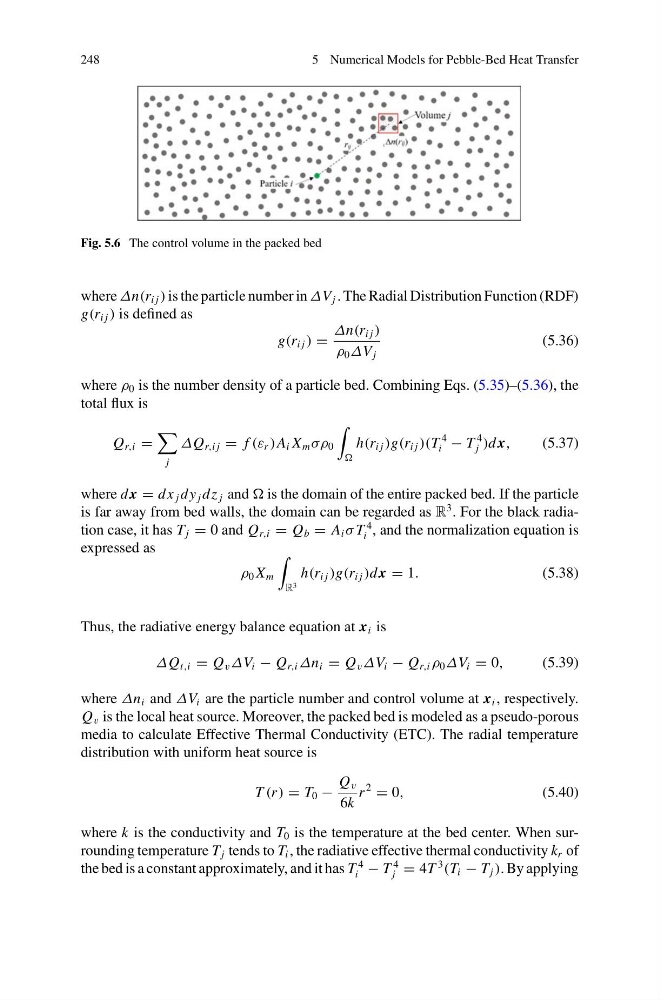
Fig. 5.6 The control volume in the packed bed
where Δn(r i j ) is the particle number in ΔV j . The Radial Distribution Function (RDF)
g(r i j ) is defined as
g(r i j ) =
Δn(r i j )
ρ 0 ΔV j
(5.36)
where ρ 0 is the number density of a particle bed. Combining Eqs. (5.35)–(5.36), the
total flux is
Q r,i =
j
ΔQ r,i j = f (ε r )A i X m σρ 0
h(r i j )g(r i j )(T
4
i − T
4
j )d x,
(5.37)
where d x = dx j dy j dz j and is the domain of the entire packed bed. If the particle
is far away from bed walls, the domain can be regarded as R
3 . For the black radiation case, it has T j = 0 and Q r,i = Q b = A i σ T
4
i , and the normalization equation is
expressed as
ρ 0 X m
R 3
h(r i j )g(r i j )d x = 1.
(5.38)
Thus, the radiative energy balance equation at x i is
ΔQ t,i = Q v ΔV i − Q r,i Δn i = Q v ΔV i − Q r,i ρ 0 ΔV i = 0,
(5.39)
where Δn i and ΔV i are the particle number and control volume at x i , respectively.
Q v is the local heat source. Moreover, the packed bed is modeled as a pseudo-porous
media to calculate Effective Thermal Conductivity (ETC). The radial temperature
distribution with uniform heat source is
T (r ) = T 0 −
Q v
6k
r
2
= 0,
(5.40)
where k is the conductivity and T 0 is the temperature at the bed center. When surrounding temperature T j tends to T i , the radiative effective thermal conductivity k r of
the bed is a constant approximately, and it has T
4
i − T
4
j = 4T
3
(T i − T j ). By applying
5 Numerical Models for Pebble-Bed Heat Transfer
Fig. 5.6 The control volume in the packed bed
where Δn(r i j ) is the particle number in ΔV j . The Radial Distribution Function (RDF)
g(r i j ) is defined as
g(r i j ) =
Δn(r i j )
ρ 0 ΔV j
(5.36)
where ρ 0 is the number density of a particle bed. Combining Eqs. (5.35)–(5.36), the
total flux is
Q r,i =
j
ΔQ r,i j = f (ε r )A i X m σρ 0
h(r i j )g(r i j )(T
4
i − T
4
j )d x,
(5.37)
where d x = dx j dy j dz j and is the domain of the entire packed bed. If the particle
is far away from bed walls, the domain can be regarded as R
3 . For the black radiation case, it has T j = 0 and Q r,i = Q b = A i σ T
4
i , and the normalization equation is
expressed as
ρ 0 X m
R 3
h(r i j )g(r i j )d x = 1.
(5.38)
Thus, the radiative energy balance equation at x i is
ΔQ t,i = Q v ΔV i − Q r,i Δn i = Q v ΔV i − Q r,i ρ 0 ΔV i = 0,
(5.39)
where Δn i and ΔV i are the particle number and control volume at x i , respectively.
Q v is the local heat source. Moreover, the packed bed is modeled as a pseudo-porous
media to calculate Effective Thermal Conductivity (ETC). The radial temperature
distribution with uniform heat source is
T (r ) = T 0 −
Q v
6k
r
2
= 0,
(5.40)
where k is the conductivity and T 0 is the temperature at the bed center. When surrounding temperature T j tends to T i , the radiative effective thermal conductivity k r of
the bed is a constant approximately, and it has T
4
i − T
4
j = 4T
3
(T i − T j ). By applying