

230
4 Numerical Methods and Simulation for Pebble Flows
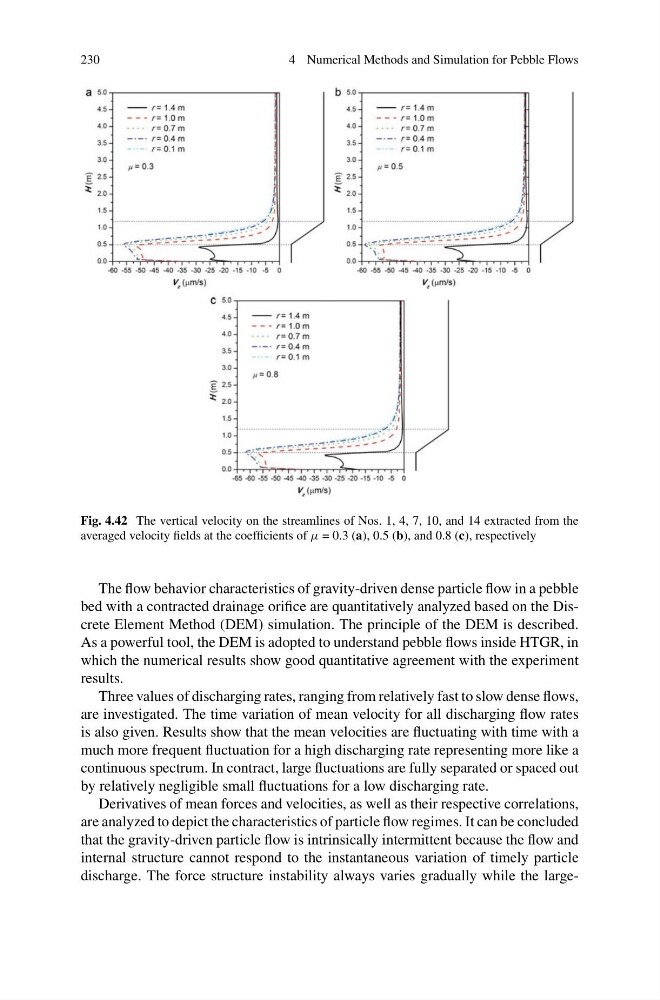
Fig. 4.42 The vertical velocity on the streamlines of Nos. 1, 4, 7, 10, and 14 extracted from the
averaged velocity fields at the coefficients of μ = 0.3 (a), 0.5 (b), and 0.8 (c), respectively
The flow behavior characteristics of gravity-driven dense particle flow in a pebble
bed with a contracted drainage orifice are quantitatively analyzed based on the Discrete Element Method (DEM) simulation. The principle of the DEM is described.
As a powerful tool, the DEM is adopted to understand pebble flows inside HTGR, in
which the numerical results show good quantitative agreement with the experiment
results.
Three values of discharging rates, ranging from relatively fast to slow dense flows,
are investigated. The time variation of mean velocity for all discharging flow rates
is also given. Results show that the mean velocities are fluctuating with time with a
much more frequent fluctuation for a high discharging rate representing more like a
continuous spectrum. In contract, large fluctuations are fully separated or spaced out
by relatively negligible small fluctuations for a low discharging rate.
Derivatives of mean forces and velocities, as well as their respective correlations,
are analyzed to depict the characteristics of particle flow regimes. It can be concluded
that the gravity-driven particle flow is intrinsically intermittent because the flow and
internal structure cannot respond to the instantaneous variation of timely particle
discharge. The force structure instability always varies gradually while the large-
4 Numerical Methods and Simulation for Pebble Flows
Fig. 4.42 The vertical velocity on the streamlines of Nos. 1, 4, 7, 10, and 14 extracted from the
averaged velocity fields at the coefficients of μ = 0.3 (a), 0.5 (b), and 0.8 (c), respectively
The flow behavior characteristics of gravity-driven dense particle flow in a pebble
bed with a contracted drainage orifice are quantitatively analyzed based on the Discrete Element Method (DEM) simulation. The principle of the DEM is described.
As a powerful tool, the DEM is adopted to understand pebble flows inside HTGR, in
which the numerical results show good quantitative agreement with the experiment
results.
Three values of discharging rates, ranging from relatively fast to slow dense flows,
are investigated. The time variation of mean velocity for all discharging flow rates
is also given. Results show that the mean velocities are fluctuating with time with a
much more frequent fluctuation for a high discharging rate representing more like a
continuous spectrum. In contract, large fluctuations are fully separated or spaced out
by relatively negligible small fluctuations for a low discharging rate.
Derivatives of mean forces and velocities, as well as their respective correlations,
are analyzed to depict the characteristics of particle flow regimes. It can be concluded
that the gravity-driven particle flow is intrinsically intermittent because the flow and
internal structure cannot respond to the instantaneous variation of timely particle
discharge. The force structure instability always varies gradually while the large-