

222
4 Numerical Methods and Simulation for Pebble Flows
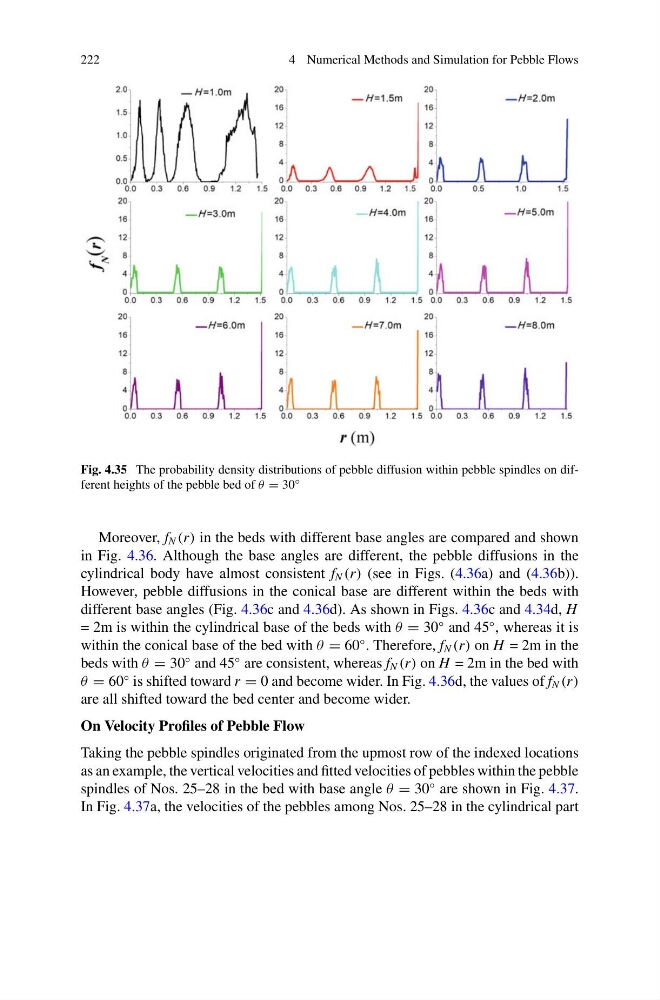
Fig. 4.35 The probability density distributions of pebble diffusion within pebble spindles on different heights of the pebble bed of θ = 30 ◦
Moreover, f N (r) in the beds with different base angles are compared and shown
in Fig. 4.36. Although the base angles are different, the pebble diffusions in the
cylindrical body have almost consistent f N (r) (see in Figs. (4.36a) and (4.36b)).
However, pebble diffusions in the conical base are different within the beds with
different base angles (Fig. 4.36c and 4.36d). As shown in Figs. 4.36c and 4.34d, H
= 2m is within the cylindrical base of the beds with θ = 30
◦ and 45
◦ , whereas it is
within the conical base of the bed with θ = 60
◦ . Therefore, f N (r) on H = 2m in the
beds with θ = 30
◦ and 45
◦ are consistent, whereas f N (r) on H = 2m in the bed with
θ = 60
◦ is shifted toward r = 0 and become wider. In Fig. 4.36d, the values of f N (r)
are all shifted toward the bed center and become wider.
On Velocity Profiles of Pebble Flow
Taking the pebble spindles originated from the upmost row of the indexed locations
as an example, the vertical velocities and fitted velocities of pebbles within the pebble
spindles of Nos. 25–28 in the bed with base angle θ = 30
◦ are shown in Fig. 4.37.
In Fig. 4.37a, the velocities of the pebbles among Nos. 25–28 in the cylindrical part
4 Numerical Methods and Simulation for Pebble Flows
Fig. 4.35 The probability density distributions of pebble diffusion within pebble spindles on different heights of the pebble bed of θ = 30 ◦
Moreover, f N (r) in the beds with different base angles are compared and shown
in Fig. 4.36. Although the base angles are different, the pebble diffusions in the
cylindrical body have almost consistent f N (r) (see in Figs. (4.36a) and (4.36b)).
However, pebble diffusions in the conical base are different within the beds with
different base angles (Fig. 4.36c and 4.36d). As shown in Figs. 4.36c and 4.34d, H
= 2m is within the cylindrical base of the beds with θ = 30
◦ and 45
◦ , whereas it is
within the conical base of the bed with θ = 60
◦ . Therefore, f N (r) on H = 2m in the
beds with θ = 30
◦ and 45
◦ are consistent, whereas f N (r) on H = 2m in the bed with
θ = 60
◦ is shifted toward r = 0 and become wider. In Fig. 4.36d, the values of f N (r)
are all shifted toward the bed center and become wider.
On Velocity Profiles of Pebble Flow
Taking the pebble spindles originated from the upmost row of the indexed locations
as an example, the vertical velocities and fitted velocities of pebbles within the pebble
spindles of Nos. 25–28 in the bed with base angle θ = 30
◦ are shown in Fig. 4.37.
In Fig. 4.37a, the velocities of the pebbles among Nos. 25–28 in the cylindrical part