

4.3 Three-Dimensional Pebble Flow
221
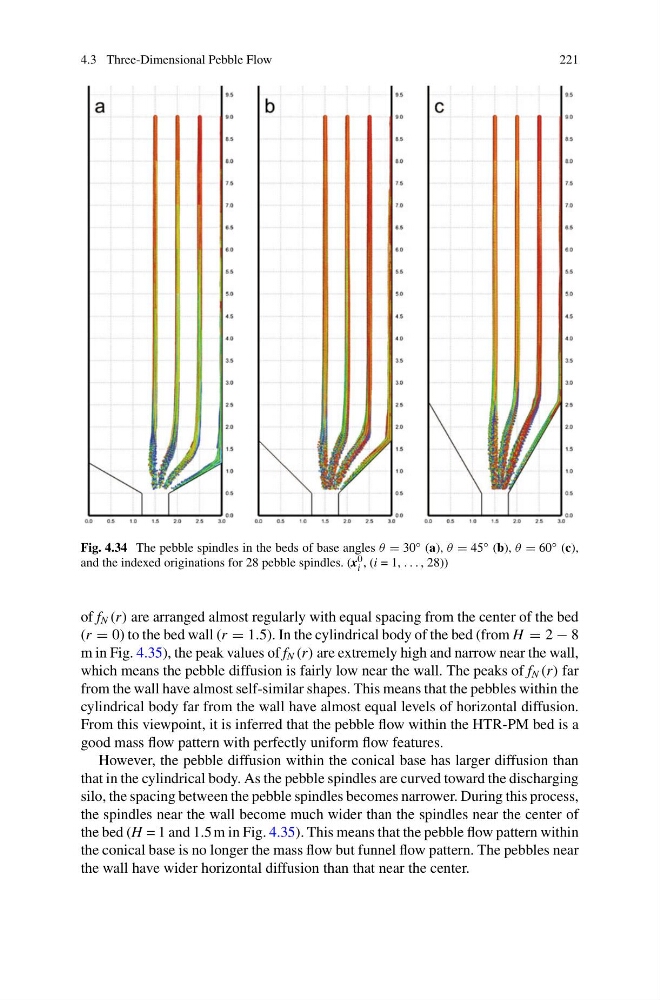
Fig. 4.34 The pebble spindles in the beds of base angles θ = 30 ◦ (a), θ = 45 ◦ (b), θ = 60 ◦ (c),
and the indexed originations for 28 pebble spindles. (x 0
i , (i = 1, . . . , 28))
of f N (r) are arranged almost regularly with equal spacing from the center of the bed
(r = 0) to the bed wall (r = 1.5). In the cylindrical body of the bed (from H = 2 − 8
m in Fig. 4.35), the peak values of f N (r) are extremely high and narrow near the wall,
which means the pebble diffusion is fairly low near the wall. The peaks of f N (r) far
from the wall have almost self-similar shapes. This means that the pebbles within the
cylindrical body far from the wall have almost equal levels of horizontal diffusion.
From this viewpoint, it is inferred that the pebble flow within the HTR-PM bed is a
good mass flow pattern with perfectly uniform flow features.
However, the pebble diffusion within the conical base has larger diffusion than
that in the cylindrical body. As the pebble spindles are curved toward the discharging
silo, the spacing between the pebble spindles becomes narrower. During this process,
the spindles near the wall become much wider than the spindles near the center of
the bed (H = 1 and 1.5 m in Fig. 4.35). This means that the pebble flow pattern within
the conical base is no longer the mass flow but funnel flow pattern. The pebbles near
the wall have wider horizontal diffusion than that near the center.
221
Fig. 4.34 The pebble spindles in the beds of base angles θ = 30 ◦ (a), θ = 45 ◦ (b), θ = 60 ◦ (c),
and the indexed originations for 28 pebble spindles. (x 0
i , (i = 1, . . . , 28))
of f N (r) are arranged almost regularly with equal spacing from the center of the bed
(r = 0) to the bed wall (r = 1.5). In the cylindrical body of the bed (from H = 2 − 8
m in Fig. 4.35), the peak values of f N (r) are extremely high and narrow near the wall,
which means the pebble diffusion is fairly low near the wall. The peaks of f N (r) far
from the wall have almost self-similar shapes. This means that the pebbles within the
cylindrical body far from the wall have almost equal levels of horizontal diffusion.
From this viewpoint, it is inferred that the pebble flow within the HTR-PM bed is a
good mass flow pattern with perfectly uniform flow features.
However, the pebble diffusion within the conical base has larger diffusion than
that in the cylindrical body. As the pebble spindles are curved toward the discharging
silo, the spacing between the pebble spindles becomes narrower. During this process,
the spindles near the wall become much wider than the spindles near the center of
the bed (H = 1 and 1.5 m in Fig. 4.35). This means that the pebble flow pattern within
the conical base is no longer the mass flow but funnel flow pattern. The pebbles near
the wall have wider horizontal diffusion than that near the center.