

4.3 Three-Dimensional Pebble Flow
213
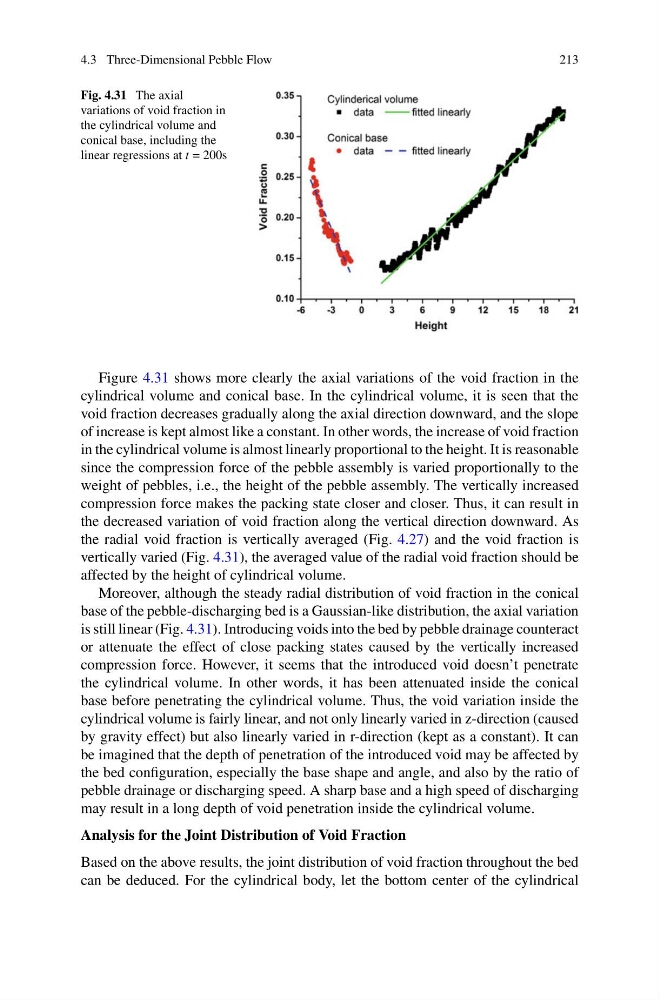
Fig. 4.31 The axial
variations of void fraction in
the cylindrical volume and
conical base, including the
linear regressions at t = 200s
Figure 4.31 shows more clearly the axial variations of the void fraction in the
cylindrical volume and conical base. In the cylindrical volume, it is seen that the
void fraction decreases gradually along the axial direction downward, and the slope
of increase is kept almost like a constant. In other words, the increase of void fraction
in the cylindrical volume is almost linearly proportional to the height. It is reasonable
since the compression force of the pebble assembly is varied proportionally to the
weight of pebbles, i.e., the height of the pebble assembly. The vertically increased
compression force makes the packing state closer and closer. Thus, it can result in
the decreased variation of void fraction along the vertical direction downward. As
the radial void fraction is vertically averaged (Fig. 4.27) and the void fraction is
vertically varied (Fig. 4.31), the averaged value of the radial void fraction should be
affected by the height of cylindrical volume.
Moreover, although the steady radial distribution of void fraction in the conical
base of the pebble-discharging bed is a Gaussian-like distribution, the axial variation
is still linear (Fig. 4.31). Introducing voids into the bed by pebble drainage counteract
or attenuate the effect of close packing states caused by the vertically increased
compression force. However, it seems that the introduced void doesn’t penetrate
the cylindrical volume. In other words, it has been attenuated inside the conical
base before penetrating the cylindrical volume. Thus, the void variation inside the
cylindrical volume is fairly linear, and not only linearly varied in z-direction (caused
by gravity effect) but also linearly varied in r-direction (kept as a constant). It can
be imagined that the depth of penetration of the introduced void may be affected by
the bed configuration, especially the base shape and angle, and also by the ratio of
pebble drainage or discharging speed. A sharp base and a high speed of discharging
may result in a long depth of void penetration inside the cylindrical volume.
Analysis for the Joint Distribution of Void Fraction
Based on the above results, the joint distribution of void fraction throughout the bed
can be deduced. For the cylindrical body, let the bottom center of the cylindrical
213
Fig. 4.31 The axial
variations of void fraction in
the cylindrical volume and
conical base, including the
linear regressions at t = 200s
Figure 4.31 shows more clearly the axial variations of the void fraction in the
cylindrical volume and conical base. In the cylindrical volume, it is seen that the
void fraction decreases gradually along the axial direction downward, and the slope
of increase is kept almost like a constant. In other words, the increase of void fraction
in the cylindrical volume is almost linearly proportional to the height. It is reasonable
since the compression force of the pebble assembly is varied proportionally to the
weight of pebbles, i.e., the height of the pebble assembly. The vertically increased
compression force makes the packing state closer and closer. Thus, it can result in
the decreased variation of void fraction along the vertical direction downward. As
the radial void fraction is vertically averaged (Fig. 4.27) and the void fraction is
vertically varied (Fig. 4.31), the averaged value of the radial void fraction should be
affected by the height of cylindrical volume.
Moreover, although the steady radial distribution of void fraction in the conical
base of the pebble-discharging bed is a Gaussian-like distribution, the axial variation
is still linear (Fig. 4.31). Introducing voids into the bed by pebble drainage counteract
or attenuate the effect of close packing states caused by the vertically increased
compression force. However, it seems that the introduced void doesn’t penetrate
the cylindrical volume. In other words, it has been attenuated inside the conical
base before penetrating the cylindrical volume. Thus, the void variation inside the
cylindrical volume is fairly linear, and not only linearly varied in z-direction (caused
by gravity effect) but also linearly varied in r-direction (kept as a constant). It can
be imagined that the depth of penetration of the introduced void may be affected by
the bed configuration, especially the base shape and angle, and also by the ratio of
pebble drainage or discharging speed. A sharp base and a high speed of discharging
may result in a long depth of void penetration inside the cylindrical volume.
Analysis for the Joint Distribution of Void Fraction
Based on the above results, the joint distribution of void fraction throughout the bed
can be deduced. For the cylindrical body, let the bottom center of the cylindrical