

4.3 Three-Dimensional Pebble Flow
207
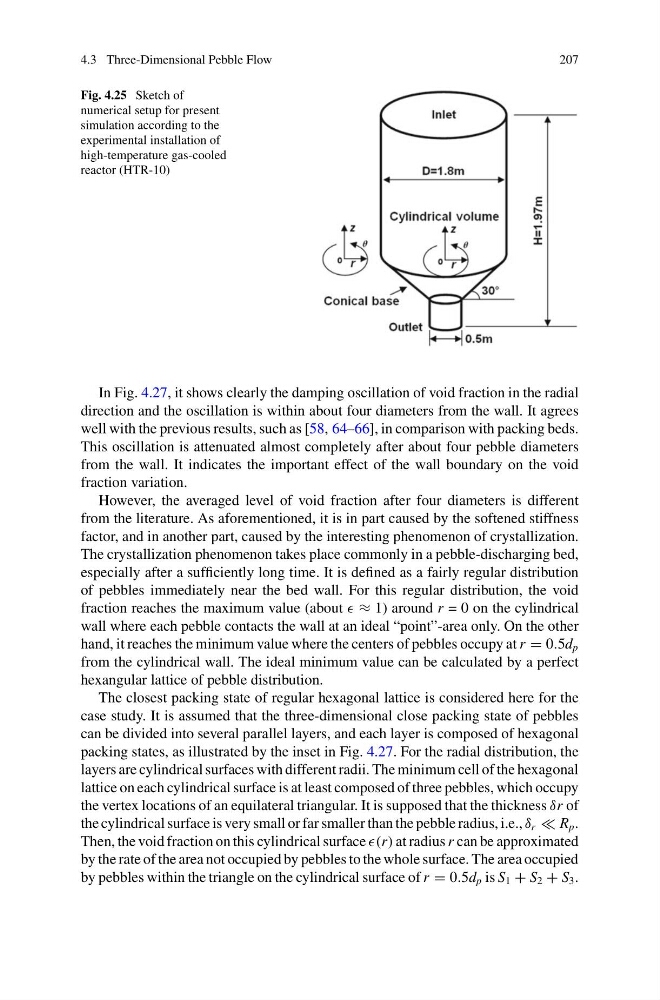
Fig. 4.25 Sketch of
numerical setup for present
simulation according to the
experimental installation of
high-temperature gas-cooled
reactor (HTR-10)
In Fig. 4.27, it shows clearly the damping oscillation of void fraction in the radial
direction and the oscillation is within about four diameters from the wall. It agrees
well with the previous results, such as [58, 64–66], in comparison with packing beds.
This oscillation is attenuated almost completely after about four pebble diameters
from the wall. It indicates the important effect of the wall boundary on the void
fraction variation.
However, the averaged level of void fraction after four diameters is different
from the literature. As aforementioned, it is in part caused by the softened stiffness
factor, and in another part, caused by the interesting phenomenon of crystallization.
The crystallization phenomenon takes place commonly in a pebble-discharging bed,
especially after a sufficiently long time. It is defined as a fairly regular distribution
of pebbles immediately near the bed wall. For this regular distribution, the void
fraction reaches the maximum value (about ≈ 1) around r = 0 on the cylindrical
wall where each pebble contacts the wall at an ideal “point”-area only. On the other
hand, it reaches the minimum value where the centers of pebbles occupy at r = 0.5d p
from the cylindrical wall. The ideal minimum value can be calculated by a perfect
hexangular lattice of pebble distribution.
The closest packing state of regular hexagonal lattice is considered here for the
case study. It is assumed that the three-dimensional close packing state of pebbles
can be divided into several parallel layers, and each layer is composed of hexagonal
packing states, as illustrated by the inset in Fig. 4.27. For the radial distribution, the
layers are cylindrical surfaces with different radii. The minimum cell of the hexagonal
lattice on each cylindrical surface is at least composed of three pebbles, which occupy
the vertex locations of an equilateral triangular. It is supposed that the thickness δr of
the cylindrical surface is very small or far smaller than the pebble radius, i.e., δ r R p .
Then, the void fraction on this cylindrical surface (r) at radius r can be approximated
by the rate of the area not occupied by pebbles to the whole surface. The area occupied
by pebbles within the triangle on the cylindrical surface of r = 0.5d p is S 1 + S 2 + S 3 .
207
Fig. 4.25 Sketch of
numerical setup for present
simulation according to the
experimental installation of
high-temperature gas-cooled
reactor (HTR-10)
In Fig. 4.27, it shows clearly the damping oscillation of void fraction in the radial
direction and the oscillation is within about four diameters from the wall. It agrees
well with the previous results, such as [58, 64–66], in comparison with packing beds.
This oscillation is attenuated almost completely after about four pebble diameters
from the wall. It indicates the important effect of the wall boundary on the void
fraction variation.
However, the averaged level of void fraction after four diameters is different
from the literature. As aforementioned, it is in part caused by the softened stiffness
factor, and in another part, caused by the interesting phenomenon of crystallization.
The crystallization phenomenon takes place commonly in a pebble-discharging bed,
especially after a sufficiently long time. It is defined as a fairly regular distribution
of pebbles immediately near the bed wall. For this regular distribution, the void
fraction reaches the maximum value (about ≈ 1) around r = 0 on the cylindrical
wall where each pebble contacts the wall at an ideal “point”-area only. On the other
hand, it reaches the minimum value where the centers of pebbles occupy at r = 0.5d p
from the cylindrical wall. The ideal minimum value can be calculated by a perfect
hexangular lattice of pebble distribution.
The closest packing state of regular hexagonal lattice is considered here for the
case study. It is assumed that the three-dimensional close packing state of pebbles
can be divided into several parallel layers, and each layer is composed of hexagonal
packing states, as illustrated by the inset in Fig. 4.27. For the radial distribution, the
layers are cylindrical surfaces with different radii. The minimum cell of the hexagonal
lattice on each cylindrical surface is at least composed of three pebbles, which occupy
the vertex locations of an equilateral triangular. It is supposed that the thickness δr of
the cylindrical surface is very small or far smaller than the pebble radius, i.e., δ r R p .
Then, the void fraction on this cylindrical surface (r) at radius r can be approximated
by the rate of the area not occupied by pebbles to the whole surface. The area occupied
by pebbles within the triangle on the cylindrical surface of r = 0.5d p is S 1 + S 2 + S 3 .