

180
4 Numerical Methods and Simulation for Pebble Flows
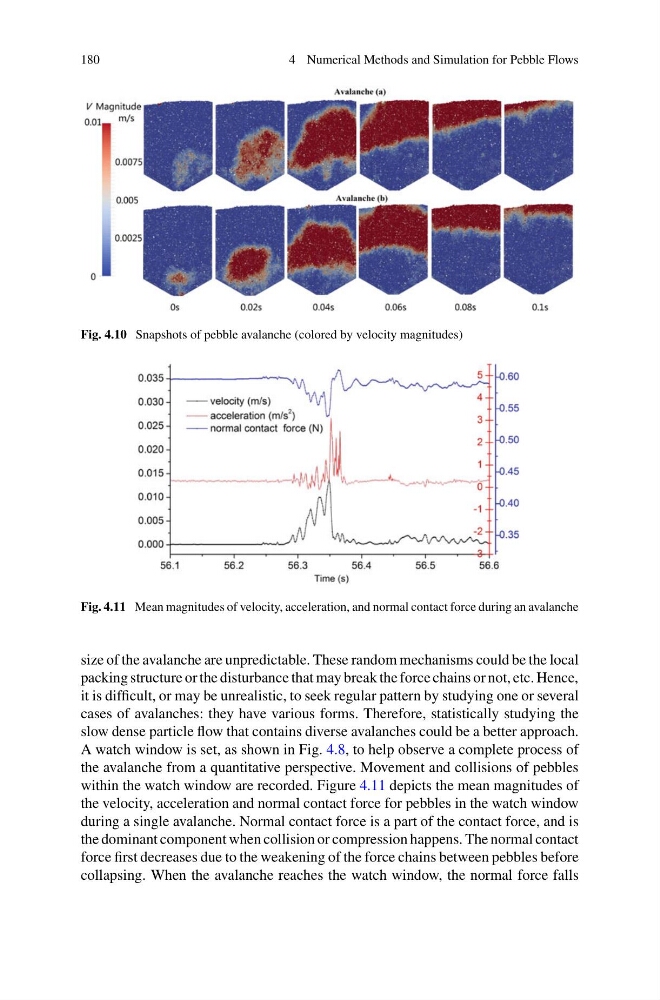
Fig. 4.10 Snapshots of pebble avalanche (colored by velocity magnitudes)
Fig. 4.11 Mean magnitudes of velocity, acceleration, and normal contact force during an avalanche
size of the avalanche are unpredictable. These random mechanisms could be the local
packing structure or the disturbance that may break the force chains or not, etc. Hence,
it is difficult, or may be unrealistic, to seek regular pattern by studying one or several
cases of avalanches: they have various forms. Therefore, statistically studying the
slow dense particle flow that contains diverse avalanches could be a better approach.
A watch window is set, as shown in Fig. 4.8, to help observe a complete process of
the avalanche from a quantitative perspective. Movement and collisions of pebbles
within the watch window are recorded. Figure 4.11 depicts the mean magnitudes of
the velocity, acceleration and normal contact force for pebbles in the watch window
during a single avalanche. Normal contact force is a part of the contact force, and is
the dominant component when collision or compression happens. The normal contact
force first decreases due to the weakening of the force chains between pebbles before
collapsing. When the avalanche reaches the watch window, the normal force falls
4 Numerical Methods and Simulation for Pebble Flows
Fig. 4.10 Snapshots of pebble avalanche (colored by velocity magnitudes)
Fig. 4.11 Mean magnitudes of velocity, acceleration, and normal contact force during an avalanche
size of the avalanche are unpredictable. These random mechanisms could be the local
packing structure or the disturbance that may break the force chains or not, etc. Hence,
it is difficult, or may be unrealistic, to seek regular pattern by studying one or several
cases of avalanches: they have various forms. Therefore, statistically studying the
slow dense particle flow that contains diverse avalanches could be a better approach.
A watch window is set, as shown in Fig. 4.8, to help observe a complete process of
the avalanche from a quantitative perspective. Movement and collisions of pebbles
within the watch window are recorded. Figure 4.11 depicts the mean magnitudes of
the velocity, acceleration and normal contact force for pebbles in the watch window
during a single avalanche. Normal contact force is a part of the contact force, and is
the dominant component when collision or compression happens. The normal contact
force first decreases due to the weakening of the force chains between pebbles before
collapsing. When the avalanche reaches the watch window, the normal force falls