

150
3 Experiments in Pebble Bed Heat Transfer
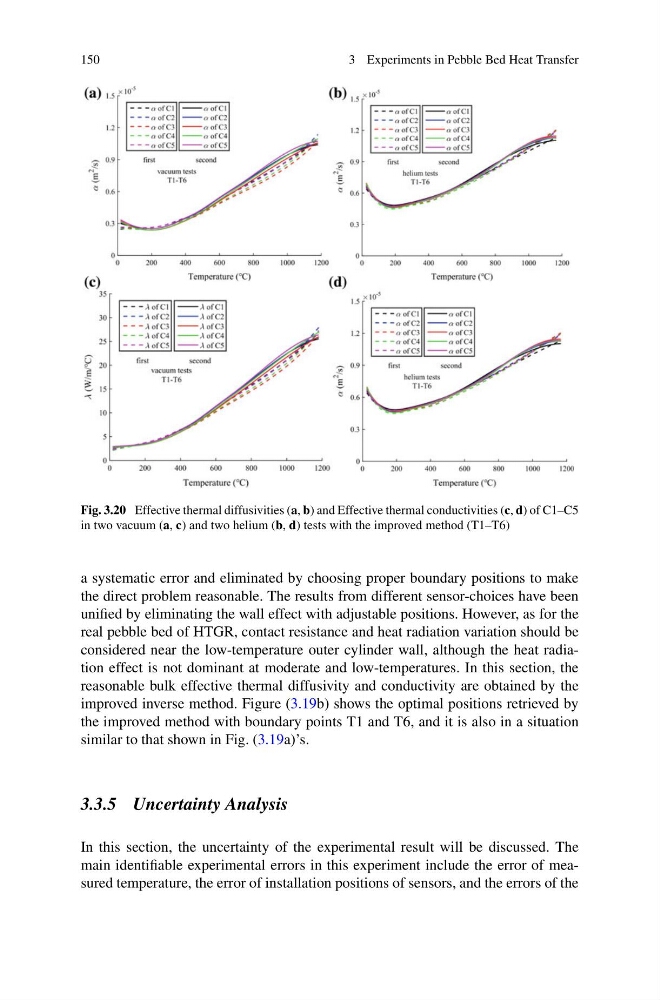
Fig. 3.20 Effective thermal diffusivities (a, b) and Effective thermal conductivities (c, d) of C1–C5
in two vacuum (a, c) and two helium (b, d) tests with the improved method (T1–T6)
a systematic error and eliminated by choosing proper boundary positions to make
the direct problem reasonable. The results from different sensor-choices have been
unified by eliminating the wall effect with adjustable positions. However, as for the
real pebble bed of HTGR, contact resistance and heat radiation variation should be
considered near the low-temperature outer cylinder wall, although the heat radiation effect is not dominant at moderate and low-temperatures. In this section, the
reasonable bulk effective thermal diffusivity and conductivity are obtained by the
improved inverse method. Figure (3.19b) shows the optimal positions retrieved by
the improved method with boundary points T1 and T6, and it is also in a situation
similar to that shown in Fig. (3.19a)’s.
3.3.5 Uncertainty Analysis
In this section, the uncertainty of the experimental result will be discussed. The
main identifiable experimental errors in this experiment include the error of measured temperature, the error of installation positions of sensors, and the errors of the
3 Experiments in Pebble Bed Heat Transfer
Fig. 3.20 Effective thermal diffusivities (a, b) and Effective thermal conductivities (c, d) of C1–C5
in two vacuum (a, c) and two helium (b, d) tests with the improved method (T1–T6)
a systematic error and eliminated by choosing proper boundary positions to make
the direct problem reasonable. The results from different sensor-choices have been
unified by eliminating the wall effect with adjustable positions. However, as for the
real pebble bed of HTGR, contact resistance and heat radiation variation should be
considered near the low-temperature outer cylinder wall, although the heat radiation effect is not dominant at moderate and low-temperatures. In this section, the
reasonable bulk effective thermal diffusivity and conductivity are obtained by the
improved inverse method. Figure (3.19b) shows the optimal positions retrieved by
the improved method with boundary points T1 and T6, and it is also in a situation
similar to that shown in Fig. (3.19a)’s.
3.3.5 Uncertainty Analysis
In this section, the uncertainty of the experimental result will be discussed. The
main identifiable experimental errors in this experiment include the error of measured temperature, the error of installation positions of sensors, and the errors of the