

104
2 Experiments in Pebble Flows
(a)
(b)
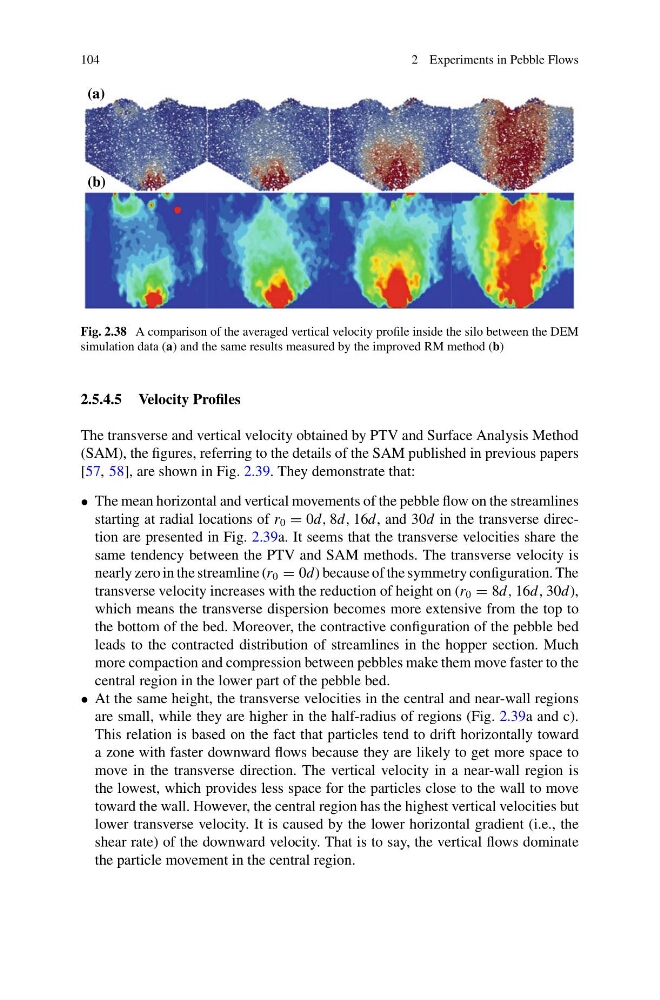
Fig. 2.38 A comparison of the averaged vertical velocity profile inside the silo between the DEM
simulation data (a) and the same results measured by the improved RM method (b)
2.5.4.5 Velocity Profiles
The transverse and vertical velocity obtained by PTV and Surface Analysis Method
(SAM), the figures, referring to the details of the SAM published in previous papers
[57, 58], are shown in Fig. 2.39. They demonstrate that:
• The mean horizontal and vertical movements of the pebble flow on the streamlines
starting at radial locations of r 0 = 0d, 8d, 16d, and 30d in the transverse direction are presented in Fig. 2.39a. It seems that the transverse velocities share the
same tendency between the PTV and SAM methods. The transverse velocity is
nearly zero in the streamline (r 0 = 0d) because of the symmetry configuration. The
transverse velocity increases with the reduction of height on (r 0 = 8d, 16d, 30d),
which means the transverse dispersion becomes more extensive from the top to
the bottom of the bed. Moreover, the contractive configuration of the pebble bed
leads to the contracted distribution of streamlines in the hopper section. Much
more compaction and compression between pebbles make them move faster to the
central region in the lower part of the pebble bed.
• At the same height, the transverse velocities in the central and near-wall regions
are small, while they are higher in the half-radius of regions (Fig. 2.39a and c).
This relation is based on the fact that particles tend to drift horizontally toward
a zone with faster downward flows because they are likely to get more space to
move in the transverse direction. The vertical velocity in a near-wall region is
the lowest, which provides less space for the particles close to the wall to move
toward the wall. However, the central region has the highest vertical velocities but
lower transverse velocity. It is caused by the lower horizontal gradient (i.e., the
shear rate) of the downward velocity. That is to say, the vertical flows dominate
the particle movement in the central region.
2 Experiments in Pebble Flows
(a)
(b)
Fig. 2.38 A comparison of the averaged vertical velocity profile inside the silo between the DEM
simulation data (a) and the same results measured by the improved RM method (b)
2.5.4.5 Velocity Profiles
The transverse and vertical velocity obtained by PTV and Surface Analysis Method
(SAM), the figures, referring to the details of the SAM published in previous papers
[57, 58], are shown in Fig. 2.39. They demonstrate that:
• The mean horizontal and vertical movements of the pebble flow on the streamlines
starting at radial locations of r 0 = 0d, 8d, 16d, and 30d in the transverse direction are presented in Fig. 2.39a. It seems that the transverse velocities share the
same tendency between the PTV and SAM methods. The transverse velocity is
nearly zero in the streamline (r 0 = 0d) because of the symmetry configuration. The
transverse velocity increases with the reduction of height on (r 0 = 8d, 16d, 30d),
which means the transverse dispersion becomes more extensive from the top to
the bottom of the bed. Moreover, the contractive configuration of the pebble bed
leads to the contracted distribution of streamlines in the hopper section. Much
more compaction and compression between pebbles make them move faster to the
central region in the lower part of the pebble bed.
• At the same height, the transverse velocities in the central and near-wall regions
are small, while they are higher in the half-radius of regions (Fig. 2.39a and c).
This relation is based on the fact that particles tend to drift horizontally toward
a zone with faster downward flows because they are likely to get more space to
move in the transverse direction. The vertical velocity in a near-wall region is
the lowest, which provides less space for the particles close to the wall to move
toward the wall. However, the central region has the highest vertical velocities but
lower transverse velocity. It is caused by the lower horizontal gradient (i.e., the
shear rate) of the downward velocity. That is to say, the vertical flows dominate
the particle movement in the central region.