

88
4 Two Computational Schemes of χ (2)
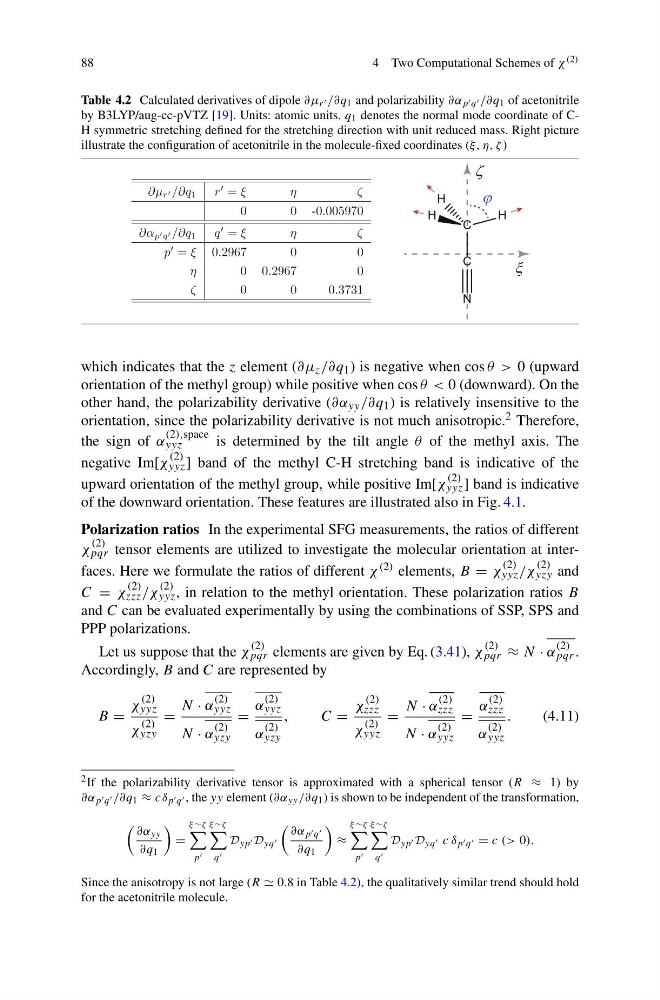
Table 4.2 Calculated derivatives of dipole ∂μ r /∂q 1 and polarizability ∂α p q /∂q 1 of acetonitrile
by B3LYP/aug-cc-pVTZ [19]. Units: atomic units. q 1 denotes the normal mode coordinate of CH symmetric stretching defined for the stretching direction with unit reduced mass. Right picture
illustrate the configuration of acetonitrile in the molecule-fixed coordinates (ξ, η, ζ )
C
C
H
H
H
N
which indicates that the z element (∂μ z /∂q 1 ) is negative when cos θ > 0 (upward
orientation of the methyl group) while positive when cos θ < 0 (downward). On the
other hand, the polarizability derivative (∂α yy /∂q 1 ) is relatively insensitive to the
orientation, since the polarizability derivative is not much anisotropic. 2 Therefore,
the sign of α
(2),space
yyz
is determined by the tilt angle θ of the methyl axis. The
negative Im[χ
(2)
yyz ] band of the methyl C-H stretching band is indicative of the
upward orientation of the methyl group, while positive Im[χ
(2)
yyz ] band is indicative
of the downward orientation. These features are illustrated also in Fig. 4.1.
Polarization ratios In the experimental SFG measurements, the ratios of different
χ
(2)
pqr tensor elements are utilized to investigate the molecular orientation at interfaces. Here we formulate the ratios of different χ (2) elements, B = χ
(2)
yyz /χ
(2)
yzy and
C = χ
(2)
zzz /χ
(2)
yyz , in relation to the methyl orientation. These polarization ratios B
and C can be evaluated experimentally by using the combinations of SSP, SPS and
PPP polarizations.
Let us suppose that the χ
(2)
pqr elements are given by Eq. (3.41), χ
(2)
pqr ≈ N · α
(2)
pqr .
Accordingly, B and C are represented by
B =
χ
(2)
yyz
χ
(2)
yzy
=
N · α
(2)
yyz
N · α
(2)
yzy
=
α
(2)
yyz
α
(2)
yzy
,
C =
χ
(2)
zzz
χ
(2)
yyz
=
N · α
(2)
zzz
N · α
(2)
yyz
=
α
(2)
zzz
α
(2)
yyz
.
(4.11)
2 If the polarizability derivative tensor is approximated with a spherical tensor (R ≈ 1) by
∂α p q /∂q 1 ≈ cδ p q , the yy element (∂α yy /∂q 1 ) is shown to be independent of the transformation,
∂α yy
∂q 1
=
ξ ∼ζ
p
ξ ∼ζ
q
D yp D yq
∂α p q
∂q 1
≈
ξ ∼ζ
p
ξ ∼ζ
q
D yp D yq c δ p q = c (> 0).
Since the anisotropy is not large (R 0.8 in Table 4.2), the qualitatively similar trend should hold
for the acetonitrile molecule.
4 Two Computational Schemes of χ (2)
Table 4.2 Calculated derivatives of dipole ∂μ r /∂q 1 and polarizability ∂α p q /∂q 1 of acetonitrile
by B3LYP/aug-cc-pVTZ [19]. Units: atomic units. q 1 denotes the normal mode coordinate of CH symmetric stretching defined for the stretching direction with unit reduced mass. Right picture
illustrate the configuration of acetonitrile in the molecule-fixed coordinates (ξ, η, ζ )
C
C
H
H
H
N
which indicates that the z element (∂μ z /∂q 1 ) is negative when cos θ > 0 (upward
orientation of the methyl group) while positive when cos θ < 0 (downward). On the
other hand, the polarizability derivative (∂α yy /∂q 1 ) is relatively insensitive to the
orientation, since the polarizability derivative is not much anisotropic. 2 Therefore,
the sign of α
(2),space
yyz
is determined by the tilt angle θ of the methyl axis. The
negative Im[χ
(2)
yyz ] band of the methyl C-H stretching band is indicative of the
upward orientation of the methyl group, while positive Im[χ
(2)
yyz ] band is indicative
of the downward orientation. These features are illustrated also in Fig. 4.1.
Polarization ratios In the experimental SFG measurements, the ratios of different
χ
(2)
pqr tensor elements are utilized to investigate the molecular orientation at interfaces. Here we formulate the ratios of different χ (2) elements, B = χ
(2)
yyz /χ
(2)
yzy and
C = χ
(2)
zzz /χ
(2)
yyz , in relation to the methyl orientation. These polarization ratios B
and C can be evaluated experimentally by using the combinations of SSP, SPS and
PPP polarizations.
Let us suppose that the χ
(2)
pqr elements are given by Eq. (3.41), χ
(2)
pqr ≈ N · α
(2)
pqr .
Accordingly, B and C are represented by
B =
χ
(2)
yyz
χ
(2)
yzy
=
N · α
(2)
yyz
N · α
(2)
yzy
=
α
(2)
yyz
α
(2)
yzy
,
C =
χ
(2)
zzz
χ
(2)
yyz
=
N · α
(2)
zzz
N · α
(2)
yyz
=
α
(2)
zzz
α
(2)
yyz
.
(4.11)
2 If the polarizability derivative tensor is approximated with a spherical tensor (R ≈ 1) by
∂α p q /∂q 1 ≈ cδ p q , the yy element (∂α yy /∂q 1 ) is shown to be independent of the transformation,
∂α yy
∂q 1
=
ξ ∼ζ
p
ξ ∼ζ
q
D yp D yq
∂α p q
∂q 1
≈
ξ ∼ζ
p
ξ ∼ζ
q
D yp D yq c δ p q = c (> 0).
Since the anisotropy is not large (R 0.8 in Table 4.2), the qualitatively similar trend should hold
for the acetonitrile molecule.