

82
4 Two Computational Schemes of χ (2)
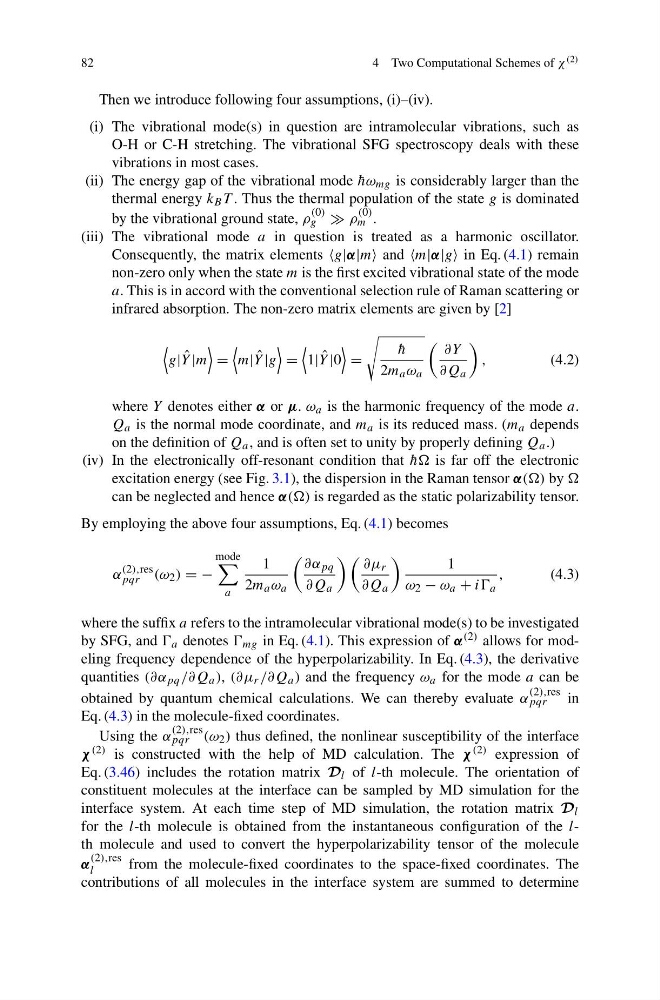
Then we introduce following four assumptions, (i)–(iv).
(i) The vibrational mode(s) in question are intramolecular vibrations, such as
O-H or C-H stretching. The vibrational SFG spectroscopy deals with these
vibrations in most cases.
(ii) The energy gap of the vibrational mode ¯
hω mg is considerably larger than the
thermal energy k B T . Thus the thermal population of the state g is dominated
by the vibrational ground state, ρ
(0)
g ρ
(0)
m .
(iii) The vibrational mode a in question is treated as a harmonic oscillator.
Consequently, the matrix elements g|α|m and m|α|g in Eq. (4.1) remain
non-zero only when the state m is the first excited vibrational state of the mode
a. This is in accord with the conventional selection rule of Raman scattering or
infrared absorption. The non-zero matrix elements are given by [2]
g| ˆ
Y |m
=
m| ˆ
Y |g
=
1| ˆ
Y |0
=
¯
h
2m a ω a
∂Y
∂Q a
,
(4.2)
where Y denotes either α or μ. ω a is the harmonic frequency of the mode a.
Q a is the normal mode coordinate, and m a is its reduced mass. (m a depends
on the definition of Q a , and is often set to unity by properly defining Q a .)
(iv) In the electronically off-resonant condition that ¯
hh is far off the electronic
excitation energy (see Fig. 3.1), the dispersion in the Raman tensor α(() by
can be neglected and hence α(() is regarded as the static polarizability tensor.
By employing the above four assumptions, Eq. (4.1) becomes
α
(2),res
pqr (ω 2 ) = −
mode
a
1
2m a ω a
∂α pq
∂Q a
∂μ r
∂Q a
1
ω 2 − ω a + ii a
,
(4.3)
where the suffix a refers to the intramolecular vibrational mode(s) to be investigated
by SFG, and a denotes mg in Eq. (4.1). This expression of α (2) allows for modeling frequency dependence of the hyperpolarizability. In Eq. (4.3), the derivative
quantities (∂α pq /∂Q a ), (∂μ r /∂Q a ) and the frequency ω a for the mode a can be
obtained by quantum chemical calculations. We can thereby evaluate α
(2),res
pqr
in
Eq. (4.3) in the molecule-fixed coordinates.
Using the α
(2),res
pqr (ω 2 ) thus defined, the nonlinear susceptibility of the interface
χ (2) is constructed with the help of MD calculation. The χ (2) expression of
Eq. (3.46) includes the rotation matrix D l of l-th molecule. The orientation of
constituent molecules at the interface can be sampled by MD simulation for the
interface system. At each time step of MD simulation, the rotation matrix D l
for the l-th molecule is obtained from the instantaneous configuration of the lth molecule and used to convert the hyperpolarizability tensor of the molecule
α
(2),res
l
from the molecule-fixed coordinates to the space-fixed coordinates. The
contributions of all molecules in the interface system are summed to determine
4 Two Computational Schemes of χ (2)
Then we introduce following four assumptions, (i)–(iv).
(i) The vibrational mode(s) in question are intramolecular vibrations, such as
O-H or C-H stretching. The vibrational SFG spectroscopy deals with these
vibrations in most cases.
(ii) The energy gap of the vibrational mode ¯
hω mg is considerably larger than the
thermal energy k B T . Thus the thermal population of the state g is dominated
by the vibrational ground state, ρ
(0)
g ρ
(0)
m .
(iii) The vibrational mode a in question is treated as a harmonic oscillator.
Consequently, the matrix elements g|α|m and m|α|g in Eq. (4.1) remain
non-zero only when the state m is the first excited vibrational state of the mode
a. This is in accord with the conventional selection rule of Raman scattering or
infrared absorption. The non-zero matrix elements are given by [2]
g| ˆ
Y |m
=
m| ˆ
Y |g
=
1| ˆ
Y |0
=
¯
h
2m a ω a
∂Y
∂Q a
,
(4.2)
where Y denotes either α or μ. ω a is the harmonic frequency of the mode a.
Q a is the normal mode coordinate, and m a is its reduced mass. (m a depends
on the definition of Q a , and is often set to unity by properly defining Q a .)
(iv) In the electronically off-resonant condition that ¯
hh is far off the electronic
excitation energy (see Fig. 3.1), the dispersion in the Raman tensor α(() by
can be neglected and hence α(() is regarded as the static polarizability tensor.
By employing the above four assumptions, Eq. (4.1) becomes
α
(2),res
pqr (ω 2 ) = −
mode
a
1
2m a ω a
∂α pq
∂Q a
∂μ r
∂Q a
1
ω 2 − ω a + ii a
,
(4.3)
where the suffix a refers to the intramolecular vibrational mode(s) to be investigated
by SFG, and a denotes mg in Eq. (4.1). This expression of α (2) allows for modeling frequency dependence of the hyperpolarizability. In Eq. (4.3), the derivative
quantities (∂α pq /∂Q a ), (∂μ r /∂Q a ) and the frequency ω a for the mode a can be
obtained by quantum chemical calculations. We can thereby evaluate α
(2),res
pqr
in
Eq. (4.3) in the molecule-fixed coordinates.
Using the α
(2),res
pqr (ω 2 ) thus defined, the nonlinear susceptibility of the interface
χ (2) is constructed with the help of MD calculation. The χ (2) expression of
Eq. (3.46) includes the rotation matrix D l of l-th molecule. The orientation of
constituent molecules at the interface can be sampled by MD simulation for the
interface system. At each time step of MD simulation, the rotation matrix D l
for the l-th molecule is obtained from the instantaneous configuration of the lth molecule and used to convert the hyperpolarizability tensor of the molecule
α
(2),res
l
from the molecule-fixed coordinates to the space-fixed coordinates. The
contributions of all molecules in the interface system are summed to determine