

62
3 Microscopic Expressions of Nonlinear Polarization
mg
mg
(a) C mg > 0
(b) C mg < 0
O
H
H
C
H
H
H
O
H
H
C
H
H
H
Water O-H
Methyl sym. C-H
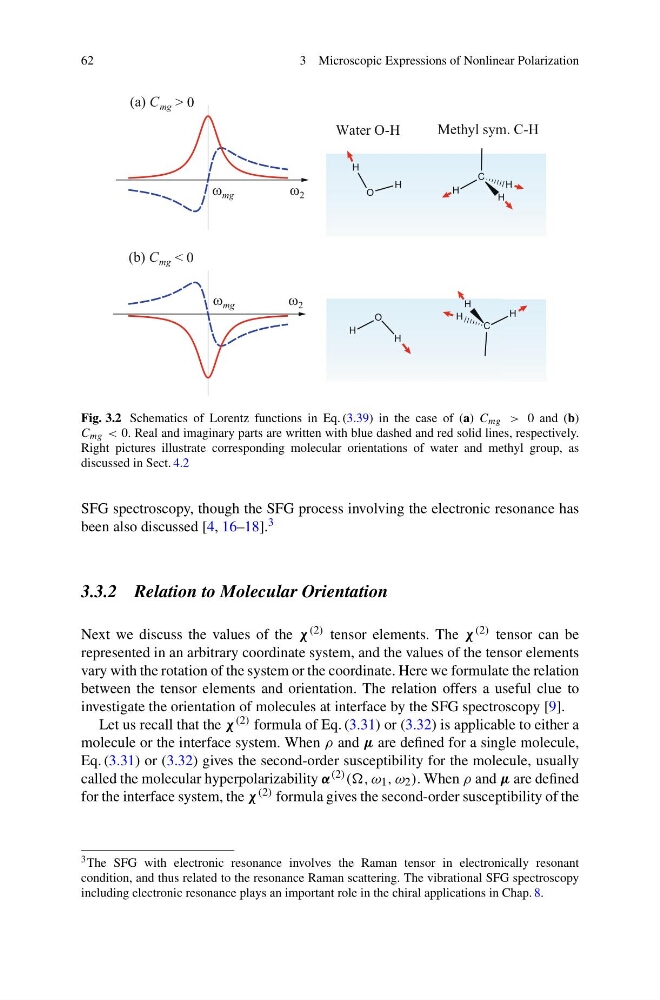
Fig. 3.2 Schematics of Lorentz functions in Eq. (3.39) in the case of (a) C mg > 0 and (b)
C mg < 0. Real and imaginary parts are written with blue dashed and red solid lines, respectively.
Right pictures illustrate corresponding molecular orientations of water and methyl group, as
discussed in Sect. 4.2
SFG spectroscopy, though the SFG process involving the electronic resonance has
been also discussed [4, 16–18]. 3
3.3.2 Relation to Molecular Orientation
Next we discuss the values of the χ (2) tensor elements. The χ (2) tensor can be
represented in an arbitrary coordinate system, and the values of the tensor elements
vary with the rotation of the system or the coordinate. Here we formulate the relation
between the tensor elements and orientation. The relation offers a useful clue to
investigate the orientation of molecules at interface by the SFG spectroscopy [9].
Let us recall that the χ (2) formula of Eq. (3.31) or (3.32) is applicable to either a
molecule or the interface system. When ρ and μ are defined for a single molecule,
Eq. (3.31) or (3.32) gives the second-order susceptibility for the molecule, usually
called the molecular hyperpolarizability α (2) ((, ω 1 , ω 2 ). When ρ and μ are defined
for the interface system, the χ (2) formula gives the second-order susceptibility of the
3 The SFG with electronic resonance involves the Raman tensor in electronically resonant
condition, and thus related to the resonance Raman scattering. The vibrational SFG spectroscopy
including electronic resonance plays an important role in the chiral applications in Chap. 8.
3 Microscopic Expressions of Nonlinear Polarization
mg
mg
(a) C mg > 0
(b) C mg < 0
O
H
H
C
H
H
H
O
H
H
C
H
H
H
Water O-H
Methyl sym. C-H
Fig. 3.2 Schematics of Lorentz functions in Eq. (3.39) in the case of (a) C mg > 0 and (b)
C mg < 0. Real and imaginary parts are written with blue dashed and red solid lines, respectively.
Right pictures illustrate corresponding molecular orientations of water and methyl group, as
discussed in Sect. 4.2
SFG spectroscopy, though the SFG process involving the electronic resonance has
been also discussed [4, 16–18]. 3
3.3.2 Relation to Molecular Orientation
Next we discuss the values of the χ (2) tensor elements. The χ (2) tensor can be
represented in an arbitrary coordinate system, and the values of the tensor elements
vary with the rotation of the system or the coordinate. Here we formulate the relation
between the tensor elements and orientation. The relation offers a useful clue to
investigate the orientation of molecules at interface by the SFG spectroscopy [9].
Let us recall that the χ (2) formula of Eq. (3.31) or (3.32) is applicable to either a
molecule or the interface system. When ρ and μ are defined for a single molecule,
Eq. (3.31) or (3.32) gives the second-order susceptibility for the molecule, usually
called the molecular hyperpolarizability α (2) ((, ω 1 , ω 2 ). When ρ and μ are defined
for the interface system, the χ (2) formula gives the second-order susceptibility of the
3 The SFG with electronic resonance involves the Raman tensor in electronically resonant
condition, and thus related to the resonance Raman scattering. The vibrational SFG spectroscopy
including electronic resonance plays an important role in the chiral applications in Chap. 8.