

3.2 Perturbation Forms of Susceptibilities
55
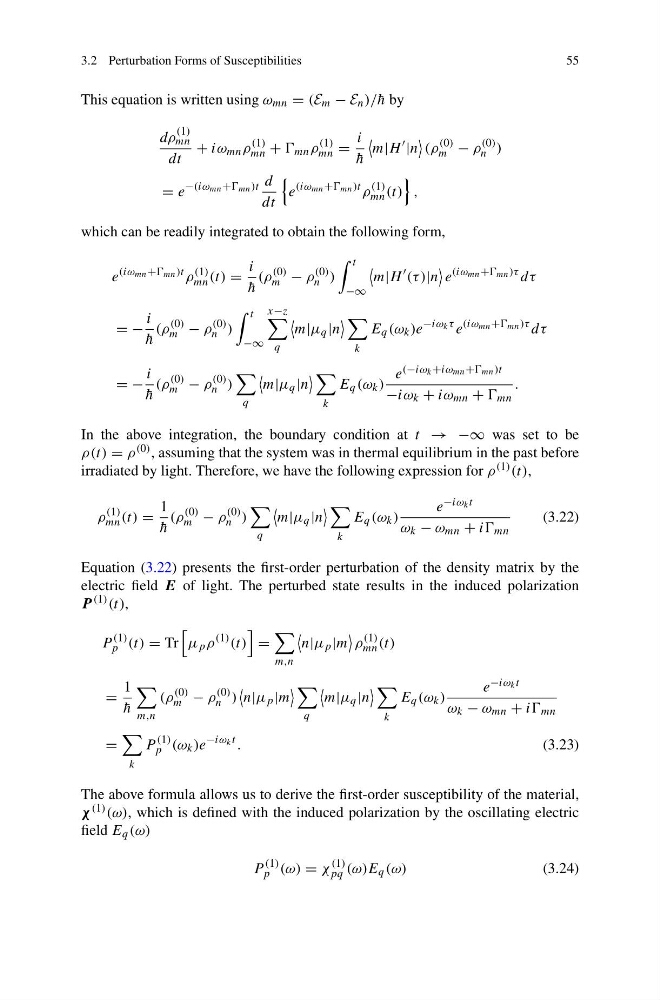
This equation is written using ω mn = (E m − E n )/ ¯
h by
dρ
(1)
mn
dt
+ iω mn ρ
(1)
mn + mn ρ
(1)
mn =
i
¯
h
m|H
|n
(ρ
(0)
m − ρ
(0)
n )
= e
−(iω mn + mn )t d
dt
e
(iω mn + mn )t ρ
(1)
mn (t)
,
which can be readily integrated to obtain the following form,
e
(iω mn + mn )t ρ
(1)
mn (t) =
i
¯
h
(ρ
(0)
m − ρ
(0)
n )
t
−∞
m|H
(τ )|n
e
(iω mn + mn )τ dτ
= −
i
¯
h
(ρ
(0)
m − ρ
(0)
n )
t
−∞
x−z
q
m|μ q |n
k
E q (ω k )e
−iω k τ e
(iω mn + mn )τ dτ
= −
i
¯
h
(ρ
(0)
m − ρ
(0)
n )
q
m|μ q |n
k
E q (ω k )
e (−iω k +iω mn + mn )t
−iω k + iω mn + mn
.
In the above integration, the boundary condition at t → −∞ was set to be
ρ(t) = ρ (0) , assuming that the system was in thermal equilibrium in the past before
irradiated by light. Therefore, we have the following expression for ρ (1) (t),
ρ
(1)
mn (t) =
1
¯
h
(ρ
(0)
m − ρ
(0)
n )
q
m|μ q |n
k
E q (ω k )
e −iω k t
ω k − ω mn + ii mn
(3.22)
Equation (3.22) presents the first-order perturbation of the density matrix by the
electric field E of light. The perturbed state results in the induced polarization
P (1) (t),
P
(1)
p (t) = Tr
μ p ρ
(1) (t)
=
m,n
n|μ p |m
ρ
(1)
mn (t)
=
1
¯
h
m,n
(ρ
(0)
m − ρ
(0)
n )
n|μ p |m
q
m|μ q |n
k
E q (ω k )
e −iω k t
ω k − ω mn + ii mn
=
k
P
(1)
p (ω k )e
−iω k t .
(3.23)
The above formula allows us to derive the first-order susceptibility of the material,
χ (1) (ω), which is defined with the induced polarization by the oscillating electric
field E q (ω)
P
(1)
p (ω) = χ
(1)
pq (ω)E q (ω)
(3.24)
55
This equation is written using ω mn = (E m − E n )/ ¯
h by
dρ
(1)
mn
dt
+ iω mn ρ
(1)
mn + mn ρ
(1)
mn =
i
¯
h
m|H
|n
(ρ
(0)
m − ρ
(0)
n )
= e
−(iω mn + mn )t d
dt
e
(iω mn + mn )t ρ
(1)
mn (t)
,
which can be readily integrated to obtain the following form,
e
(iω mn + mn )t ρ
(1)
mn (t) =
i
¯
h
(ρ
(0)
m − ρ
(0)
n )
t
−∞
m|H
(τ )|n
e
(iω mn + mn )τ dτ
= −
i
¯
h
(ρ
(0)
m − ρ
(0)
n )
t
−∞
x−z
q
m|μ q |n
k
E q (ω k )e
−iω k τ e
(iω mn + mn )τ dτ
= −
i
¯
h
(ρ
(0)
m − ρ
(0)
n )
q
m|μ q |n
k
E q (ω k )
e (−iω k +iω mn + mn )t
−iω k + iω mn + mn
.
In the above integration, the boundary condition at t → −∞ was set to be
ρ(t) = ρ (0) , assuming that the system was in thermal equilibrium in the past before
irradiated by light. Therefore, we have the following expression for ρ (1) (t),
ρ
(1)
mn (t) =
1
¯
h
(ρ
(0)
m − ρ
(0)
n )
q
m|μ q |n
k
E q (ω k )
e −iω k t
ω k − ω mn + ii mn
(3.22)
Equation (3.22) presents the first-order perturbation of the density matrix by the
electric field E of light. The perturbed state results in the induced polarization
P (1) (t),
P
(1)
p (t) = Tr
μ p ρ
(1) (t)
=
m,n
n|μ p |m
ρ
(1)
mn (t)
=
1
¯
h
m,n
(ρ
(0)
m − ρ
(0)
n )
n|μ p |m
q
m|μ q |n
k
E q (ω k )
e −iω k t
ω k − ω mn + ii mn
=
k
P
(1)
p (ω k )e
−iω k t .
(3.23)
The above formula allows us to derive the first-order susceptibility of the material,
χ (1) (ω), which is defined with the induced polarization by the oscillating electric
field E q (ω)
P
(1)
p (ω) = χ
(1)
pq (ω)E q (ω)
(3.24)