

3.2 Perturbation Forms of Susceptibilities
53
The states for the entire system (system + bath) are hard to treat in practical
applications. However, in some occasions, the original formula of Eq. (3.8) is more
convenient than Eq. (3.16) to deal with formal properties of the susceptibilities,
since the discussion becomes free from the phenomenological parameter. We will
encounter such occasions in Sects. 4.3 and 7.4.
3.2 Perturbation Forms of Susceptibilities
3.2.1 Perturbation Expansion of Density Matrix
Based on the density matrix introduced above, let us discuss the quantum formulas
of susceptibilities [1, 13, 15]. We begin with the general perturbation theory of
materials by lights, and apply the formulas to the first-order susceptibility. In what
follows, the material in question is arbitrarily chosen, either a single molecule or the
interface system of condensed matter, since the following formulas are commonly
applicable.
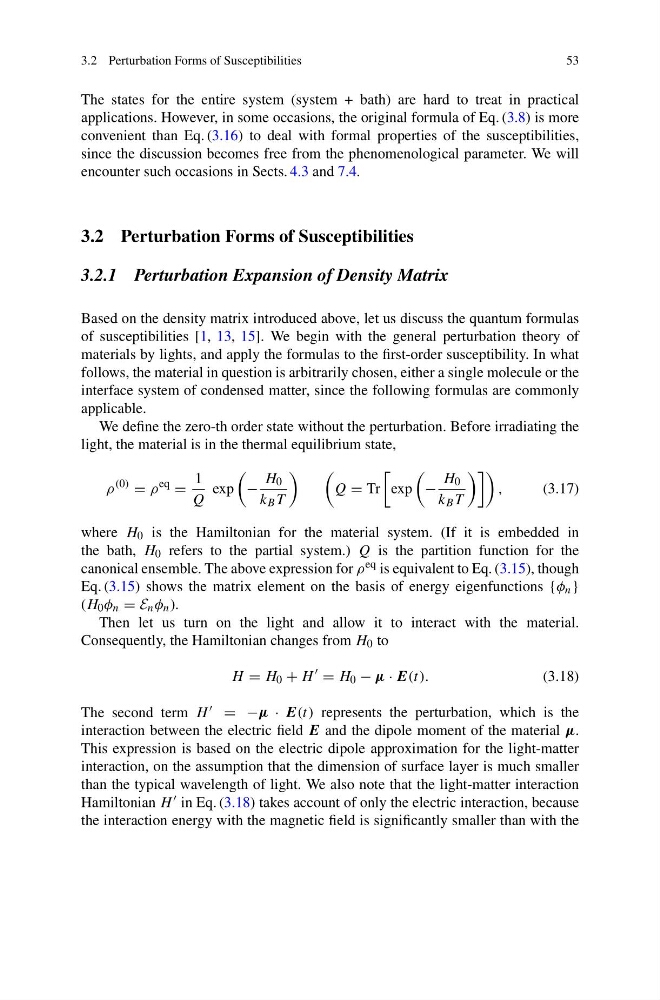
We define the zero-th order state without the perturbation. Before irradiating the
light, the material is in the thermal equilibrium state,
ρ
(0)
= ρ
eq
=
1
Q
exp
−
H 0
k B T
Q = Tr
exp
−
H 0
k B T
,
(3.17)
where H 0 is the Hamiltonian for the material system. (If it is embedded in
the bath, H 0 refers to the partial system.) Q is the partition function for the
canonical ensemble. The above expression for ρ eq is equivalent to Eq. (3.15), though
Eq. (3.15) shows the matrix element on the basis of energy eigenfunctions {φ n }
(H 0 φ n = E n φ n ).
Then let us turn on the light and allow it to interact with the material.
Consequently, the Hamiltonian changes from H 0 to
H = H 0 + H
= H 0 − μ · E(t).
(3.18)
The second term H = −μ · E(t) represents the perturbation, which is the
interaction between the electric field E and the dipole moment of the material μ.
This expression is based on the electric dipole approximation for the light-matter
interaction, on the assumption that the dimension of surface layer is much smaller
than the typical wavelength of light. We also note that the light-matter interaction
Hamiltonian H in Eq. (3.18) takes account of only the electric interaction, because
the interaction energy with the magnetic field is significantly smaller than with the
53
The states for the entire system (system + bath) are hard to treat in practical
applications. However, in some occasions, the original formula of Eq. (3.8) is more
convenient than Eq. (3.16) to deal with formal properties of the susceptibilities,
since the discussion becomes free from the phenomenological parameter. We will
encounter such occasions in Sects. 4.3 and 7.4.
3.2 Perturbation Forms of Susceptibilities
3.2.1 Perturbation Expansion of Density Matrix
Based on the density matrix introduced above, let us discuss the quantum formulas
of susceptibilities [1, 13, 15]. We begin with the general perturbation theory of
materials by lights, and apply the formulas to the first-order susceptibility. In what
follows, the material in question is arbitrarily chosen, either a single molecule or the
interface system of condensed matter, since the following formulas are commonly
applicable.
We define the zero-th order state without the perturbation. Before irradiating the
light, the material is in the thermal equilibrium state,
ρ
(0)
= ρ
eq
=
1
Q
exp
−
H 0
k B T
Q = Tr
exp
−
H 0
k B T
,
(3.17)
where H 0 is the Hamiltonian for the material system. (If it is embedded in
the bath, H 0 refers to the partial system.) Q is the partition function for the
canonical ensemble. The above expression for ρ eq is equivalent to Eq. (3.15), though
Eq. (3.15) shows the matrix element on the basis of energy eigenfunctions {φ n }
(H 0 φ n = E n φ n ).
Then let us turn on the light and allow it to interact with the material.
Consequently, the Hamiltonian changes from H 0 to
H = H 0 + H
= H 0 − μ · E(t).
(3.18)
The second term H = −μ · E(t) represents the perturbation, which is the
interaction between the electric field E and the dipole moment of the material μ.
This expression is based on the electric dipole approximation for the light-matter
interaction, on the assumption that the dimension of surface layer is much smaller
than the typical wavelength of light. We also note that the light-matter interaction
Hamiltonian H in Eq. (3.18) takes account of only the electric interaction, because
the interaction energy with the magnetic field is significantly smaller than with the