

2.1 Electromagnetic Fields at Interface
17
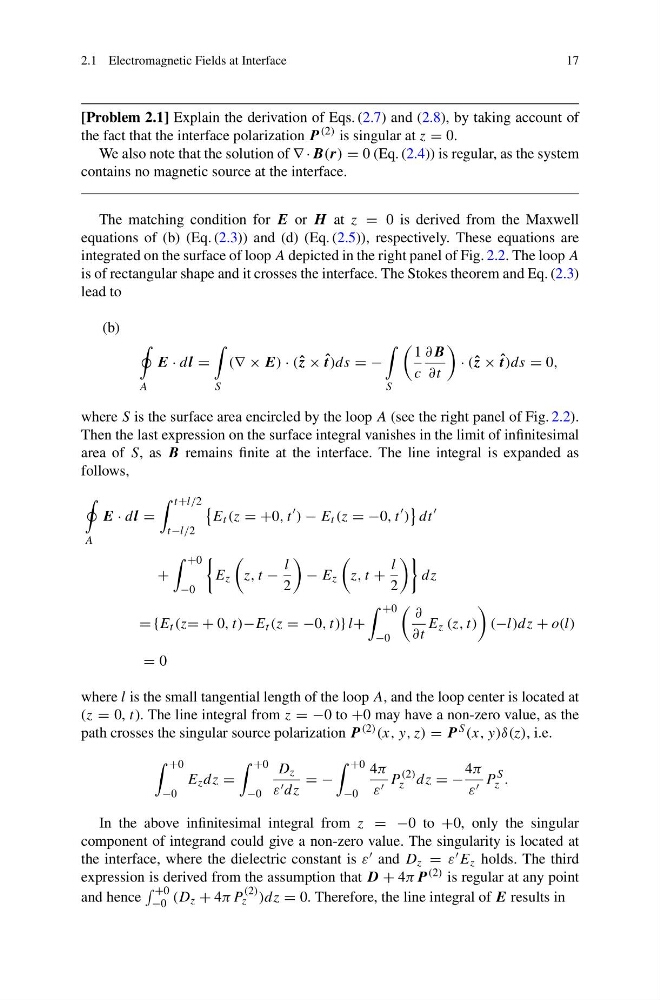
[Problem 2.1] Explain the derivation of Eqs. (2.7) and (2.8), by taking account of
the fact that the interface polarization P (2) is singular at z = 0.
We also note that the solution of ∇ ·B(r) = 0 (Eq. (2.4)) is regular, as the system
contains no magnetic source at the interface.
The matching condition for E or H at z = 0 is derived from the Maxwell
equations of (b) (Eq. (2.3)) and (d) (Eq. (2.5)), respectively. These equations are
integrated on the surface of loop A depicted in the right panel of Fig. 2.2. The loop A
is of rectangular shape and it crosses the interface. The Stokes theorem and Eq. (2.3)
lead to
(b)
A
E · dl =
S
(∇ × E) · (ˆ z × ˆ
t)ds = −
S
1
c
∂B
∂t
· (ˆ z × ˆ
t)ds = 0,
where S is the surface area encircled by the loop A (see the right panel of Fig. 2.2).
Then the last expression on the surface integral vanishes in the limit of infinitesimal
area of S, as B remains finite at the interface. The line integral is expanded as
follows,
A
E · dl =
t+l/2
t−l/2
E t (z = +0, t
) − E t (z = −0, t
)
dt
+
+0
−0
E z
z, t −
l
2
− E z
z, t +
l
2
dz
= {E t (z= + 0, t)−E t (z = −0, t)} l+
+0
−0
∂
∂t
E z (z, t)
(−l)dz + o(l)
= 0
where l is the small tangential length of the loop A, and the loop center is located at
(z = 0, t). The line integral from z = −0 to +0 may have a non-zero value, as the
path crosses the singular source polarization P (2) (x, y, z) = P S (x, y)δ(z), i.e.
+0
−0
E z dz =
+0
−0
D z
ε dz
= −
+0
−0
4π
ε P
(2)
z dz = −
4π
ε P
S
z .
In the above infinitesimal integral from z = −0 to +0, only the singular
component of integrand could give a non-zero value. The singularity is located at
the interface, where the dielectric constant is ε and D z = ε E z holds. The third
expression is derived from the assumption that D + 4π P (2) is regular at any point
and hence
+0
−0 (D z + 4πP
(2)
z )dz = 0. Therefore, the line integral of E results in
17
[Problem 2.1] Explain the derivation of Eqs. (2.7) and (2.8), by taking account of
the fact that the interface polarization P (2) is singular at z = 0.
We also note that the solution of ∇ ·B(r) = 0 (Eq. (2.4)) is regular, as the system
contains no magnetic source at the interface.
The matching condition for E or H at z = 0 is derived from the Maxwell
equations of (b) (Eq. (2.3)) and (d) (Eq. (2.5)), respectively. These equations are
integrated on the surface of loop A depicted in the right panel of Fig. 2.2. The loop A
is of rectangular shape and it crosses the interface. The Stokes theorem and Eq. (2.3)
lead to
(b)
A
E · dl =
S
(∇ × E) · (ˆ z × ˆ
t)ds = −
S
1
c
∂B
∂t
· (ˆ z × ˆ
t)ds = 0,
where S is the surface area encircled by the loop A (see the right panel of Fig. 2.2).
Then the last expression on the surface integral vanishes in the limit of infinitesimal
area of S, as B remains finite at the interface. The line integral is expanded as
follows,
A
E · dl =
t+l/2
t−l/2
E t (z = +0, t
) − E t (z = −0, t
)
dt
+
+0
−0
E z
z, t −
l
2
− E z
z, t +
l
2
dz
= {E t (z= + 0, t)−E t (z = −0, t)} l+
+0
−0
∂
∂t
E z (z, t)
(−l)dz + o(l)
= 0
where l is the small tangential length of the loop A, and the loop center is located at
(z = 0, t). The line integral from z = −0 to +0 may have a non-zero value, as the
path crosses the singular source polarization P (2) (x, y, z) = P S (x, y)δ(z), i.e.
+0
−0
E z dz =
+0
−0
D z
ε dz
= −
+0
−0
4π
ε P
(2)
z dz = −
4π
ε P
S
z .
In the above infinitesimal integral from z = −0 to +0, only the singular
component of integrand could give a non-zero value. The singularity is located at
the interface, where the dielectric constant is ε and D z = ε E z holds. The third
expression is derived from the assumption that D + 4π P (2) is regular at any point
and hence
+0
−0 (D z + 4πP
(2)
z )dz = 0. Therefore, the line integral of E results in