

Bibliography
241
3200
3400
3600
0
0.2
0.4
0.6
0.8
1
1.2
MD
Mondal et al. (exp)
Hua et al. (exp)
arb. unit
O
O
O
O
O
P
O
O
-
O
N
+
O
O
O
O
O
P
O
O -
O
N
+
(A) (A)
N
(B) (B)
NP NP
(C) (C)
NPO NPO
O
O
O
O
P
O
O
-
O
N
+
O
O
P
O
O -
O
N
+
(A) N
(B) NP
(C) NPO
Frequency (cm )
-1
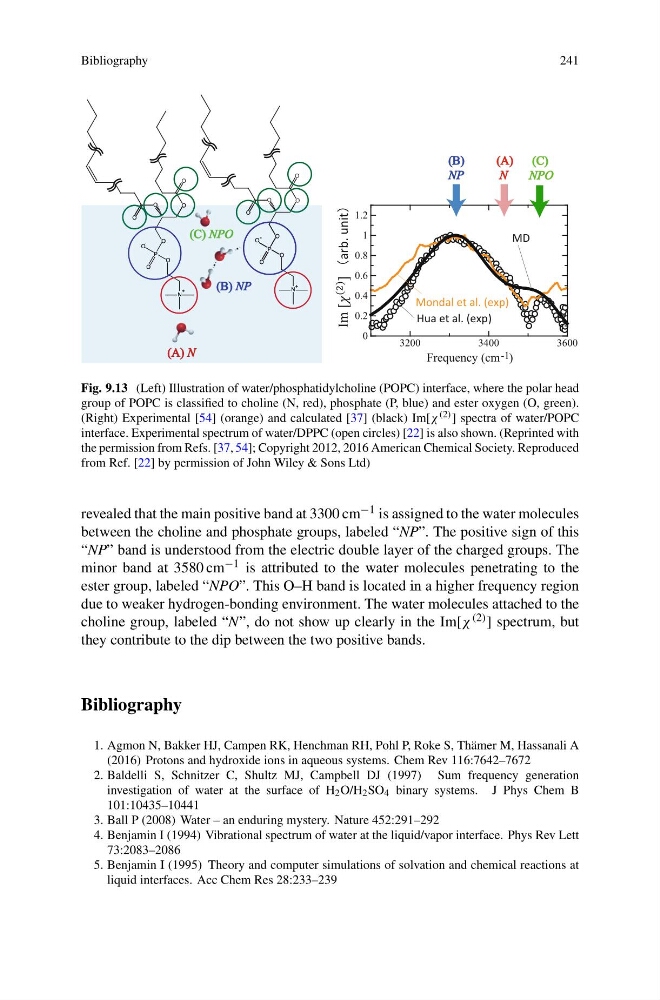
Fig. 9.13 (Left) Illustration of water/phosphatidylcholine (POPC) interface, where the polar head
group of POPC is classified to choline (N, red), phosphate (P, blue) and ester oxygen (O, green).
(Right) Experimental [54] (orange) and calculated [37] (black) Im[χ (2) ] spectra of water/POPC
interface. Experimental spectrum of water/DPPC (open circles) [22] is also shown. (Reprinted with
the permission from Refs. [37, 54]; Copyright 2012, 2016 American Chemical Society. Reproduced
from Ref. [22] by permission of John Wiley & Sons Ltd)
revealed that the main positive band at 3300 cm −1 is assigned to the water molecules
between the choline and phosphate groups, labeled “NP”. The positive sign of this
“NP” band is understood from the electric double layer of the charged groups. The
minor band at 3580 cm −1 is attributed to the water molecules penetrating to the
ester group, labeled “NPO”. This O–H band is located in a higher frequency region
due to weaker hydrogen-bonding environment. The water molecules attached to the
choline group, labeled “N”, do not show up clearly in the Im[χ (2) ] spectrum, but
they contribute to the dip between the two positive bands.
Bibliography
1. Agmon N, Bakker HJ, Campen RK, Henchman RH, Pohl P, Roke S, Thämer M, Hassanali A
(2016) Protons and hydroxide ions in aqueous systems. Chem Rev 116:7642–7672
2. Baldelli S, Schnitzer C, Shultz MJ, Campbell DJ (1997) Sum frequency generation
investigation of water at the surface of H 2 O/H 2 SO 4 binary systems. J Phys Chem B
101:10435–10441
3. Ball P (2008) Water – an enduring mystery. Nature 452:291–292
4. Benjamin I (1994) Vibrational spectrum of water at the liquid/vapor interface. Phys Rev Lett
73:2083–2086
5. Benjamin I (1995) Theory and computer simulations of solvation and chemical reactions at
liquid interfaces. Acc Chem Res 28:233–239
241
3200
3400
3600
0
0.2
0.4
0.6
0.8
1
1.2
MD
Mondal et al. (exp)
Hua et al. (exp)
arb. unit
O
O
O
O
O
P
O
O
-
O
N
+
O
O
O
O
O
P
O
O -
O
N
+
(A) (A)
N
(B) (B)
NP NP
(C) (C)
NPO NPO
O
O
O
O
P
O
O
-
O
N
+
O
O
P
O
O -
O
N
+
(A) N
(B) NP
(C) NPO
Frequency (cm )
-1
Fig. 9.13 (Left) Illustration of water/phosphatidylcholine (POPC) interface, where the polar head
group of POPC is classified to choline (N, red), phosphate (P, blue) and ester oxygen (O, green).
(Right) Experimental [54] (orange) and calculated [37] (black) Im[χ (2) ] spectra of water/POPC
interface. Experimental spectrum of water/DPPC (open circles) [22] is also shown. (Reprinted with
the permission from Refs. [37, 54]; Copyright 2012, 2016 American Chemical Society. Reproduced
from Ref. [22] by permission of John Wiley & Sons Ltd)
revealed that the main positive band at 3300 cm −1 is assigned to the water molecules
between the choline and phosphate groups, labeled “NP”. The positive sign of this
“NP” band is understood from the electric double layer of the charged groups. The
minor band at 3580 cm −1 is attributed to the water molecules penetrating to the
ester group, labeled “NPO”. This O–H band is located in a higher frequency region
due to weaker hydrogen-bonding environment. The water molecules attached to the
choline group, labeled “N”, do not show up clearly in the Im[χ (2) ] spectrum, but
they contribute to the dip between the two positive bands.
Bibliography
1. Agmon N, Bakker HJ, Campen RK, Henchman RH, Pohl P, Roke S, Thämer M, Hassanali A
(2016) Protons and hydroxide ions in aqueous systems. Chem Rev 116:7642–7672
2. Baldelli S, Schnitzer C, Shultz MJ, Campbell DJ (1997) Sum frequency generation
investigation of water at the surface of H 2 O/H 2 SO 4 binary systems. J Phys Chem B
101:10435–10441
3. Ball P (2008) Water – an enduring mystery. Nature 452:291–292
4. Benjamin I (1994) Vibrational spectrum of water at the liquid/vapor interface. Phys Rev Lett
73:2083–2086
5. Benjamin I (1995) Theory and computer simulations of solvation and chemical reactions at
liquid interfaces. Acc Chem Res 28:233–239