

228
9 Applications: Aqueous Interfaces
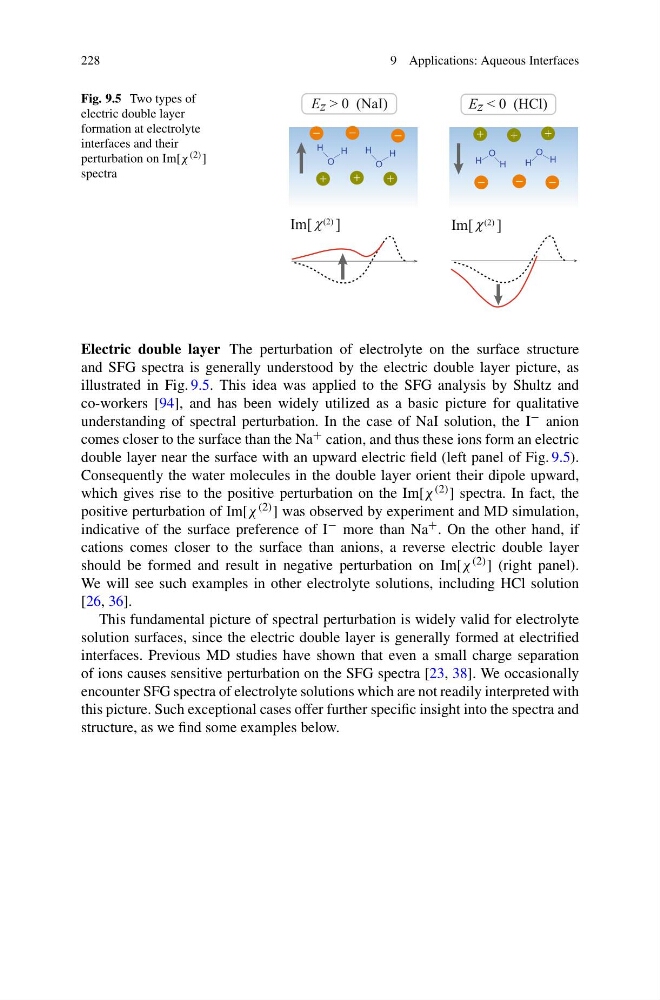
Fig. 9.5 Two types of
electric double layer
formation at electrolyte
interfaces and their
perturbation on Im[χ (2) ]
spectra
H
O
H
H
O
H
H
O
H
H
O
H
Im[
]
Im[
]
E z > 0 (NaI)
E z < 0 (HCl)
Electric double layer The perturbation of electrolyte on the surface structure
and SFG spectra is generally understood by the electric double layer picture, as
illustrated in Fig. 9.5. This idea was applied to the SFG analysis by Shultz and
co-workers [94], and has been widely utilized as a basic picture for qualitative
understanding of spectral perturbation. In the case of NaI solution, the I − anion
comes closer to the surface than the Na + cation, and thus these ions form an electric
double layer near the surface with an upward electric field (left panel of Fig. 9.5).
Consequently the water molecules in the double layer orient their dipole upward,
which gives rise to the positive perturbation on the Im[χ (2) ] spectra. In fact, the
positive perturbation of Im[χ (2) ] was observed by experiment and MD simulation,
indicative of the surface preference of I − more than Na + . On the other hand, if
cations comes closer to the surface than anions, a reverse electric double layer
should be formed and result in negative perturbation on Im[χ (2) ] (right panel).
We will see such examples in other electrolyte solutions, including HCl solution
[26, 36].
This fundamental picture of spectral perturbation is widely valid for electrolyte
solution surfaces, since the electric double layer is generally formed at electrified
interfaces. Previous MD studies have shown that even a small charge separation
of ions causes sensitive perturbation on the SFG spectra [23, 38]. We occasionally
encounter SFG spectra of electrolyte solutions which are not readily interpreted with
this picture. Such exceptional cases offer further specific insight into the spectra and
structure, as we find some examples below.
9 Applications: Aqueous Interfaces
Fig. 9.5 Two types of
electric double layer
formation at electrolyte
interfaces and their
perturbation on Im[χ (2) ]
spectra
H
O
H
H
O
H
H
O
H
H
O
H
Im[
]
Im[
]
E z > 0 (NaI)
E z < 0 (HCl)
Electric double layer The perturbation of electrolyte on the surface structure
and SFG spectra is generally understood by the electric double layer picture, as
illustrated in Fig. 9.5. This idea was applied to the SFG analysis by Shultz and
co-workers [94], and has been widely utilized as a basic picture for qualitative
understanding of spectral perturbation. In the case of NaI solution, the I − anion
comes closer to the surface than the Na + cation, and thus these ions form an electric
double layer near the surface with an upward electric field (left panel of Fig. 9.5).
Consequently the water molecules in the double layer orient their dipole upward,
which gives rise to the positive perturbation on the Im[χ (2) ] spectra. In fact, the
positive perturbation of Im[χ (2) ] was observed by experiment and MD simulation,
indicative of the surface preference of I − more than Na + . On the other hand, if
cations comes closer to the surface than anions, a reverse electric double layer
should be formed and result in negative perturbation on Im[χ (2) ] (right panel).
We will see such examples in other electrolyte solutions, including HCl solution
[26, 36].
This fundamental picture of spectral perturbation is widely valid for electrolyte
solution surfaces, since the electric double layer is generally formed at electrified
interfaces. Previous MD studies have shown that even a small charge separation
of ions causes sensitive perturbation on the SFG spectra [23, 38]. We occasionally
encounter SFG spectra of electrolyte solutions which are not readily interpreted with
this picture. Such exceptional cases offer further specific insight into the spectra and
structure, as we find some examples below.