

8.2 Chiral Elements of χ (2)
211
to be dipole allowed. In the preceding chapters we have focused on the SFG response
from interfaces. Chiral materials were known to be SFG active in 1960s [10], though
the chiral vibrational SFG spectroscopy has not been fully explored until recently,
mainly because the chiral response is weak in ordinary conditions. However, there
is a promising avenue to exploit both the interface and chiral sensitivities in future
SFG spectroscopy. In what follows, we summarize fundamental features of SFG
from chiral systems, which are somewhat distinct from the features of SFG from
the interfaces [5, 13].
8.2.1 Symmetry
For a chiral system, the inversion or reflection operation changes its chirality.
Accordingly, the χ (2) elements associated to chiral properties should not be invariant
by the inversion or reflection. The above reasoning from the symmetry requirement
leads to the fact that the following six elements of χ
(2)
pqr could be pertinent to the
chirality:
χ
(2)
xyz ,
χ
(2)
xzy ,
χ
(2)
yxz ,
χ
(2)
yzx ,
χ
(2)
zxy ,
χ
(2)
zyx .
(8.19)
This is a general conclusion for third-rank tensor properties. Any other tensor
elements χ
(2)
pqr than in Eq. (8.19) miss either of x, y or z in the suffixes pqr. For
example, χ
(2)
zxx does not have y in the suffixes zxx. We can readiy understand that
those other tensor elements χ
(2)
pqr except for those in Eq. (8.19) do not satisfy the
symmetry requirement of inversion or reflection. For example, let us consider the
element χ
(2)
zxx . It is responsible to the second-order polarization P
(2)
z (() induced by
E x (ω 1 ) and E x (ω 2 ),
P
(2)
z (() = χ
(2)
zxx ((, ω 1 , ω 2 )E x (ω 1 )E x (ω 2 ).
This equation can never be associated to the chirality. If we operate the reflection at
the plane perpendicular to the y axis, the vector elements of P
(2)
z , E x (ω 1 ), E x (ω 2 )
are unaffected. Consequently, the χ
(2)
zxx should not change to satisfy the relation,
which means that χ
(2)
zxx is not a chiral property. The same argument holds for the
other elements of χ
(2)
pqr except for the above six elements.
Some of the six χ (2) elements in Eq. (8.19) may be related when the material
has a certain spatial symmetry. We treat here two cases, (i) isotropic bulk and (ii)
interface of C ∞ symmetry.
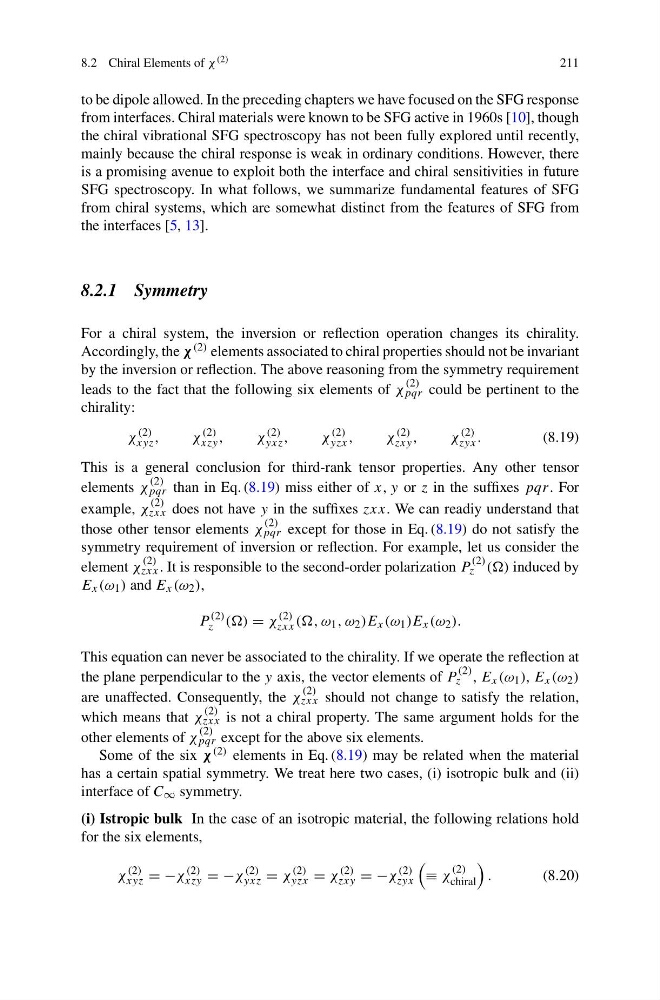
(i) Istropic bulk In the case of an isotropic material, the following relations hold
for the six elements,
χ
(2)
xyz = −χ
(2)
xzy = −χ
(2)
yxz = χ
(2)
yzx = χ
(2)
zxy = −χ
(2)
zyx
≡ χ
(2)
chiral
.
(8.20)
211
to be dipole allowed. In the preceding chapters we have focused on the SFG response
from interfaces. Chiral materials were known to be SFG active in 1960s [10], though
the chiral vibrational SFG spectroscopy has not been fully explored until recently,
mainly because the chiral response is weak in ordinary conditions. However, there
is a promising avenue to exploit both the interface and chiral sensitivities in future
SFG spectroscopy. In what follows, we summarize fundamental features of SFG
from chiral systems, which are somewhat distinct from the features of SFG from
the interfaces [5, 13].
8.2.1 Symmetry
For a chiral system, the inversion or reflection operation changes its chirality.
Accordingly, the χ (2) elements associated to chiral properties should not be invariant
by the inversion or reflection. The above reasoning from the symmetry requirement
leads to the fact that the following six elements of χ
(2)
pqr could be pertinent to the
chirality:
χ
(2)
xyz ,
χ
(2)
xzy ,
χ
(2)
yxz ,
χ
(2)
yzx ,
χ
(2)
zxy ,
χ
(2)
zyx .
(8.19)
This is a general conclusion for third-rank tensor properties. Any other tensor
elements χ
(2)
pqr than in Eq. (8.19) miss either of x, y or z in the suffixes pqr. For
example, χ
(2)
zxx does not have y in the suffixes zxx. We can readiy understand that
those other tensor elements χ
(2)
pqr except for those in Eq. (8.19) do not satisfy the
symmetry requirement of inversion or reflection. For example, let us consider the
element χ
(2)
zxx . It is responsible to the second-order polarization P
(2)
z (() induced by
E x (ω 1 ) and E x (ω 2 ),
P
(2)
z (() = χ
(2)
zxx ((, ω 1 , ω 2 )E x (ω 1 )E x (ω 2 ).
This equation can never be associated to the chirality. If we operate the reflection at
the plane perpendicular to the y axis, the vector elements of P
(2)
z , E x (ω 1 ), E x (ω 2 )
are unaffected. Consequently, the χ
(2)
zxx should not change to satisfy the relation,
which means that χ
(2)
zxx is not a chiral property. The same argument holds for the
other elements of χ
(2)
pqr except for the above six elements.
Some of the six χ (2) elements in Eq. (8.19) may be related when the material
has a certain spatial symmetry. We treat here two cases, (i) isotropic bulk and (ii)
interface of C ∞ symmetry.
(i) Istropic bulk In the case of an isotropic material, the following relations hold
for the six elements,
χ
(2)
xyz = −χ
(2)
xzy = −χ
(2)
yxz = χ
(2)
yzx = χ
(2)
zxy = −χ
(2)
zyx
≡ χ
(2)
chiral
.
(8.20)