

174
7 Quadrupole Contributions from Interface and Bulk
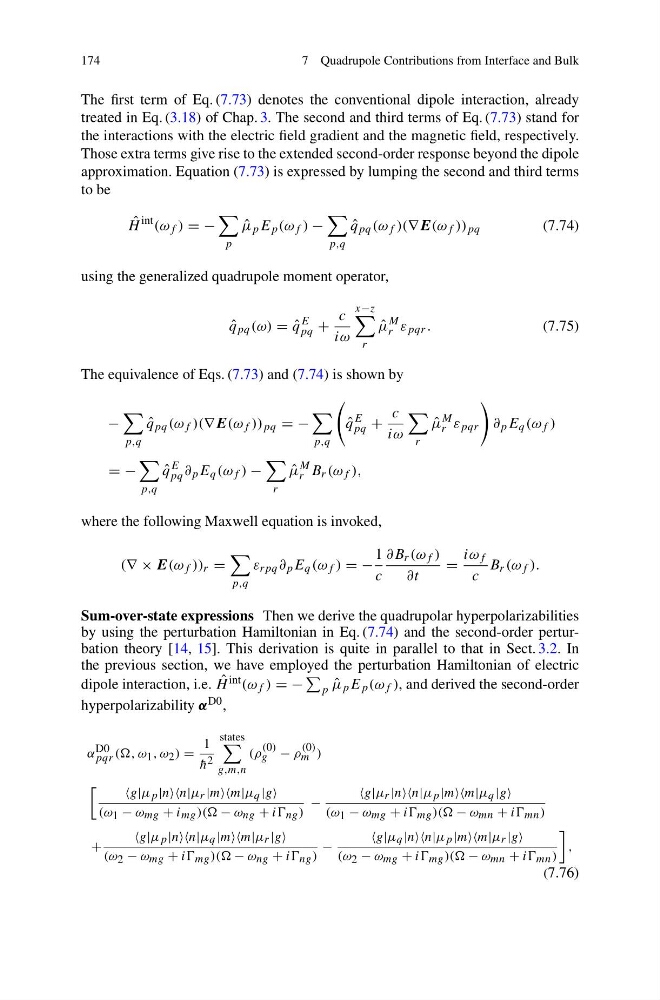
The first term of Eq. (7.73) denotes the conventional dipole interaction, already
treated in Eq. (3.18) of Chap. 3. The second and third terms of Eq. (7.73) stand for
the interactions with the electric field gradient and the magnetic field, respectively.
Those extra terms give rise to the extended second-order response beyond the dipole
approximation. Equation (7.73) is expressed by lumping the second and third terms
to be
ˆ
H
int (ω f ) = −
p
ˆ
μ p E p (ω f ) −
p,q
ˆ
q pq (ω f )(∇E(ω f )) pq
(7.74)
using the generalized quadrupole moment operator,
ˆ
q pq (ω) = ˆ
q
E
pq +
c
iω
x−z
r
ˆ
μ
M
r ε pqr .
(7.75)
The equivalence of Eqs. (7.73) and (7.74) is shown by
−
p,q
ˆ
q pq (ω f )(∇E(ω f )) pq = −
p,q
ˆ
q
E
pq +
c
iω
r
ˆ
μ
M
r ε pqr
∂ p E q (ω f )
= −
p,q
ˆ
q
E
pq ∂ p E q (ω f ) −
r
ˆ
μ
M
r B r (ω f ),
where the following Maxwell equation is invoked,
(∇ × E(ω f )) r =
p,q
ε rpq ∂ p E q (ω f ) = −
1
c
∂B r (ω f )
∂t
=
iω f
c
B r (ω f ).
Sum-over-state expressions Then we derive the quadrupolar hyperpolarizabilities
by using the perturbation Hamiltonian in Eq. (7.74) and the second-order perturbation theory [14, 15]. This derivation is quite in parallel to that in Sect. 3.2. In
the previous section, we have employed the perturbation Hamiltonian of electric
dipole interaction, i.e. ˆ
H int (ω f ) = −
p ˆ
μ p E p (ω f ), and derived the second-order
hyperpolarizability α D0 ,
α D0
pqr ((, ω 1 , ω 2 ) =
1
¯
h 2
states
g,m,n
(ρ
(0)
g − ρ
(0)
m )
g|μ p |nn|μ r |mm|μ q |g
(ω 1 − ω mg + i mg )(( − ω ng + ii ng )
−
g|μ r |nn|μ p |mm|μ q |g
(ω 1 − ω mg + ii mg )(( − ω mn + ii mn )
+
g|μ p |nn|μ q |mm|μ r |g
(ω 2 − ω mg + ii mg )(( − ω ng + ii ng )
−
g|μ q |nn|μ p |mm|μ r |g
(ω 2 − ω mg + ii mg )(( − ω mn + ii mn )
,
(7.76)
7 Quadrupole Contributions from Interface and Bulk
The first term of Eq. (7.73) denotes the conventional dipole interaction, already
treated in Eq. (3.18) of Chap. 3. The second and third terms of Eq. (7.73) stand for
the interactions with the electric field gradient and the magnetic field, respectively.
Those extra terms give rise to the extended second-order response beyond the dipole
approximation. Equation (7.73) is expressed by lumping the second and third terms
to be
ˆ
H
int (ω f ) = −
p
ˆ
μ p E p (ω f ) −
p,q
ˆ
q pq (ω f )(∇E(ω f )) pq
(7.74)
using the generalized quadrupole moment operator,
ˆ
q pq (ω) = ˆ
q
E
pq +
c
iω
x−z
r
ˆ
μ
M
r ε pqr .
(7.75)
The equivalence of Eqs. (7.73) and (7.74) is shown by
−
p,q
ˆ
q pq (ω f )(∇E(ω f )) pq = −
p,q
ˆ
q
E
pq +
c
iω
r
ˆ
μ
M
r ε pqr
∂ p E q (ω f )
= −
p,q
ˆ
q
E
pq ∂ p E q (ω f ) −
r
ˆ
μ
M
r B r (ω f ),
where the following Maxwell equation is invoked,
(∇ × E(ω f )) r =
p,q
ε rpq ∂ p E q (ω f ) = −
1
c
∂B r (ω f )
∂t
=
iω f
c
B r (ω f ).
Sum-over-state expressions Then we derive the quadrupolar hyperpolarizabilities
by using the perturbation Hamiltonian in Eq. (7.74) and the second-order perturbation theory [14, 15]. This derivation is quite in parallel to that in Sect. 3.2. In
the previous section, we have employed the perturbation Hamiltonian of electric
dipole interaction, i.e. ˆ
H int (ω f ) = −
p ˆ
μ p E p (ω f ), and derived the second-order
hyperpolarizability α D0 ,
α D0
pqr ((, ω 1 , ω 2 ) =
1
¯
h 2
states
g,m,n
(ρ
(0)
g − ρ
(0)
m )
g|μ p |nn|μ r |mm|μ q |g
(ω 1 − ω mg + i mg )(( − ω ng + ii ng )
−
g|μ r |nn|μ p |mm|μ q |g
(ω 1 − ω mg + ii mg )(( − ω mn + ii mn )
+
g|μ p |nn|μ q |mm|μ r |g
(ω 2 − ω mg + ii mg )(( − ω ng + ii ng )
−
g|μ q |nn|μ p |mm|μ r |g
(ω 2 − ω mg + ii mg )(( − ω mn + ii mn )
,
(7.76)