

7.2 Extended Nonlinear Susceptibility
157
where the diagonal elements of L G (ω f ) are specified with a single subscript of
spatial coordinate; i.e. L G,p (ω f ) ≡ [L G (ω f )] pp (p = x, y, z). The present
Eqs. (7.15), (7.16), (7.17), (7.18) correspond to Eqs. (3.49), (3.50), (3.51), (3.52)
in Chap. 3 based on the three-layer model.
7.2 Extended Nonlinear Susceptibility
Next we extend the effective susceptibility χ
(2)
eff,G in Eq. (7.14) to include the
quadrupole, and elucidate the mechanism of surface and bulk contributions beyond
the dipole approximation.
7.2.1 Extended Source Polarization
The sum-frequency polarization P
(2)
0 (r, ,, t) in Eq. (7.5) has been given by
Eq. (7.6). The equivalent formula including the phase factors is
P
(2)
0 (r, ,, t) = χ
D0 (z, ,, ω 1 , ω 2 ) : E
loc (r, ω 1 , t)E
loc (r, ω 2 , t)
or P
(2)
0,p (r, ,, t) =
x∼z
q,r
χ
D0
pqr (z, ,, ω 1 , ω 2 )E
loc
q (r, ω 1 , t)E
loc
r (r, ω 2 , t)
.
(7.19)
Then, we expand this formula to incorporate the quadrupole contributions as
follows,
P
(2)
0,p (r, ,, t) =
x∼z
q,r
χ
D0
pqr (z, ,, ω 1 , ω 2 )E
loc
q (r, ω 1 , t)E
loc
r (r, ω 2 , t)
+
x−z
q,r,s
χ
D1
pqrs (z, ,, ω 1 , ω 2 )
∂E loc
q (r, ω 1 , t)
∂s
E
loc
r (r, ω 2 , t)
+ χ
D2
pqrs (z, ,, ω 1 , ω 2 )E
loc
q (r, ω 1 , t)
∂E loc
r (r, ω 2 , t)
∂s
−
∂
∂s
χ
Q
pqrs (z, ,, ω 1 , ω 2 )E
loc
q (r, ω 1 , t)E
loc
r (r, ω 2 , t)
.
(7.20)
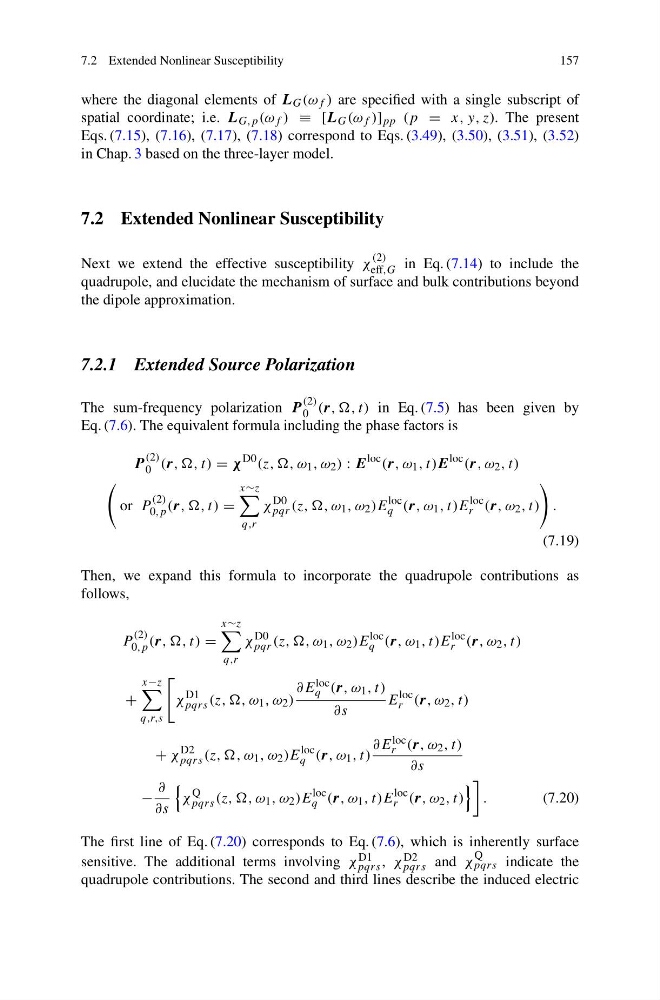
The first line of Eq. (7.20) corresponds to Eq. (7.6), which is inherently surface
sensitive. The additional terms involving χ D1
pqrs , χ D2
pqrs and χ
Q
pqrs indicate the
quadrupole contributions. The second and third lines describe the induced electric
157
where the diagonal elements of L G (ω f ) are specified with a single subscript of
spatial coordinate; i.e. L G,p (ω f ) ≡ [L G (ω f )] pp (p = x, y, z). The present
Eqs. (7.15), (7.16), (7.17), (7.18) correspond to Eqs. (3.49), (3.50), (3.51), (3.52)
in Chap. 3 based on the three-layer model.
7.2 Extended Nonlinear Susceptibility
Next we extend the effective susceptibility χ
(2)
eff,G in Eq. (7.14) to include the
quadrupole, and elucidate the mechanism of surface and bulk contributions beyond
the dipole approximation.
7.2.1 Extended Source Polarization
The sum-frequency polarization P
(2)
0 (r, ,, t) in Eq. (7.5) has been given by
Eq. (7.6). The equivalent formula including the phase factors is
P
(2)
0 (r, ,, t) = χ
D0 (z, ,, ω 1 , ω 2 ) : E
loc (r, ω 1 , t)E
loc (r, ω 2 , t)
or P
(2)
0,p (r, ,, t) =
x∼z
q,r
χ
D0
pqr (z, ,, ω 1 , ω 2 )E
loc
q (r, ω 1 , t)E
loc
r (r, ω 2 , t)
.
(7.19)
Then, we expand this formula to incorporate the quadrupole contributions as
follows,
P
(2)
0,p (r, ,, t) =
x∼z
q,r
χ
D0
pqr (z, ,, ω 1 , ω 2 )E
loc
q (r, ω 1 , t)E
loc
r (r, ω 2 , t)
+
x−z
q,r,s
χ
D1
pqrs (z, ,, ω 1 , ω 2 )
∂E loc
q (r, ω 1 , t)
∂s
E
loc
r (r, ω 2 , t)
+ χ
D2
pqrs (z, ,, ω 1 , ω 2 )E
loc
q (r, ω 1 , t)
∂E loc
r (r, ω 2 , t)
∂s
−
∂
∂s
χ
Q
pqrs (z, ,, ω 1 , ω 2 )E
loc
q (r, ω 1 , t)E
loc
r (r, ω 2 , t)
.
(7.20)
The first line of Eq. (7.20) corresponds to Eq. (7.6), which is inherently surface
sensitive. The additional terms involving χ D1
pqrs , χ D2
pqrs and χ
Q
pqrs indicate the
quadrupole contributions. The second and third lines describe the induced electric